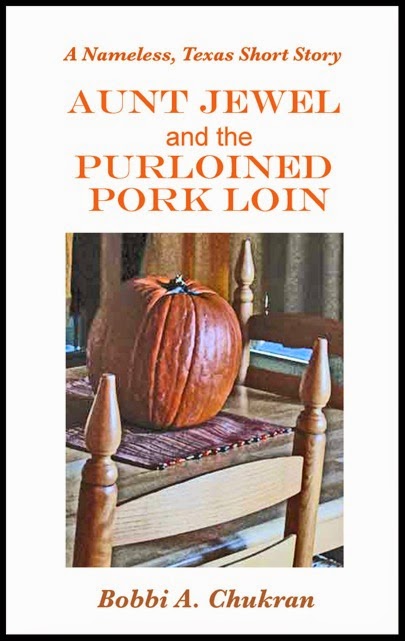
Bobbi A.
Chukran writes contemporary and historical mystery novels and short stories, as
well as comedy plays and some macabre short stories. Today she sits down for a
round of Q&A. Learn more about Bobbi and her writing at her website and
blog.
When did
you realize you wanted to write novels?
When I was young, I constantly wrote stories and
plays and "published" them with construction paper covers, stenciled
titles and brads. The urge was there; I just didn't have any guidance.
I was working in a Walden's Bookstore in '77 when The Thorn Birds came out. I remember
unpacking the books and immediately bought one. It wasn't the type of book I
usually read, but I finished it and told a co-worker, "Wow, I'd LOVE to
write a book like that some day." But it was just a passing comment and not something I really
thought I could do.
How long
did it take you to realize your dream of publication?
I was convinced to go into art in college and studied
textile design because I loved fabrics and patterns. Afterwards I worked as a
surface designer making fabric projects and selling them.
I got published in non-fiction fairly soon with some
craft projects in magazines. My first article was published after one query (to
Needle & Thread magazine), and my
first book, The Fiberworks Sourcebook,
a resource guide for fiber artists, was also published in '85 after one query. I
was 29 at the time, and decided to pursue writing fulltime. I continued writing
other non-fiction books and magazine articles and eventually started an indie
publishing company for craft and garden books.
(Bobbi: Now
I'm wondering if we ever crossed paths, Lois? J
Lois: It’s
highly possible. I used to design for Needle
& Thread.)
A few years later, I met a woman who wrote romances
for Silhouette. She said "I bet you could write one of those!" and a
light bulb went off in my head. I started researching and reading every how-to
book I could get my hands on, although it was years before I actually sat down
to start a novel.
I started writing a time-travel/mystery/romance, then
took a class from Susan Rogers Cooper, Austin mystery author, and discovered writers
like Joan Hess, Dorothy Cannell, Katherine Hall Page, Carole Nelson Douglas,
and Tony Hillerman. Boom! The world of mysteries opened up to me.
I decided I wanted to try a traditional mystery and
taking the advice of "writing what you know," I came up with a sleuth
who was a weaver and fiber artist. I went to my first Sisters in Crime
conference and talked to editors.
I got lots of encouragement from several who loved my
book but wanted more romance. They also weren't quite sure that a weaver sleuth
would be popular enough. That seems ironic to me given the popularity of the subject
now.
After going through some horrible experiences with two
publishers, I finally decided to take my self-publishing know-how and put it to
use. I put the contemporary story aside and wrote an 1880s western mystery, Lone Star Death. I published it for my
50th birthday gift—from me to me. I still don't know why I started
with that one.
After a few years, I basically quit submitting my
novels to others and revamped my publishing company to publish fiction instead
of non-fiction. Since then, I've published a number of my short stories and
novellas.
Are you
traditionally published, indie published, or a hybrid author?
I've been a hybrid author in non-fiction, but my fiction
books are all indie published, so far. I do still submit short stories to
anthologies, online 'zines and magazines published by others. If the right
situation came along, sure, I'd work with a traditional publisher on a book
project.
Where do
you write?
I write in a tiny room at the front of my 1930s home.
It used to be the "preacher's parlor"—the nice room where company was
invited. It's painted a beautiful
cool blue, it's cozy, I have a partial view of the garden and I still have the
original curtains from the '50s. I have a collection of original art on the
walls, a few muses (art dolls and glittered skeletons) sitting around and am
surrounded by books. An original '50s chair that used to be in my house was
gifted to me by a friend, and it sits in the corner with a quilt my
great-grandmother made in the '30s draped across it. My computer sits on a
wobbly table made from antique long-leaf pine that was salvaged from another
old house. But I do carry the laptop from room to room seasonally, depending on
the view of the garden at the time or whichever room is the quietest, coolest
or warmest.
Is silence
golden, or do you need music to write by? What kind?
I've never been able to write while listening to
music because I make up new lyrics or harmonies in my head to go with the music
and that distracts me.
How much of
your plots and characters are drawn from real life? From your life in particular?
Plots can get inspired by real life (like my "Dewey& the Peckerwood Tree" short story), and I do love watching people and
pick up quirky or interesting characteristics from them. I've never based any
one character on a real person. My characters are more of a composite of real
life people. My Aunt Jewel character (in Dye,
Dyeing, Dead and the other Nameless short stories) is a composite of older,
feisty Texan women who had a sense of humor, even though they didn't often show
it.
Describe your
process for naming your character?
For my historical fiction, I look up names that were
popular at the time. There are lots of resources online. Back before I had the 'net,
I'd look in old phone books, newspaper articles or obituaries in libraries. I
"audition" names for my characters. When I hit on the right one, I
know it's right, and go with it. I once named my contemporary sleuth Kendra
O'Keefe. I love playing with alliteration, but didn't feel her name was quite
right. Now she's Kendra Louise Harper.
Now, I "collect" names I like and have
lists of them in notebooks and mix and match them up. Naming characters is
important to me. And fun. I love to play with language, and names are one way
to do that.
Of course, all my female characters have middle names
and nicknames, because that's just the way it's done here in Texas and the South.
Real
settings or fictional towns?
A little of both. My "Nameless, Texas"
location is a fictional town outside of Austin, and is a composite of four
small towns I've lived in. I've
visited hundreds of other small towns, too, and take photos, write down
descriptions and impressions, etc. and use those. I'm a keen observer of people
and always find something to use in a story.
My first novel, Lone
Star Death, had some added real places and people that were in Austin at
the time.
What’s the
quirkiest quirk one of your characters has?
Oh, Jeremy Clifford! He's a theatrical fellow, into
drama, very flamboyant and colorful, and is a bright spot in everyone's day. I'd
LOVE to have a friend like Jeremy. He loves vintage fashion, dressing like TV
characters, loves to burst out with a song and is just a hoot. I'm not sure
where he came from, to tell the truth. He's been lurking around for a while.
What’s your
quirkiest quirk?
Not sure it's a quirk, but I have a strange sense of
humor that can be wicked and a very vivid imagination. I still paint now and
then, and some very bizarre creatures appear on my canvases. Day-glo robots,
all sorts of winged creatures and monsters cavorting with blue cats and strange
little girl creatures with big off-centered eyes. I write captions for them,
make up stories, etc.
If you
could have written any book (one that someone else has already written,) which
one would it be? Why?
I don't think it was written originally as a book,
but I love The Nightmare BeforeChristmas. And I recently fell
in love with The Stupidest Angel.
It's a hilarious satire. I love crazy satire.
Everyone at
some point wishes for a do-over. What’s
yours?
I wish I had started seriously writing fiction
earlier than I did. I wish I had majored in creative writing or playwriting in
college instead of studio art/graphics. I wish somebody other than my high
school English teacher had told me early on, "YES, you can write fiction."
It took me years to convince myself I could do it.
What’s your
biggest pet peeve?
I have two. First, people who hurt animals. I have a
long list of delicious punishments that should be inflicted on them.
And secondly, people who have no respect for other
people's rights. People who drive down residential streets going 90 mph where
children play and people walk. And bozos who drive down those streets with
their car stereos blasting every hour of the day or night. I honestly don't
know where their sense of entitlement comes from. I'm working on several
extreme revenge stories to deal with them, though.
You’re
stranded on a deserted island. What are your three must-haves?
My husband Rudy. At least one cat. My Kindle with Wi-fi? LOL
What was
the worst job you’ve ever held?
There is a tie between my first two jobs out of high
school. I worked at a rubber factory for two days before I got sick from the
fumes. I was the person who checked to make sure little rubber balls were round
enough. The second worst was at the DFW Airport as a cleaning lady. Travelers
can be nasty. (Although, I did get
a couple of stories out of it—one was about a flasher.)
What’s the best
book you’ve ever read?
The Bottoms, by Joe Lansdale. It has everything I admire in fiction. And then some.
Ocean or
mountains?
Ocean. I'm a Pisces and dream about large bodies of
water I've never seen, although I still can't swim. Some research I've done
suggests that one of my ancestors might have been an Irish or English sea
captain, so maybe that explains it. I'm a flatlander at heart.
City girl/guy
or country girl/guy?
Country girl, definitely, although I love to run away
to the city for very short periods of time for a culture fix--to visit
bookstores, see plays/musicals, eat at a great restaurant and hear live music.
What’s on
the horizon for you?
Right now I'm working on putting a collection of my
stranger macabre short stories into a book that hopefully will come out by
Halloween. And I'm working on the
final edits and the cover for a Christmas comedy/satire novella that started
out as one of my prize-winning plays.
Anything
else you’d like to tell us about yourself and/or your books?
Somebody recently mentioned on the wonderful
Dorothy-L group that they wanted to read books by authors who are "bona
fide" — authors who know what they're talking about. I have finally
embraced the whole "small town" thing and that's been very freeing.
Yes, I lived in Austin, but that's not where I’m most comfortable. In my
stories I try to capture some of the sheer bizarre nature of small town life and
the funny people who live there. As
they say, some of this stuff I couldn't make up if I tried!
I have lots of stories I want to tell and they don't
all fit easily into some box. I want to write mystery, AND comedy, AND horror,
etc. Why not? I've followed a lot of muses over the years to get where I am
now. And for the first time ever, I feel comfortable with it. I'm a storyteller
at heart. That's one thing that has never changed.
Dye,
Dyeing, Dead, the first contemporary
cozy novella in the "Nameless, Texas" mystery series featuring Kendra
Louise Harper, Folklorist.
Kendra Louise Harper is a
folklorist, avid gardener and accidental sleuth in Nameless, Texas, a small
agricultural town (population 2,354) located about 30-miles east of Austin.
All Kendra wanted to do
that day in September was help her Aunt Jewel with a Natural Dyeing with Plants
workshop for the local garden club. Before the workshop is over, a dead body
lay face down in a pool of glass and indigo in Kendra's courtyard garden. The
neighbor swears that he saw Aunt Jewel whack the victim over the head with a
silver hammer.
No one else really
believes Aunt Jewel killed Mrs. Bunch--that is, except maybe the sheriff. But he has no proof; he's not going to
waste his time trying to prove her innocent. He'd rather bide his time and wait
for the murderer to slip up and come to him.
Kendra decides that if
anything is going to be done to get her aunt off the hook, she'll have to do
it. Along with Kendra's friends---a very colorful waiter at Do-Lolly's Diner
named Jeremy, Deputy Jim Wyman (Kendra's love interest), Ginger Marshall (a
local art quilter) and her friends---she sets out to prove that her aunt is
innocent.
The victim, Mrs. Eula Mae
Bunch, was not a popular person in Nameless. As one resident said, "That
old woman is meaner than a room full of peckish wolverines."
And there are other
mysteries in town. Who is the inebriated stranger that shows up to Eula-Mae's
funeral? And what does an erotic romance novel have to do with all of it?
Tongues are waggin' in Nameless! Things haven't been this exciting since George
Leroy Johnson got the back of his britches caught in the revolving door at the
old Railroad Hotel and was pitched out the middle of Main Street with his
wherewithalls showing.