Featuring guest authors; crafting tips and projects; recipes from food editor and sleuthing sidekick Cloris McWerther; and decorating, travel, fashion, health, beauty, and finance tips from the rest of the American Woman editors.

Note: This site uses Amazon affiliate links. As an Amazon Associate, I earn from qualifying purchases.
Showing posts with label British mysteries. Show all posts

Tuesday, April 16, 2019

#ANTIQUES WITH MYSTERY AUTHOR CONNIE BERRY

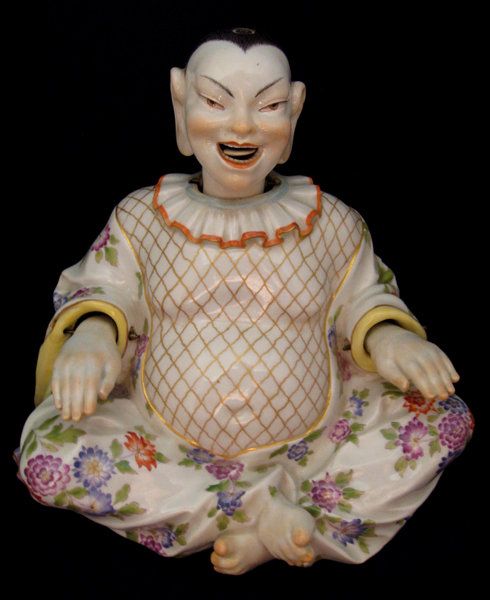
Meissen Porcelain Chinese Nodder
Connie Berry was born in Wisconsin to second-generation immigrants from Scandinavia and the British Isles. She loves antiques, cold weather, off-season foreign travel, cute animals, and all things British. Connie lives in Ohio with her husband, a champion left-side-of-the-road driver, and her completely adorable Shih Tzu, Millie. Learn more about Connie and her books at her website. 

The Chinese Nodder
"Write what you know" is a well-known cliché in the writing community, but the saying can be excellent advice, especially for new authors. "Three or four families in a country village is the very thing to work on," Jane Austen famously advised her teenage niece Anna in 1814. That's the world Jane lived in and wrote about—her characters drawn from her perceptions of the people she actually knew.

When I planned the world of my mystery series, I began with what I knew as well. Like my protagonist, Kate Hamilton, I grew up in the world of fine antiques. My parents, like hers, were avid collectors who eventually opened a shop, not because they wanted to sell antiques, but because they needed a plausible excuse to keep buying them. Family vacations were thinly disguised buying trips. One particularly successful trip to the east coast ended with boxes filling not only the car's huge trunk but the floor and backseat as well so that I was forced to travel the final hundred miles or so, head bent, on top of the pile. Today my parents would be arrested for child endangerment. Back then I thought nothing of it.

I also thought nothing of the fact that, unlike my friends, our house was filled with old furniture ("Our things have a history," my mother would say. "So much more interesting.") And unusual objects like a larger-than-life-size marble bust of Marie Antoinette and a giant ivory birdcage on a stand. One object in particular intrigued my friends. Made around 1860 by the Meissen Porcelain factory near Dresden, Germany, it was called a "Chinese Nodder," a seated pagoda figure with articulated head, hands, and tongue that moved. Ours was larger than the one shown in the photograph and had lovely Fu Manchu mustaches. I wish I still had it. Meissen Nodders in good condition today sell for between eight and ten thousand dollars.

Growing up with the artifacts of the past instilled in me a lifelong passion for history. History—the past—plays an important role in my stories. The Kate Hamilton Mystery series is set in the UK and features American antiques dealer Kate Hamilton. In the first book, Kate finds clues to the identity of a killer in an eighteenth-century marquetry casket (a small chest for valuables). In the second book (available October 2019), the crimes are tied to the Finchley Hoard, a treasure trove buried in 1549 and unearthed in 1818.

And yet the objects of the past are only one part of my fascination with history. My fictional characters live as we do—on the top layer of a deep and complex history that informs and provides context for their lives. No one really escapes their past. The important thing is how we deal with it. And that provides the tension for the fictional world I write about.

A Dream of Death
A Kate Hamilton Mystery, Book 1

Autumn has come and gone on Scotland's Isle of Glenroth, and the islanders gather for the Tartan Ball, the annual end-of-tourist-season gala. Spirits are high. A recently published novel about island history has brought hordes of tourists to the small Hebridean resort community. On the guest list is American antiques dealer Kate Hamilton. Kate returns reluctantly to the island where her husband died, determined to repair her relationship with his sister, proprietor of the island's luxe country house hotel. The next morning a body is found, murdered in a bizarre reenactment of an infamous crime described in the novel. When the Scottish police discount the historical connection, Kate teams up with a vacationing detective inspector from England to unmask a killer determined to rewrite island history—and Kate's future.

Buy Links

Wednesday, March 12, 2014

TRAVEL THURSDAY--THE GOWER PENINSULA IN WALES WITH GUEST AUTHOR JUDY HOGAN

Three Cliffs Bay
photo by John Ewing
Mystery author and poet Judy Hogan has been a reviewer, book distributor, publisher, teacher, writing consultant, and organizer of conferences, readings, and book signing events. Being a Malice Domestic contest novel finalist led to the sale of her first mystery and a subsequent sequel. Learn more about Judy and her books at her website. 
                                   
My Gower
I had no idea when I first visited the Gower Peninsula near Swansea in Wales in 1981, that ten years later I would write my first mystery novel and set it there.  I had begun reading traditional British mysteries after my eldest daughter went off to college and left me some time in the evening when I was too tired to work: Agatha Christie, Dorothy Sayers, Ngaio Marsh, P.D. James, Josephine Tey. 

I enjoyed the food scenes, when the detectives would consult over scones with jam and cream, or eat digestive biscuits (what were they?)  I had $1500 extra and my kids could spend the summer with their dad. I decided to travel to the British Isles, whence most of my ancestors had come a few centuries earlier.
Three Cliffs Bay Rock Cleft 
photo by John Ewing
I checked out a library book on guesthouses in England, Scotland, and Wales.  Several recommended for their food, I wrote to, asking if I could work part-time for them and stay there for less money.  I had two replies.  A woman in Scotland recommended her mother-in-law in Wales on the Gower Peninsula, whose bed and breakfast cost was very reasonable, and I could get an evening meal at a nearby hotel.  A second guesthouse near Llandovery in central Wales offered to hire me for a month and cut my room and board in half.  I accepted this one, but I decided to go the weekend before to the Gower one. I found a cheap airline fare, contacted two English friends of friends who said I could stay a day or two, bought a Brit-Rail pass, and left for seven weeks.  I’d never been out of the country before.

England and Scotland satisfied my curiosity about places in English Literature and my Scottish ancestors.  When I entered Wales on the train, however, I immediately knew I would write poetry.  The beauty of Wales, wilder than England’s, assured that.  I didn’t see a mystery novel coming until 1990.

I liked Wales so much that I returned and spent longer periods in 1985, ’88, and ’90, with Mrs. Edith Merrett, who had a small B&B in the village of Southgate.  She provided an evening meal and gave me her single room.  I could walk or take the bus to explore a variety of historic sites: eleventh century castles; caves where human beings had survived through the Ice Age; Stone Age tombs, like Arthur’s Stone, where by legend he pulled out Excalibur; Overton Cliff where wild orchids grew; strange rock formations like Worm’s Head (named by the Vikings--it means dragon’s head); churches originally founded in the sixth century and their graveyards. 
Worm's Head 
photo by John Ewing
A nearby library had a good collection of mysteries and books on local lore; small stores provided me with snacks, pens, and composition books for writing poetry; and there were nearby pubs if I wanted a midday meal.  After a hearty British breakfast, I would head out for the day to walk along the cliffs or visit a spot where I’d not been yet, and I’d usually write a poem, tucked up away from the constant wind, before I returned for supper in the evening.

In 1990 I managed to sprain my ankle and was housebound for most of my stay.  Edith suggested I write a murder.  She knew I liked to read them.  I began plotting one set at a B&B very like Edith’s, though I didn’t write it until the next summer when I was back in North Carolina.  In The Sands of Gower my detective, Penny Weaver, loosely based on me, falls for a Welsh police detective, Kenneth Morgan.  I tried to publish it, even had a nice rejection letter from Ruth Cavin of St. Martin’s Press, and then in 1997 I wrote a second one, set in North Carolina but again involving Kenneth and Penny, so my series began.
Pennard Castlephoto by John Ewing
Every few years I’d write another one, but not until I joined Sisters in Crime in late 2007 did I work consistently at getting them published.  I’d also been entering each one in the Malice Domestic contest for the first best traditional mystery.  In 2011 I was a finalist, which led to my having that novel, my sixth, published in 2012.  In 2013 Farm Fesh and Fatal, the seventh novel in the series, was published.  The one I’d like to publish next is the first one, The Sands of Gower.  I’ve since revised and shortened it, also consulted a Gower policeman.  My readers have told me they’d like to read the story of how Penny and Kenneth got together.  Gower is almost a character in it, and certainly my fictional Evelyn and her B&B are modeled on Edith and the B&B where I spent many happy summers.

Farm Fresh and Fatal
When Penny Weaver joins the new Riverdell Farmers’ Market, things start out badly and get much worse. The county’s unpopular poultry agent is poisoned, apparently after drinking fruit punch provided by the abrasive and market manager, who claims innocence but is arrested. The state agricultural department threatens to close the market, so Penny and her friend Sammie rush to uncover the truth. What caused the agent’s death, and who put it in the punch?

"...vegetables turn out to be a lot more interesting than we'd ever guessed."--Mystery Scene Magazine

Buy Links