Featuring guest authors; crafting tips and projects; recipes from food editor and sleuthing sidekick Cloris McWerther; and decorating, travel, fashion, health, beauty, and finance tips from the rest of the American Woman editors.

Note: This site uses Amazon affiliate links. As an Amazon Associate, I earn from qualifying purchases.
Showing posts with label English mystery. Show all posts

Monday, December 5, 2022

AN INTERVIEW WITH DEBUT MYSTERY AUTHOR SHARON LYNN

The Roman Baths
Bath, England
Sharon Lynn was raised in Arizona, but it was living in England as a teenager, and every return trip since that inspired the setting of her first novel, Death Takes a Bath. As a professor of theater, film, and writing, she coaches and mentors aspiring artists. Her short stories can be found in anthologies from Malice Domestic and Desert Sleuths. Learn more about her and her books at her website where you’ll also find links to her other social media and to sign up for her newsletter.  

When did you realize you wanted to write novels?

For me, it wasn’t so much about writing as it was about wanting to solve mysteries. When I was about nine years old, I started creating mysteries based on the things I found around the house. We had a gorgeous bunch of yellow and red columbines in our front yard, and I thought they would make a great clue in a story. “The girl loved the flowers and always had one in hand, then she disappeared, but there is a crushed columbine under a stone…” I never got much further than that, but I always had scenarios bouncing around my head. 


How long did it take you to realize your dream of publication?

Death Takes a Bath, my debut novel, is the third manuscript I wrote before getting published. The first was two decades ago, and I didn’t do anything with it. About five years ago, I wrote a novel about Death Takes a Bath’s main character’s mother. Once I wrote it, I started attending conferences and learning what I did wrong. I did rewrite after rewrite, and it turned into a monster. I may go back to it at some point and turn it into a taught suspense novel. I wrote my debut for my daughter and used all the lessons learned from the previous manuscript to polish it.


Are you traditionally published, indie published, or a hybrid author?

Traditionally published.


Where do you write? 

I write everywhere! Coffee shops, airplanes, my living room, home office, and restaurants. I use an iPad that goes with me everywhere, so I can write whenever the mood strikes me. 


Is silence golden, or do you need music to write by? What kind?

Silence is golden, but I have the ability to block out my surroundings. Chaos can swirl around me, and I focus. Unless the music has words – then I sing.


How much of your plots and characters are drawn from real life? From your life in particular? 

My main character Maddie McGuire was built off many of my daughter’s traits, but I couldn’t make her too exact because then I couldn’t put the character in danger. A lot of the situations in the plot were from when my sister and I lived in Bath as teenagers. The most significant difference between the novel and real life is that Bath is an extremely safe city with next to no crime. I interviewed two retired police officers, and they both said that Bath has maybe one murder a year. It’s a lovely city, and I highly recommend visiting if you get a chance.


Describe your process for naming your character. 

When I name characters, I want them to feel real. I chose Maddie because my daughter had four friends named Maddie. The last name came from the character’s strawberry-blonde hair. I wanted her to have Irish ancestry, and I liked the flow of McGuire. The aristocracy in the novel came from research, and the young constable Edward was named after English kings. 


Real settings or fictional towns?

Bath is a real city, and it is lovely. My series, The Cotswold Crime Mysteries, takes place in the Cotswolds, which extends through seventy miles of Areas of Outstanding Beauty. Maddie’s home is the one my family lived in when I was a teen, but I changed the house’s name to Ash Tree Cottage. I love the idea of someone reading my book, then going to Bath (which, if you’re ever in England, you should do!), and recognizing sites like the Roman Baths and the Abbey.


What’s the quirkiest quirk one of your characters has?

Maddie is a ranter. When she gets mad, or nervous, or excited, she babbles on without a breath. It’s a trait I never do, so it’s really fun to write.


What’s your quirkiest quirk?

I have zero sense of direction. When I’m driving, my husband will ask, “Do you know where you’re going?” I used to get offended until I realized that about 60% of the time, I didn’t. Now I take a full 30 seconds to get my bearings and then admit, “No.”


If you could have written any book (one that someone else has already written,) which one would it be? Why?

Goodness, this is a tricky question. I’m going to sound pretentious, but one of the subjects I teach is Introduction to Shakespeare, so my answer is Hamlet, Prince of Denmark. Here me out – no one was better at human nature than Shakespeare. His smart characters did dumb things, and stupid characters said wise things, just like in real life. Hamlet knows he is depressed, knows why, and is incapable of fixing it. I know so many college students who feel the same way.


Everyone at some point wishes for a do-over. What’s yours?

I wish I had started writing sooner. If you’re not sure you should write that novel, do it!


What is your biggest pet peeve?

Rudeness. I don’t see how it ever makes a situation better. 


You’re stranded on a deserted island. What are your three must-haves?

Can I pick my husband and my dog? I’m guessing that would make it “not deserted.” All my photos so I can dream of my family, a piano so I can finally learn to play, and enough paper and pens to keep writing.


What is the worst job you’ve ever held?

My first “real” job out of college was managing an apartment complex. Everyone who worked there gossiped and made fun of everyone else, it paid next to nothing, and had a six-day workweek. I lasted three days before the symphony (my dream) called me in for an interview in the marketing department. I worked in the arts for years until I became a professor teaching theater, communication, and creative writing.


Who’s your all-time favorite literary character (any genre)? Why?

Lady Georgiana Rannoch from Rhys Bowen’s Her Royal Spyness series. Bowen develops the character from book to book, allowing her to learn from her mistakes and gain confidence. Even her disaster of a maid, Queenie grows and changes. Also, I think Georgie would like my main character Maddie if they lived in the same time period. 


Oceans or mountains?

Both! We have a boat docked in San Diego and just moved to the mountains in Northern Arizona. 


City girl/guy or country girl/guy?

City. Even though I’m a peaceful little person, I like good restaurants, movies, and concerts.


What’s on the horizon for you?

Death Takes a Bath, the first in the Cotswold Crimes Mystery Series, releases tomorrow, but you can preorder it now. Watch for book signings and launch party info on my website. I’m busily writing Book 2, Death Takes a Fall, which will be out December 2023, and doing research for Book 3.


Anything else you’d like to tell us about yourself and/or your books?

Yes, thank you! As I mentioned, one of the things I teach is writing, which I came to through the theater. When acting, you are creating a character – especially in plays where all you have to go on is dialogue. I never considered those experiences would make me a better writer, but they did. My advice to anyone who isn’t writing because they don’t have the training is to write. You have done more than you think, and those experiences will make your characters come off the page.


Death Takes a Bath

A Cotswold Crimes Mystery, Book 1


In this series debut, a college sophomore discovers a severed human ear on her doorstep while on an international internship in England. She must solve its meaning before she becomes the next victim or, worse, gets deported.


When Maddie McGuire gets an archeology internship at the Roman Baths in England, she assumes everything will go her way. After all, it always has. But her first week turns from a princess fairytale into a nightmare when a human ear lands on her doorstep. The only bonus of the ordeal is meeting young constable Edward Bailey. Their budding friendship is a source of comfort, except when rules get in the way. 


Throwing her attention into her internship, she vows to forget anything ear related. The Roman Baths are the perfect escape, except for her aristocratic coworker Simon Pacock who sabotages her every move. And he only becomes more aggressive when she discovers a dead body at the Baths, both ears intact.


As the danger ratchets higher, Maddie must use her wits and knowledge to come out of this ordeal alive.


Buy Link 

Wednesday, August 1, 2018

AUTHOR HEATHER REDMOND REIMAGINES A YOUNG CHARLES DICKENS AS A SLEUTH

Young Charles Dickens
Critically acclaimed author Heather Redmond is a committed anglophile, Dickens devotee, and lover of all things nineteenth century. Learn more about her and her writing at her website. 

Charles Dickens, Amateur Sleuth

It’s often hard to explain why a writer decides to bring a real-life person into a novel, to reanimate an individual and their era. The fact that he’d become a virtual overnight success fascinated me. Obviously, I’ve been reading Charles Dickens’s novels since childhood, but I had no idea he’d become a literary star so young, only in his early twenties, and with so little formal education to inform his great works. We’re perennially interested in Shakespeare for some of the same reasons.

The idea of Dickens as a young man on the cusp of greatness intrigued me. I wanted to bring this brilliant and charismatic soul to life. In my favor, I had written many romance novels set in the Victorian age he strode so broadly across and had some idea of what I was getting into with this kind of project.

There have been a few novels written with Charles Dickens as a character, but it’s very rare
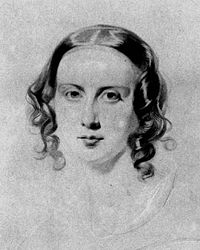
Catherine Hogarth
to see him portrayed as young, or even out of a paranormal fantasy context. I know we love him for A Christmas Carol, but he wrote a lot more stories than that! I wanted readers to see him as the vibrant, striving, and wildly intelligent young man determined to make something of himself, in between the tragedies of his youth and his middle age. I also wanted to study his relationship with Catherine Hogarth, his Kate, whose ill-starred romance seemed so perfect back at the beginning in 1835…

Charles Dickens at twenty-two, in 1835, seemed an ideal sleuth for a historical mystery series. As a reporter, he was trained to observe and record. Who better to hunt down a killer? Every sleuth needs a sidekick. While I developed a cast of characters to work alongside Dickens, his Scottish-born future bride added a touch of extra magic to the proceedings.

I hope readers enjoy the mysteries I’ve created and find themselves eager to learn more about Dickens’s novels and times.


A Tale of Two Murders

On the eve of the Victorian era, London has a new sleuth . . .

In the winter of 1835, young Charles Dickens is a journalist at the Evening Chronicle. Invited to dinner at his editor’s estate, Charles is smitten with his boss's daughter, vivacious Kate Hogarth. They are having the best of times when a scream shatters the evening. Charles and Kate rush to the neighbors' home, where Christiana Lugoson lies dying on the floor. With a twist or two in this most peculiar case, he and Kate may be in for the worst of times . . .

Buy Links

Thursday, January 5, 2017

BOOK CLUB FRIDAY--GUEST AUTHOR GINGER MONETTE

Award-winning author Ginger Monette enjoys dancing on the treadmill, watching period dramas, public speaking, and reading—a full-length novel every Sunday afternoon. Learn more about her and her books at her website.

Is Downton Abbey a Copycat of Pride & Prejudice?

One Sunday night while watching season 2 of Downton Abbey, it dawned on me: Downton Abbey is a copycat of Pride & Prejudice! Now, whether Julian Fellowes really did look to Jane Austen's classic as inspiration, I cannot say, but let's look at some of the similarities.

A houseful of daughters with no heir
Both storylines are built on the premise of impending doom due to the family's misgivings about the unfamiliar heir. In Pride & Prejudice, Austen placed a cast of five daughters at risk of being “thrown to the hedgerows” should their father die before they are wed. Julian Fellowes chose three sisters for Downton Abbey's cast, although they seem more concerned for the future of their physical home and the general uncertainty brought about by the new heir rather than their personal futures.

Similar characters
Both Austen and Fellowes chose a heroine who is an “obstinate, headstrong girl.” Downton Abbey's Lady Mary Crawley was never one to hold her tongue. And certainly Austen's Elizabeth Bennet never hesitated to voice her opinion on everyone and everything!

Perhaps the most similar characters in the two stories is a domineering matriarch. The outspoken dowager Lady Grantham is one of Downton Abbey's most colorful characters. But I believe Fitzwilliam Darcy's imperious aunt, Lady Catherine de Bourgh, could have given even Violet Crawley a run for her money!

An attempted elopement
Both dramas include an attempted elopement that spawns uproar in the respective families. Readers are aghast when Austen's rogue, George Wickham, runs off with Elizabeth's younger sister, nearly ruining the Bennet family's reputation. Conversely, Downton Abbey fans cheered when daughter-of-the-manor Lady Sybil and chauffeur-servant Branson finally kissed. But their pairing and attempted elopement was scandalous nonetheless, and sent Sybil's sisters hurrying after her and their father into a thunderous outage.

Both Austen and Fellowes used the scandalous union as a clever plot device to not only create drama, but to keep audiences on the edge of their seats. Would the scandalous pair remain together? How would the scandal drive future storylines and affect the other characters?

A grand estate
In both Pride & Prejudice and Downton Abbey, a grand house is a silent, yet central character. For nearly 200 years women have been swooning over Pemberley, the estate of Austen's heartthrob Fitzwilliam Darcy. And Highclere Castle's gold rectangular structure topped with corner towers and spires is instantly recognizable as the Crawley's beloved family home on Downton Abbey.

These lavish homes set our hearts to dreaming and become a beloved character in and of themselves. But the Austen/Fellowes parallels don't stop there. It is worth noting that the name Downton Abbey is suspiciously similar to Donwell Abbey, the name Austen chose for George Knightley's estate in her classic work, Emma.

An entailed estate with an “unsuitable” heir
In Pride & Prejudice, the unsuitable heir is the obnoxious rector William Collins, whose marriage proposal to Elizabeth Bennet is flatly refused. In Downton Abbey, Matthew Crawley is a dashing, but lowly solicitor. And although both “unsuitable heirs” go on to propose to other women, in the case of Downton Abbey, viewers are thrilled when the love struck hero and heroine eventually marry.

High society characters falling in love with, well, those not so high society
Fitzwilliam Darcy is downright disgusted with himself for falling in love with Elizabeth Bennet, a woman so decidedly beneath him. And in Downton Abbey, Lady Mary Crawley is incensed that a man in trade will inherit her family home. But in the end, fans are delighted when love wins out for both couples.

We may never know if Julian Fellowes was inspired by Jane Austen, but certainly in both cases, the premise has enchanted millions and proven to be a blockbuster success in both literature and film.

Darcy's Hope ~ Beauty from Ashes
A Pride & Prejudice Great War Romance (Volume 1)
Escape to the era of Downton Abbey and experience all the drama of World War 1 alongside literature's iconic Elizabeth Bennet and Fitzwilliam Darcy. You'll watch their tender love unfold as they learn to work together and reconcile their differences at a field hospital only miles from the Front.

1916. World War 1 has turned French chateaux into bloody field hospitals, British gentlemen into lice-infested soldiers, and left Elizabeth Bennet's life in tatters. Her father is dead and her home destroyed. Never again will Elizabeth depend on a man to secure her future! But when an opportunity arises to advance her dreams of becoming a doctor, she is elated--until HE arrives....

Heartbroken. Devastated. Captain Fitzwilliam Darcy is left rejected by the woman he loved and reeling from the slaughter of his men on the battlefield. "Enough!" Darcy vows. "No more sentimental attachments!" But arriving at a field hospital to pursue a covert investigation, Darcy discovers his beloved Elizabeth training with a dashing American doctor and embroiled in an espionage conspiracy. With only a few months to expose the plot, Darcy is forced to grapple with his feelings for Elizabeth while uncovering the truth. Is she indeed innocent? Darcy can only hope....

Note: Darcy's Hope has a happy ending but continues in Darcy's Hope at Donwell Abbey.  In the sequel, readers will experience the full resolution of the mystery, and our beloved couple's love will face a new, tragic test.

Buy Links

Wednesday, December 14, 2016

#CORNWALL WALKING PATHS WITH GUEST AUTHOR CAROLA DUNN

Carola Dunn is the author of twenty-six mysteries and thirty-two Regencies. She was born and grew up in England but has lived in the US for many years. When not writing, she enjoys gardening, reading, and walking the dog. She has two grandchildren and cannot believe one is a teenager. Where did the years go? Learn more about Carola and her books at her website. 

The Joy of Walking
One of the features of England that I miss most here in the US, at least in the West, is the public foot paths. They crisscross the countryside, paying no heed to boundaries, climbing over walls and fences with the aid of stiles, crossing farmers' fields as freely as woods, hills, and dales.

Many of the paths are of ancient origin, medieval at least. Legally they are rights of way and can't be closed by landowners. The Ramblers organization zealously guards the public's access.

Cornwall, like the rest of the country, has footpaths everywhere. The main character of my Cornish mysteries, Eleanor, loves walking with her Westie Teazle on the cliffs and moors. She enjoys it the more because she spent most of her adventurous life traveling the world, working for an international charity.

On retiring to Cornwall, Eleanor looks forward to tranquility. She settles in a small fishing port on the North Coast and opens a charity shop, a peaceful occupation. But human nature is the same the world over. When crime comes to Port Mabyn, Eleanor finds the skills learned in far off places are not forgotten and become useful once again.

In the fourth book in the series, Buried in the Country, Eleanor’s talent for diplomacy is called upon by a friend from the past, a government official. He is holding a secret conference at a hotel on the cliffs near Tintagel, and he wants Eleanor to smooth relations between the antagonistic participants.
Megan's niece, Detective Sergeant Megan Pencarrow, is helping with security for the conference, although she's already on another case, the disappearance of a local solicitor. When two strangers turn up at the hotel, she can see they're villains. What she can't guess is whether they're a threat to the conference, connected somehow with the lawyer's disappearance, or contemplating some other nefarious business.

Now Eleanor's enjoyment of walking becomes vital to the story. Her description of the view of King Arthur's legendary castle ruins from the cliff top paths inspires enthusiasm in the young people. Their insistence on going for a walk, whatever the risk of being seen, leads to the revelation of what the two London villains are up to.

Caught in the act, the villains flee with hostages. The ensuing car chase takes them to fog-bound Bodmin Moor at dusk. Eleanor's familiarity with the rural byways helps Megan to follow and to rendezvous with her colleagues. They end up on Bodmin Moor, where the murderers disappear into the fog.

Night is falling. It seems they'll escape. But Eleanor often walks here. She knows the lay of the land and all the hazards: bogs, old mine shafts, precipitous quarry walls. She describes it for the searchers, and when she's denied a part in the search, she goes off hunting on her own.

Using every scrap of her local knowledge, combined with her talent at diplomacy and a few tricks she's learned in foreign parts, Eleanor emerges from the fog triumphant: She has captured one of the villains and he's spilled the beans.

Walking the footpaths of England, you are not at all likely to meet a murderer, of course. Nor will you meet a bear, a cougar, a skunk, a porcupine, or a rattlesnake; you won't even encounter poison oak or poison ivy!

Buried in the Country
After many years working around the world for an international charity in the late 1960s, Eleanor Trewynn has retired to the relative quiet of a small town in Cornwall. But her quiet life is short-lived when, due to her experience, the Commonwealth Relations Office reaches out to her to assist in a secret conference that is to take place in a small hotel outside the historical village of Tintagel.

Meanwhile, her niece, Detective Sargent Megan Pencarrow, is investigating the disappearance of a local solicitor when she is assigned to help provide security for the conference. Two African students, refugees from Ian Smith’s Rhodesia, arrive for the conference, escorted by Megan’s bête noire from Scotland Yard. They are followed by two mysterious and sinister Londoners, whose allegiances and connections to the conference and the missing solicitor are unclear. With a raging storm having trapped everyone in the hotel, the stage is set for murder, and it’s up to Eleanor and Megan to uncover the truth before more lives are lost.

Buy Links