
 |
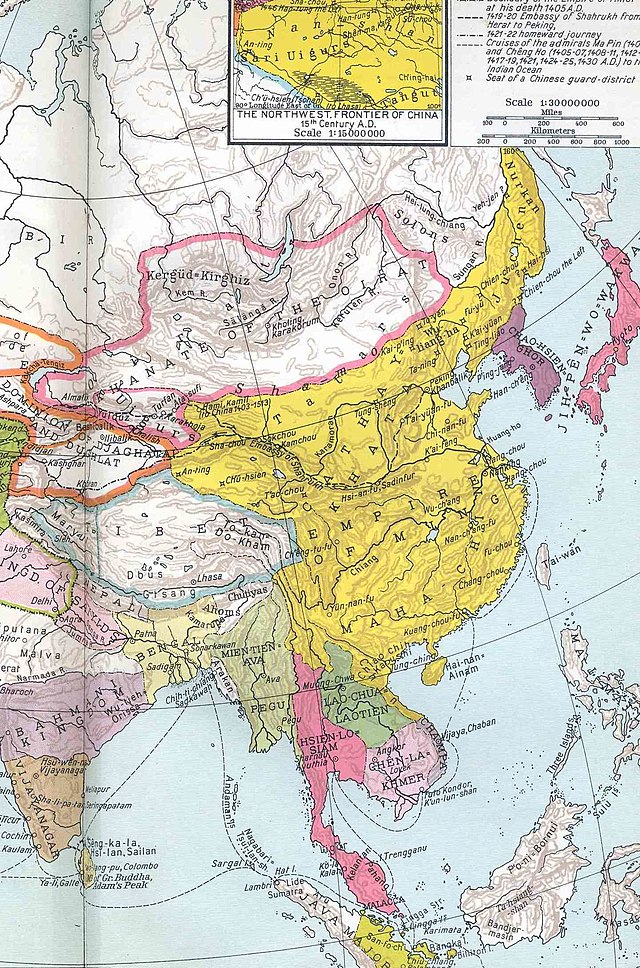
| Ming Dynasty |
Award-winning historical mystery author P.A. De Voe
is an anthropologist with a PhD in Asian studies and a specialty in China. She
has written several books and short stories featuring the Ming Dynasty. Learn
more about P.A. and her books at her website.
China is a highly diverse
country whose diversity can be broken down in various ways, for example, by
region (north, south, west), province, or language. Deadly Relations, A Ming Dynasty Mystery is a late fourteenth
century story set in the southeastern province of Jiangxi in the market town of
Jian.
While my Jian is fictional,
I wanted it to reflect important characteristics of southern villages and towns
and which I could use in developing the characters and plot line of my new Ming
Dynasty Mysteries series. First, the majority, if not all, of the residents
belonged to only one or two patrilineal clans. That is, the families were all directly
related to one another through the father’s line. When women married, they
married out of their patrilineal home and moved to their husband’s family’s house
in another village. Therefore, all of the married women would normally be from
other villages or towns. As a result of this living arrangement, the husband
had lots of family around him, and the wife had no one around her from her own
natal family. Another consequence of this pattern, intended or not, was that most
women transferred their identity, loyalty, and attachment to the husband’s
family and its interests. I pursue this idea in Deadly Relations, looking at both the positives and negatives that
can arise from such a situation.
In Deadly Relations there are two main clans: the Gao and Xin. The Gao
clan is the dominant clan; they have the most members, prestige, and control of
the town. My protagonist Hong Shu-chang’s mother was a member of the Xin clan,
the secondary clan in the village. Because Jian is a market town, however, there
would also be non-Gao and Xin living in Jian. They would be immigrants and
traders. The normal, everyday Chinese wanted to remain in their home area (the
emperor also wanted this!) but famine or war would drive them away in search of
economic survival. Nevertheless, no matter how long they stayed in Jian, they were
always considered outsiders.
These tight vs. loose
networks (i.e., men vs. women, clan members vs. outsiders) allows for
interesting dynamics in character development.
Another issue related to
north-south differences, is how schooling is treated. Although the emperor
encouraged his magistrates to set up public schools for boys, in the south most
boys received their education through clan-based schools. A clan-based school
was set up and run by a specific clan for its members only. At the death of
Hong Shu-chang’s father, his mother’s brother offered him a job as teacher in Jian’s
Xin clan school. All of his students are cousins who can trace their family
line to a common ancestor.
There were no schools for
girls in either the north or the south. If they received any education, it was
through home schooling. Shu-chang’s female counterpart, Xin Xiang-hua, is
highly educated as a woman’s doctor because her medical family trained her
through home schooling and an apprenticeship with her own grandmother. This
professional training was highly unusual for girls. However, it did happen.
Xiang-hua is based on a real, historical woman’s doctor who lived during the
Ming Dynasty.
I invite you to take a trip
to Jiangxi province in southern China during the late 1300s. Read Deadly Relations, where history and
mystery meet!

Deadly Relations, A Ming Dynasty Mystery
As Hong Shu-chang struggles
to move out of poverty, his father and uncle are murdered. Facing destitution,
yet determined to find their killers, he takes a position as teacher in a
nearby town where he meets Xiang-hua, the enigmatic local women’s doctor. Soon,
a burned-out warehouse and two more mysterious deaths lead to his teaming up
with Xiang-hua, and together they delve into the dark side of the town and its
families, endangering both their reputations and lives.
Buy Links


