Featuring guest authors; crafting tips and projects; recipes from food editor and sleuthing sidekick Cloris McWerther; and decorating, travel, fashion, health, beauty, and finance tips from the rest of the American Woman editors.

Note: This site uses Amazon affiliate links. As an Amazon Associate, I earn from qualifying purchases.
Showing posts with label Sue Viders. Show all posts

Friday, October 28, 2022

BOOK CLUB FRIDAY--SUE VIDERS AND BECKY MARTINEZ ON THE PROCESS OF CO-AUTHORING A BOOK

Today we welcome the writing team of Sue Videos and Becky Martinez to tell us about their working partnership. Learn more about them and their books at their website.

Sue:

H.G.Wells said it perfectly…and I use his words in reference to co-authoring ….


No passion in the world is equal 

to the passion 

to alter someone else’s draft.


Which of course is what co-authors do on a daily basis, or should I say on a critique basis.


Becky and I have worked together for many, many years, first as just friends in the same writing groups, and then as teachers. We taught on-line writing classes together all over the county.  Then suddenly, about two years ago, Becky emailed me one day and asked if I would like to write a book with her.  My answer, “Oh, yes!” I was thrilled, because we both brought to the table different, unique skills based on how we write. 


Becky is definitely a fly-by-the-seat type of writer--that is, she comes up with an idea for a plot and characters and simply starts writing. Her characters and scenes come to life as she writes the story. 


On the other hand, I am a planner. I don’t even begin to write until I have the whole idea planned out and the ending written down.


So how do these two different ways of writing blend so well? First of all, when writing with another writer, ground rules need to be determined before the first word is typed.


Our ground rules were:


1- Decide on the type of story to write. 

We agreed on a light cozy mystery.


2 - Create the plot and the main characters.

We wanted an artist as one protagonist and a small boutique owners as the other, and we wanted to set the story in a small Colorado town (since we both know the area.)


3 - Decide who would do what.

We had meetings to loosely plot the story. I would write the first draft of each chapter. Becky would heavily critique it and add any additional information. I would then critique what she changed. Then together, on the phone, we would critique the chapter, line by line, word by word until we were satisfied. We set deadlines and did this once a week. 


The reason this worked so well for us, is that I am dyslexic and cannot spell very well and have absolutely no idea where the damn commas go. Becky, on the other hand, as a retired journalist, spells exceptionally well, and is a comma queen. 


I kid her a lot because she is also the world’s best editor. She takes my short, sometimes unfinished sentences and often in the wrong tense, and smooths them out. She has, hidden on her keyboard a “delete” key which she uses all the time. And this makes the writing flow smoother and better.


If I were to give any advice to a writer who is contemplating co-authoring any genre, I would state that before writing anything agree on these ground rules:


1 - Lose the ego.

2 - Learn how to critique constructively.

3 - Set deadlines.

4 - Learn how to disagree.

5 - Be honest in your comments.

6 - Bottom line, all that really matters is how to make the book a great read. 


Becky:


…and that’s the way it is…--Walter Cronkite at the end of  every CBS news broadcast


Sue and I have been able to make co-authoring work because of our constant desire to collaborate and to join together to make our books as entertaining and correct as possible. Sue is well known for her nonfiction books on writing, and we have worked together both on nonfiction and fiction over the years. She excels in creating characters from the very beginning, while I often let my characters come to life on the pages as I write them. She fills out character charts in advance, while I have character charts that I fill out as I write the story. I usually know the beginning of my story and the ending, but everything in the middle comes out as I write. It’s not that I can’t plan—I just know that things will change along the way. So I like to be prepared for when that happens and a character gets out of line and starts acting differently.


As a television news producer, who had to plan a newscast every day but never saw one go in the exact order I planned it, I have learned to be flexible over the years, and I do that with my fiction writing. One thing I always knew as a TV news producer—the network news was coming on the air at 6:00pm no matter what I did, so my newscast better be done at that exact second! 


I do that with my writing too. I know how I am going to begin and end my books and everything else in the middle might change, but I need that beginning to make my readers want to keep turning the pages, and I want to end the story with them feeling as though they got everything they needed to know and ready to “tune in” (or buy my book) the next time they see my name as an author.  


As co-authors Sue and I have had to combine our distinctive styles, and it can be quite rewarding even though it can also be challenging. She considers me the queen of commas, but I consider her the queen of character building, and she is also very dedicated to the writing process itself. Together we work hard to make our characters, our locations, and our plots come to life. We both also love to talk about writing and learn from and about other writers, which is why we began co-authoring books on writing and teaching classes many years ago. We’ve learned everyone has a different style, so we recommend, find what works for you and your writing co-author, and then team up and enjoy the process.


Together we have managed to write not only not only nonfiction but fiction books together.  Our newest co-authored novel, Secrets and Swindles, is a cozy mystery that was published this month.  It took months of working together, both formulating the plot and then writing and editing it, but it was a fun book to do, and we are now working on a second installment even while we both work on individual fiction. 


Whether writing fiction or nonfiction, the writing process may be challenging, but neither one of us intends giving it up any time in the future, continuing to work together as well as write our own suspense books. 


Secrets and Swindles

A Sleuthing Sisters Mystery, Book 1


All Josephine and her sister want to do is enjoy their senior years in a small community in the Rocky Mountain foothills, but when Josephine discovers that someone has made prints of her artwork without her permission and is profiting off them, she is determined to track down the thief. She knows the person must be nearby, but who could it be?


Olivia runs a resale clothing shop in town and has growing problems of her own. The alcoholic husband of her store clerk, Ginny, has just been killed in a suspicious automobile accident. Now police are questioning the cause and Ginny may become a suspect in his mysterious death. Olivia wants to help, but how? And now she has her own doubts about Ginny.


As the two sisters search for answers with the help of an elderly ex-judge and his grandson, they suddenly find themselves caught in a web of deception and danger. Someone is watching them…leaving vague warnings to stop their sleuthing. The next warning could cost them their lives.


Buy Links

paperback 

ebook 

Thursday, March 25, 2021

BOOK CLUB FRIDAY--ESSAYS ON LIFE BY COZY AND NOFICTION AUTHOR SUE VIDERS


Cozy mystery and nonfiction author 
Sue Viders has a B.F.A. degree and is a teacher and an artist. She began writing for national art magazines to help artists market their works but switched to teaching writers how to better organize and write more effectively. Her most well-known nonfiction book, often called the Bible of building characters, is The Complete Writer’s Guide to Heroes and Heroines, Sixteen Master Archetypes.

Now approaching the big Nine-0, and having survived numerous bouts with cancer and other interesting medical problems, along with raising five children and assisting her attorney husband in his law practice, Sue Viders says she is proud to present her latest endeavor, which, according to Sue, all began at a lunch. Learn more about Sue and her books at her Amazon author page.


There were four of us, all over the age of 65, enjoying a writing-lunch get-together. We all had several books under our belts and were gathered to bemoan the fact that we all wanted to write something but didn’t quite know what.


As we tossed around various ideas of what we might write together we came up with the idea of writing short articles for senior-oriented magazines, and maybe a newspaper or two. We came up with the name, “Roads Well Traveled,” where we would take turns reflecting on our life’s journey.


After a lot of query letters and networking, a large newspaper loved our idea and my short essay on ‘Mother, you really need a new phone’ was the first one published. And lo and behold, I got fan letters. I was thrilled. My thoughts were hitting home with the over 65 crowd. So, I reasoned, maybe I should jot down more of my personal thoughts and observations on living.


After much soul searching, I realized I was not alone in my thoughts and how I approached life. And that other people played as much solitaire as I did … so that observation became my essay “The World without Solitaire.”  


I decided writing essays was very soul satisfying and that I would write about all the little things that both bothered or irritated me. A sample of her essay titles include:


Scamming the Scammer


Adverbs — Game Changers, because I was tired of listening to the so-called expert talking heads who never seemed to tell the truth.


Ketchup and Pickles, which is not about food.


Why do we Swear? Which came about when my kids accused meof swearing too much.


The Trouble with Tissues, which wrote itself after watching an old Star Trek episode.


Chutzpah Needs a Partner … My favorite.


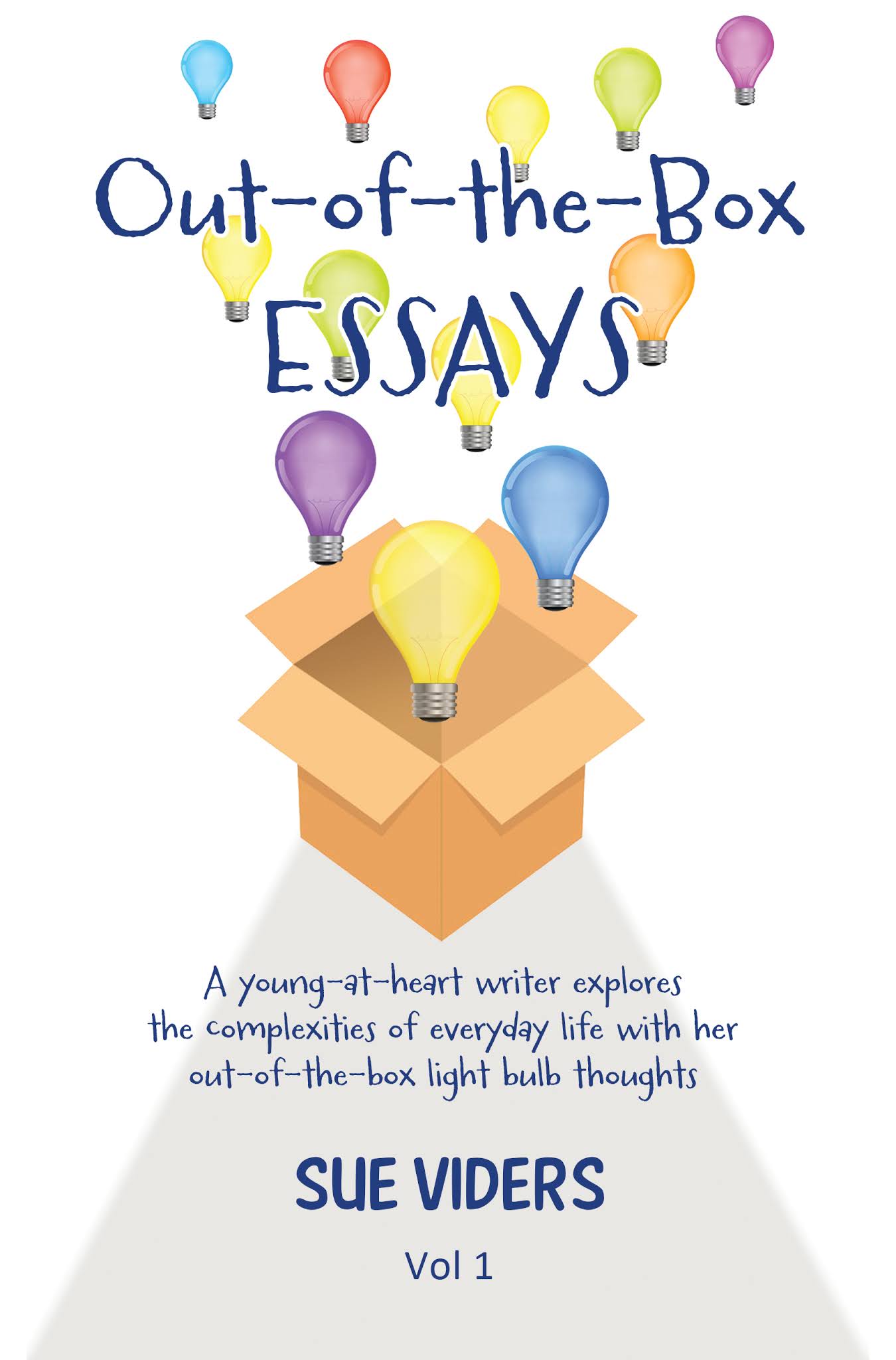
And so these newspaper articles gradually morphed into Out-of-the-Box Essays, containing forty-four short thought-provoking and humorous comments on my life and living.


Out of the Box Essays

A Young at Heart Writer Explores the Complexities of Everyday Life


Why do writers write these short essays?


Are my thoughts, ideas or random bits of observation any better than yours?


Will my words change the world somehow? Will they change or somehow inspire you in some way?


Probably not, but I do believe writers write these “pearls of wisdom” and “gems of observation” because we’ve been around the block a few times and want to share what we have learned—so you, the reader will have a few laughs, a few “that’s exactly right” or “that’s exactly what I thought” comments.


Buy Links

paperback 

ebook 

Sunday, August 16, 2015

CRAFTS WITH ANASTASIA--GUEST AUTHOR SUE VIDERS/D.B. HUMEL

Meg's earrings
Sue Viders, co-author of the best selling reference book, The Complete Writer’s Guide to HEROES and HEROINES, SixteenMaster Archetypes, is now writing cozy mysteries under her maiden name of D.B. Humel. An artist turned writer, Viders wanted her heroine to be a mature artist trying to find her way into the art world. What developed as she wrote her first mystery story was an opinionated and spirited character that turned out to be an avatar of herself, but with a bit more moxie. Learn more about D.B., her books, and Meg's special earrings at her website. 

After writing nonfiction books, charts, organizers and even tapes and guides for writers, I really wanted to try my hand at lying… grin. Since I loved mysteries and light sci-fi stories, I wanted to create a story that had both a murder in it with a touch of the paranormal to make it more interesting…not too much fantasy, but just enough to make it a bit different and give the main character a more unique personality.

With a strong background in art, personal knowledge in the various techniques and mediums, I decided this fiction book would be about a creative woman who was trying to find herself as she grew older. I still do art work and participate in art shows and I wanted to use my art work in the writing of the book. First I had to decide just what the “fantasy” would be and how to use it. My mother-in-law was hard of hearing and her hearing aid was always buzzing or the battery had died. She was forever turning it off and on. So I got to wondering…what would happen if the earrings could do more that just help a person hear. Since I think better when I draw, I started designing earrings.

My first drawings were concerned with what would Meg’s earrings look like. Would Meg need pieced ears or would screw on earrings work?

After a bit of research into how a hearing aid works and what small battery cells can do in computers I became convinced I could create a great earring that had “special” qualities. Ah, this was a light bulb moment for me.

Where would the computer cell go? And I wanted antenna so Meg could better locate the sounds.

I soon realized that when entering the world of fiction I could do what ever I wanted to do. It was
liberating. The center of the flower controls the volume and the big dangling loops are the antenna.

After the earrings were done, the story quickly followed. It was as if the earrings had turned on my own gray cells and the words, the other characters, the twists and turns of the story just jumped out of my mind. Great fun.

Meg was not difficult to create and whenever she was thrown into a scene and had to react, I simply became Meg and let my emotions transfer into her personality. More fun.

I hope you enjoy Meg, learning how she created her paintings, and how, with the help of her earrings finally finds out who killed her favorite art professor.

Meg and the Mysterious Voices

Meg Jamison, a widow with two grown sons, is struggling to be a well-known and marketable artist when she discovers her hearing is going. Living in a small college town, nestled at the foot of the Rocky Mountains, she manages to keep her hearing loss a secret from her family and friends. Working with an oncologist and a computer expert, together they design a state-of-the-art hearing aid that they implant in a pair of silver earrings.

Oh how Meg loves them. The only trouble is that while she can now hear well again, she can also hear, if the person is angry enough, that person’s inner thoughts. Meg has trouble handling these “voices” until they help her solve the murder of her art professor’s murder.