Featuring guest authors; crafting tips and projects; recipes from food editor and sleuthing sidekick Cloris McWerther; and decorating, travel, fashion, health, beauty, and finance tips from the rest of the American Woman editors.

Note: This site uses Amazon affiliate links. As an Amazon Associate, I earn from qualifying purchases.
Showing posts with label antiques. Show all posts

Wednesday, April 6, 2022

AN INTERVIEW WITH ANTIQUE AND ART DEALER EDIE BROWN FROM AUTHOR TRISH ESDEN'S SCANDAL MOUNTAIN ANTIQUES MYSTERIES

Today we sit down for a chat with Edie Brown from author Trish Esden’s Scandal Mountain Antiques Mystery series. 

What was your life like before your author started pulling your strings?

The week before The Art of the Decoy begins, I’d just finished an internship at Christie’s auction house in New York City. I’d left the city and was planning on enjoying a vagabond life for the summer, driving around New England in my van, buying, and selling antiques and art at flea markets and shows. 


What’s the one trait you like most about yourself?

Actually, I like quite a few things about myself. My determination for one. The most unique trait would be my knack for finding quality antiques and art, even when they’re hidden amid piles of fakes and other junk. 


What do you like least about yourself?

How hard it is to get past events that happened years ago, such as witnessing the single-engine plane crash that killed my grandparents. 


What is the strangest thing your author has had you do or had happen to you?

My goodness, Trish is always coming up with strange situations to put me in. But that’s probably because she’s an antique dealer, and she knows firsthand that weird situations happen in real life as well as in the Scandal Mountain Mystery Series. 


Do you argue with your author? If so, what do you argue about?

Making me face my feelings toward my mom and finding forgiveness. My mom and I have always had a hard time getting along for a variety of reasons. We’ve both held onto our resentments for far too long. 


What is your greatest fear?

Having the antique and art business my grandparents lovingly created fail under my watch. 


What makes you happy?

Lots of things! The hunt for amazing antiques and art. Spending time with my uncle Tuck and our new employee Kala. Being home in Vermont. I love the town of Scandal Mountain and the historic brick house I grew up in. Not to mention the possibility of rekindling the hot romance I had with Shane Payton, my ex-probation officer.  


If you could rewrite a part of your story, what would it be? Why?

My grandparents would never have died in the plane crash. I miss and love them so much. A part of my heart was crushed when I failed to save them that day, no matter how impossible that would have been. 


Of the other characters in your book, which one bugs you the most? Why?

Felix Graham. He’s a snob and a womanizer—and my family’s biggest competition in the antique and art business. Rumor also has it he might have had a finger in my mom’s arrest for art forgery. 


Of the other characters in your book, which one would you love to trade places with? Why?

If I could do anything, it would be turn back time rather than trade places. Things are difficult right now business-wise and emotionally. When I was young, life seems so much easier. Hmmm… on second thought, I’d like to trade places with our new employee Kala for a couple of hours. I’d really like to find out more about her mysterious past, and that’s one way I could do it. 


Tell us a little something about your author. Where can readers find her website/blog?

Trish Esden loves museums, gardens, wilderness, dogs, and birds, in various orders depending on the day. She lives in northern Vermont where she deals antiques with her husband, a profession she’s been involved with since her teens. Don’t ask what her favorite type of antique is. She loves hunting down old bottles and rusty barn junk as much as she enjoys fine art and furnishings.


Trish loves interacting with fans, so be sure to follow her on social media and sign up for her newsletter, too. Links and information about the Scandal Mountain Antiques Mystery Series are on her website


What's next for you?

Rumor has it that I’m going to get tangled up in an adventure that dives into the world of galleries, art connoisseurs, and high-stake schemes, as I race to untangle a mystery behind an unsettling piece of outsider art.


The Art of the Decoy

A Scandal Mountain Antiques Mystery, Book 


It should have been a simple appraisal. If it weren’t for the thief. 


After her mother is sent to prison for art forgery, Edie Brown returns to Northern Vermont to rebuild her family’s fine art and antiques business. She’s certain she can do it now that her mother’s gone. After all, butting heads with her mom over bad business practices was what drove Edie away three years ago, including a screwup that landed Edie on probation for selling stolen property. 


When Edie scores a job appraising a waterfowl decoy collection at a hoarder’s farmhouse, she’s determined to take advantage of the situation to rebuild the business’s tarnished reputation and dwindling coffers. In lieu of payment, Edie intends to cherry-pick an exceptional decoy carved by the client’s renowned Quebecoise folk artist ancestors. Only the tables turn when the collection vanishes.   


Accused of the theft, Edie’s terrified that the fallout will destroy the business and land her in prison next to her mom. She convinces the client to give her five days to find and return the decoys before calling the authorities. Desperate, she digs into the underbelly of the local antiques and art world. When Edie uncovers a possible link between the decoy theft and a deadly robbery at a Quebec museum, she longs to ask her ex-probation officer, and ex-lover, for help. But she suspects his recent interest in rekindling their romance may hide a darker motive. 


With the help of her eccentric uncle Tuck and Kala, their enigmatic new employee, Edie must risk all she holds dear to expose the thieves and recover the decoys before the FBI’s Art Crime Team or the ruthless thieves themselves catch up with her.  


Buy Links

hardcover 

ebook 

audiobook 

Sunday, January 27, 2019

#CRAFTS WITH ANASTASIA--ANTIQUE PERFUME BOTTLES INSPIRE MYSTERY AUTHOR JUDY PENZ SHELUK

A Tappan collection. Photo courtesy of Helen Farnsworth.
Judy Penz Sheluk, author of the Glass Dolphin Mysteries and the Marketville Mysteries, as well as various short stories, returns today to talk about antique perfume bottles and how they factored into one of her books. Learn more about Judy and her books at her website. 

Facts in Fiction: Herman Tappan Perfume Bottles
Until recently, I was the Senior Editor of the now-defunct New England Antiques Journal. During my decade-plus of employment there, I learned a lot about antiques, the show and auction scene, as well as the various collector associations that represented specific areas of interest. One of my favorites was the International Perfume Bottle Association (IPBA). While I don’t collect perfume bottles, the images that accompanied their press releases always captivated me.

The Herman Tappan perfume bottle
that inspired the text.
Photo courtesy of Helen Farnsworth.
 
When I was writing A Hole in One, the latest book in my Glass Dolphin Mystery series, I needed a decorative item, ideally valued in the $100-$150 range—something my protagonist, Arabella Carpenter, could donate on behalf of the Glass Dolphin antiques shop. I went to the IPBA website and started checking out their virtual museum. When it became quickly apparent that I had no clue what to select, I contacted the IPBA, who in turn put me in touch with longtime member/volunteer and archivist Helen Farnsworth. I did so, explaining my mission, and Helen came to the rescue.

Her suggestion of a figural bottle of a small girl wrapped in a wolf skin fur, made by the Herman Tappan Perfume Company, New York, NY, circa 1890, was perfect, and not just because it was valued in the $100-$150 range. This was the kind of “sleeper” find Arabella might have discovered at an auction or estate sale. While Tappan’s colognes and figural bottles were aimed at the middle class and the prices affordable, he’s not a household name like Lalique. In short, it was the sort of thing that could have been found in an inexpensive box lot.

Facts in fiction, like this perfume bottle, are often just a small part of the overall book—anywhere from a single paragraph to a couple of pages—but they are by no means insignificant. An author who gets the facts wrong is guaranteed to lose more than one reader for life. Get them right, however, and the author not only satisfies those in the know, she’s added another layer to the story, providing a bit of trivia for those who enjoy such things.

A Hole in One
A Glass Dolphin Mystery, Book 2

Hoping to promote the Glass Dolphin antiques shop, co-owners Arabella Carpenter and Emily Garland agree to sponsor a hole in one contest at a charity golf tournament. The publicity turns out to be anything but positive, however, when Arabella’s errant tee shot lands in the woods next to a corpse.

They soon learn that the victim is closely related to Arabella’s ex-husband, who had been acting as the Course Marshal. With means, opportunity, and more than enough motive, he soon becomes the police department’s prime suspect, leaving Arabella and Emily determined to clear his name—even if they’re not entirely convinced of his innocence.

Dogged by incriminating online posts from an anonymous blogger, they track down leads from Emily’s ex-fiancé (and the woman he left Emily for), an Elvis impersonator, and a retired antiques mall vendor with a secret of her own.

All trails lead to a mysterious cult that may have something to do with the murder. Can Arabella and Emily identify the killer before the murderer comes after them?

Buy Links

Tuesday, October 29, 2013

DECORATING WITH JEANIE--GUEST AUTHOR AND DECORATOR HELENA FAIRFAX


Helena Fairfax was born in Uganda to an Irish mother and British father. She’s lived in Germany and Austria and now resides in Wuthering Heights territory. She joins us today to share her love of decorating with antiques and tell us about her latest novel. Learn more about Helena at her website. 

Decorating with Antiques

Buying and selling antiques has become a popular pastime, and using antiques in your home is a great way to provide individual style.  Antiques are also more affordable than you might think.  Most antique shops don’t just stock the more valuable items such as Royal Worcester vases or seventeenth century oak furniture.  You will find an array of items covering a range of prices…and there’s nothing more fascinating than picking your way through the display!

Incorporating antiques into a modern home might seem like a contradiction in terms, but one or two vintage items of furniture can make a striking addition. If you are not keen on bringing in larger items, then a few vases, a bowl or an antique print can add interest.


It’s easy to get carried away in antique shops (or maybe that’s just me!), so to prevent your house looking like a mish-mash of styles, try to concentrate on your color scheme, or perhaps on one particular period whose style you love.

My terraced house in the north of England, for example, was built during the Victorian era, but I personally find the typical Victorian style a little too ornate and fussy.   The Victorians were great ones for frills and bows and tartan dresses, parlors cluttered with ornaments, and showy jewelry. 

The art nouveau period, at the turn of the twentieth century, swept away all these frills and furbelows, and it's a style I love.

Art nouveau is French for "new art."  It's hard to sum up in words what this new art meant, but I'll try!  To me, art nouveau is all about dramatic, curving lines with themes and colours taken from nature.  Sadly, the original stained glass windows in my house are long gone :( , but I have a replica which encapsulates the art nouveau style.

A stained glass window is one of the more pricey ways of incorporating your chosen style in your décor, but having the style you want needn’t cost a great deal.  For example, I picked up a cheap, battered wardrobe in an antique shop and covered it in a modern wallpaper.  It’s also possible to buy replica antiques, such as the replica lampshade which hangs in my hallway.

Buying antiques for your home is a great way to show your individual style.  And who knows…one day the piece you bought for a song might be worth a fortune :)

The heroine of my latest novel is a woman who knows all about the world of antiques, but maybe a little less about affairs of the heart…until she meets my gorgeous hero!

The Antique Love
One rainy day in London, Wyoming man Kurt Bold walks into an antique shop off the King’s Road and straight into the dreams of its owner, Penny Rosas. Lively, spirited and imaginative, Penny takes this handsome stranger for a romantic cowboy straight from the pages of a book. Kurt certainly looks every inch the hero…but he soon brings Penny’s dreams to earth with a thump. His job is in the City, in the logical world of finance—and as far as Kurt is concerned, romance is just for dreamers. Events in his childhood have shown him just how destructive love can be. Now he’s looking for a wife, right enough, but what he wants is a marriage based on logic and rational decisions. Kurt treats Penny like he would his kid sister, but when he hires her to help refurbish his beautiful Victorian house near Richmond Park, it’s not long before he starts to realize it’s not just his home she’s breathing life into. The logical heart he has guarded so carefully all these years is opening up to new emotions, in a most disturbing way…

Sunday, November 18, 2012

CRAFTS WITH ANASTASIA - HISTORY OF THE SEWING MACHINE


Singer Model 27 Treadle Table, Singer Manufacturing Co.
As a very young child, I used to take my dolls for seesaw rides, not on the playground but on a movable metal grate attached to a cabinet in the second floor hallway of my grandmother’s home. Years later, I learned that my makeshift seesaw was my great-grandmother’s Singer treadle sewing machine.

I have a feeling I used the machine more than she ever did. Great-grandmother preferred doing things the old fashioned way -- by hand. And grandmother owned an electric version.  I can imagine the circumstances by which great-grandmother came to own her machine, though.  Like many families in the late 1800’s, mine probably bought their machine from Mr. Singer by paying five dollars down, half an average weekly salary in those days, and three to five dollars a month thereafter until the principal and interest were paid off.

The sewing machine was the first machine to enter the American home and was seen as somewhat of a miracle when first introduced. An 1860 issue of Scientific American called it the most important invention to the world after the spinning Jenny and the plough. Godey’s Lady’s Book dubbed it “The Queen of Inventions.” The sewing machine reduced the time it took to make an average shirt from ten to fourteen hours down to a little more than an hour.

Early machines were expensive, though, and even with payment plans the price was out of reach for many households. For this reason, communities and organizations often pooled their money to purchase a single machine for communal use.  As sewing machine production and sales increased, the price dropped, and more families were able to afford a sewing machine of their own. By 1905 the electric powered machine was in wide use, and by 1910 there was a sewing machine in most working class homes.

The sewing machine was seen as a mixed blessing, though, reflecting both the advantages and social problems of the Industrial Revolution. The advent of the sewing machine moved garment work from cottage industries into factories. By 1862, three out of four sewing machines were bought for use in factories. Because production increased, prices fell, and clothing became more affordable. However, factory workers often found themselves laboring under harsh conditions in what became known as sweat shops. Many others lost their jobs. The social upheaval created by the introduction of the sewing machine fomented unrest which eventually led to the advent of workers’ unions and the establishment of government standards in the work place.

Most school text books credit Elias Howe, Jr. with the invention of the sewing machine.  However, many individuals, going back to Thomas Saint in 1790, contributed to its development. Earlier inventions had many design flaws and were never put to practical use until French tailor Barthelemy Thimmonier produced a workable machine in 1829. By 1841 eighty Thimmonier machines were producing uniforms for the French army until an angry mob of tailors, fearing the loss of their livelihood, broke into his factory and destroyed his machines. Thimmonier died penniless.

At about the same time American Walter Hunt developed a practical machine but abandoned production, fearing his invention would put seamstresses out of work. Howe, who was issued a patent in 1846, found little market for his machine. In 1850 Isaac Merrit Singer developed the first practical sewing machine. Previous machines employed a hand crank to power the needle. Singer developed a treadle mechanism to replace the hand crank.

Howe wound up suing Singer and others for copyright infringement. A compromise was reached whereby Howe received royalties. Singer went on to become the world’s largest manufacturer of sewing machines at the time. He was awarded twenty additional patents. In addition to establishing the installment plan for purchasing his machines, he implemented a company-wide policy of destroying trade-in machines to reduce the second-hand market. By 1876 Singer was selling twice as many sewing machines as his nearest competitor. By 1890 Singer had produced nine million sewing machines.

To date, over 46,000 sewing machine patents have been awarded, including one to Helen Augusta Blanchard of Portland, Maine in 1873 for inventing the zig-zag stitch. Today there are more than 4,000 different types of sewing machines manufactured.

I have no idea what happened to my great-grandmother’s treadle machine. My grandmother sold her house and moved into an apartment when I was in my mid-teens. The treadle didn’t make the move with her. But I never forgot the joy of crawling under that cabinet and taking my dolls for a ride.

Years ago, I happened upon a yard sale. There on the lawn sat a Standard treadle machine. “How much?” I asked the owner. “You can have it for fifteen dollars,” he replied. Although I prefer to sew on my ultra-modern machine, for over thirty years that old treadle machine has had a place of honor in my home.

Post a comment for a chance to win a book from our Book Club Friday guest author. -- AP

Thursday, September 9, 2010

TRAVEL WITH SERENA -- GUEST TRAVEL WRITER STACIA FRIEDMAN


Travel editor Serena Brower is on assignment, so I’ve invited a guest to blog for her today. Stacia Friedman is a travel writer who contributes regularly to TheCityTraveler.com, StaciaSleptHere.blogspot.com and regional and national magazines. Stacia’s is also a buddy fiction author who has written a travel mystery. Sauced in Armagnac, set in southwest France, is currently making the rounds of publishers. The novel’s protagonist, Fedora Wolf, is a travel writer with a weakness for French pastry (and men) and a knack for being in the wrong place at the right time. You can read more about Stacia at www.StaciaFriedman.com. -- AP

"Merci beaucoup" to Anastasia for inviting me to contribute a travel article to the Killer Crafts & Crafty Killers blog!

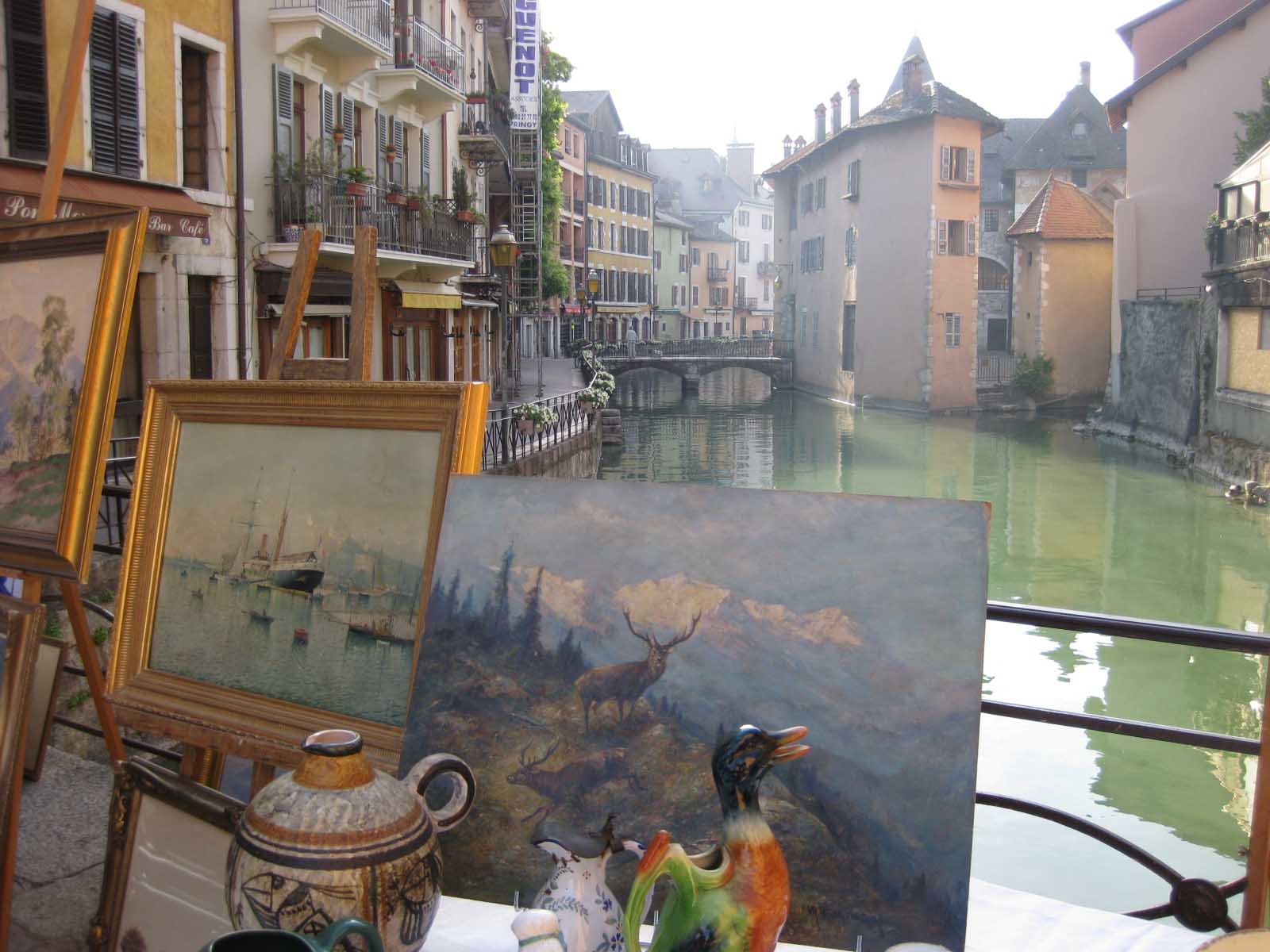
Fitting an armoire into the overhead rack of a plane is not a rational thought. But it was one I contemplated as I drooled over the treasures of the outdoor Antique Market in Annecy, France when I was there in June. Medieval weapons, Louis XVI furniture, Art Deco perfume bottles, Jazz Age flasks, bisque dolls with human hair and dishes that Josephine must’ve thrown at Napoleon. Everywhere I looked, there was another collectible screaming for my attention and VISA card. (Ah, so that’s what naughty French postcards really looked like!)

The Annecy Antique Market is located in the picturesque, older part of town where canals thread their way under romantic bridges and swans glide in search of croissant crumbs. Think Venice with a French accent. I paused on a bridge to admire landscape paintings from another era. Further up, where the canal flows into Lake Annecy, the largest, purest lake in all of Europe, artists displayed contemporary watercolors of local scenes for tourists wanting to take home the magic.  I tried to breath it all in. The lure of satin opera gloves from the Belle Epoch. The delicious aroma of fresh baguettes wafting from the boulangeries. Gypsy musicians playing for spare change. Begonias blooming in window boxes of brightly painted houses. And in the distance, para-gliders sailing like birds of Paradise through the clouds from snow-capped mountain peaks.

Aware of the limitations of my carry-on bag, I passed on the armoire and consoled myself with a fresh almond croissant and café au lait. But I’ll be back. With a truck.

If you go, Annecy is located in the Rhone Alps, a half-hour drive from the Geneva Airport. The Antique Market is held on the last Saturday of the month.

Ah…something to dream about if I ever win the lottery. If I ever have an extra dollar to buy a lottery ticket, that is. Thanks so much for stopping by, Stacia. The Annecy Antique Market sounds like a must-stop for anyone traveling to Geneva.

So dear readers, what do you think? Will you be adding Annecy to your vacation wish list? Let's hear from you. Our Book Club Friday guest author is giving away a book this week. Post a comment to be entered in the drawing. -- AP