Featuring guest authors; crafting tips and projects; recipes from food editor and sleuthing sidekick Cloris McWerther; and decorating, travel, fashion, health, beauty, and finance tips from the rest of the American Woman editors.

Note: This site uses Amazon affiliate links. As an Amazon Associate, I earn from qualifying purchases.
Showing posts with label mid-century modern. Show all posts

Tuesday, June 4, 2024

FROM MID-CENTURY MODERN TO PODCASTS TO AI, OH MY!

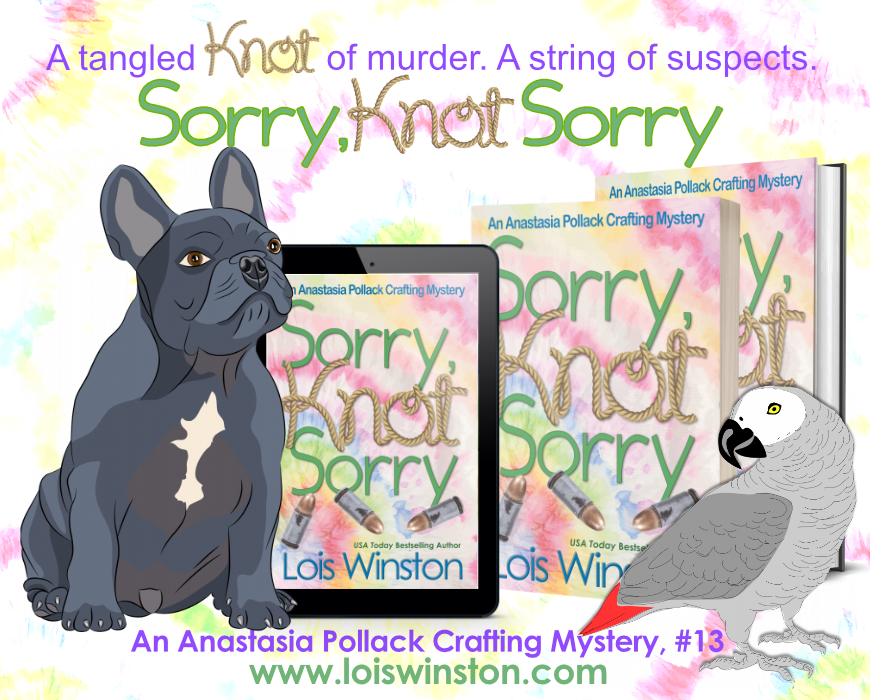
Today marks the release of Sorry, Knot Sorry, the thirteenth book in the Anastasia Pollack Crafting Mystery Series. Lucky number thirteen for my author, not so lucky number thirteen for me because once again, author Lois Winston has wreaked havoc in my life with yet another dead body. This one, gunned down in front of my house. Right after the guy left my house! So, it’s not like I can shrug my shoulders and say there was no connection between the two of us.

Lois is a news junkie who likes to draw on current and newsworthy events when developing the plots for the books in the series about me. In Sorry, Knot Sorry she weaves together such disparate topics as podcasts, artificial intelligence, and the current trend for all things mid-century modern, including a nod to tie-dye and macramé. After all, this is a crafting cozy series.


Speaking of artificial intelligence, did you hear about my author’s experiment, using me as a guinea pig? When AI hit the news full force several months ago, worry began to mount among authors. Would they all become obsolete in the not-too-distant future? Lois decided to ask Chat GPT to create a novel for the Anastasia Pollack Crafting Mysteries. She wanted to test just how intelligent this artificial intelligence is to see if her days as an author really were numbered.


Now keep in mind that you can find information about me, as well as the stories Lois has created about me, all over the Internet. A short synopsis of each book, along with the first chapter, are not only available on her website, but also on Amazon, Barnes & Noble, Kobo, iTunes, Books-a-Million, Audible, and countless other e-tailers. You’d think with all that available information, Chat GPT would scan the Internet cosmos and come up with something that bore some resemblance to me, my family, and the world Lois has created for us.


Think again! The results were so off base that they were laughable. The not-so-intelligent artificial intelligence transformed Ralph, my African Grey parrot into my uncle. My mother’s Persian cat, Catherine the Great, morphed into my employee. Instead of working as the crafts editor at a women’s magazine, AI made me the owner of a knitting shop. Worst of all? There was absolutely nothing funny in any of the pages that AI had generated. Lois writes humorous amateur sleuth mysteries. I get through all she dumps on me by relying on my sense of humor. But apparently, this new technology lacks a funny bone and is both incapable of seeing humor or generating it.


This has turned out to be a good news/bad news situation. Good news for Lois because she now feels she can rest easier, knowing her career won’t be usurped by a bunch of algorithms anytime soon. Bad news for me, though, because Lois is already plotting how she can wreak more havoc in the life of this reluctant amateur sleuth for Book Fourteen. And you can be sure, there will be more dead bodies.


Sorry, Knot Sorry

An Anastasia Pollack Crafting Mystery, Book 13


Magazine crafts editor Anastasia Pollack may finally be able to pay off the remaining debt she found herself saddled with when her duplicitous first husband dropped dead in a Las Vegas casino. But as Anastasia has discovered, nothing in her life is ever straightforward. Strings are always attached. Thanks to the success of an unauthorized true crime podcast, a television production company wants to option her life—warts and all—as a reluctant amateur sleuth. 


Is such exposure worth a clean financial slate? Anastasia isn’t sure, but at the same time, rumors are flying about layoffs at the office. Whether she wants national exposure or not, Anastasia may be forced to sign on the dotted line to keep from standing in the unemployment line. But the dead bodies keep coming, and they’re not in the script.


Craft tips included.


Buy Links

Amazon

Kobo

Nook

Apple Books

Tuesday, October 16, 2018

#FASHION--WHAT GOES AROUND COMES AROUND

Have you noticed that mid-century modern is “in”? On various HGTV shows, homebuyers are going gaga over mid-century modern. Lately, many popular TV shows and movies are set in the 1950’s and 1960’s. Recently I came across several shops that sell reproductions of fashions and home dec from the Eisenhower and Kennedy eras.

If you flip through an old family album from those years, you’ll probably see the women in wearing aprons. No matter the task—cooking, cleaning, washing dishes, hanging the laundry, gardening—mothers, grandmothers, and aunts attacked each household chore with an apron tied around their waists. As did Donna Reed, June Cleaver, Harriet Nelson, and Margaret Anderson, those quintessential television moms who came to call each evening back in the day. Aprons were a de rigueur part of a woman’s wardrobe, not to mention a standard “mom” gift for birthdays, Christmas, and Mother’s Day. Sometimes they were purchased; more often, they were handmade and embellished with embroidery, lace, smocking, or other handiwork.

Back then girls took Home Economics, and their first sewing project was often a gingham half apron. In colonial times girls mastered the alphabet and Bible sayings by embroidering samplers. In the last century they mastered the sewing machine and hand sewing in Home Ec classes.

Aprons are mentioned as far back as the Bible. In Genesis 3:7, Adam and Eve sewed fig leaves together to make themselves aprons. However, the apron didn’t become commonplace until the 13th century when blacksmiths donned leather aprons to protect themselves from the hot metals and sparks of the forge. Today, metal smiths and welders still wear aprons for protection, although they have replaced leather with more protective synthetic materials.

Eventually, more people began wearing aprons to protect both themselves and their clothing. Fishermen found that wool aprons not only kept them dry but kept their clothes free of fish smells. Aprons served multiple purposes for women who used them for both cleaning and as flexible gathering containers.

According to Joyce Cheney, the curator of the national exhibit, “Apron Strings: Ties to the Past,” at one time a person’s occupation could be discerned from the color and pattern of his apron. Gardeners, spinners, weavers, and garbage men wore blue aprons. Butlers wore green. Butchers wore blue stripes. Cobblers wore what was known as “black flag” aprons, which protected them from the black wax they used. English barbers wore checkered aprons and were known as “checkered apron men.” Stonemasons wore white. Today members of the Fraternal Order of Masons continue to don white aprons during Masonic ceremonies.

Although white was traditionally the color of aprons worn by house servants, upper class Victorian women also wore aprons. However, instead of the simple, utilitarian aprons of their maids, these Victorian ladies spent hours embellishing fine white linen with intricate embroidery and handmade lace and tatting. The aprons, often works of art in themselves, were worn, not for protection from the messiness of household tasks, but as a symbol of domestic pride and a showcase for their talents.
  
Prior to the Depression, most aprons were made of white cotton or linen. However, with the onset of the Depression, both materials and money became scarce. Women were forced to make do with whatever fabrics they could scrounge. Aprons, like quilts, were often made from feed and flour sacks or scraps of clothing. The use of these patterned fabrics heralded a turning point in the look of the apron. After the Depression, calicos became popular fabrics for aprons. By the 1940’s many aprons featured large floral print fabrics.

In the 1940’s and 1950’s women were often pictured wearing aprons in magazine advertisements and later on television commercials. The apron-clad housewife became the emblematic salesperson for everything from kitchen appliances to frozen foods. Most women had a kitchen drawer devoted to their apron collection, wearing different style aprons for different household chores. June Cleaver coordinated her aprons with her dresses and accessorized them with pearls and heels. Women embellished their aprons with rickrack, buttons, ribbons, beads, and lace, wearing tea and hostess aprons for entertaining. Aprons featuring printed pictures of popular tourist attractions became a standard souvenir item for women to purchase while on vacation.

In the early 1970’s, the hostess apron, complete with ruffles, had a brief period of popularity. Nowadays, however, most women only bother with an apron for a specific messy task, such as baking. Often, dad is the family member wearing an apron, donning a simple canvas one while flipping burgers at the grill. Today, however, aprons are mostly seen in restaurants on waiters and chefs.

Tuesday, October 22, 2013

DECORATING WITH JEANIE--GUEST DECORATOR MADISON NIGHT


Diane Vallere lives in a world where popcorn is a breakfast food and Doris Day movies are revered for their cultural significance. After over twenty years in the fashion industry, she now writes full time from her home in Los Angeles, California. She launched her own detective agency at ten years old and has maintained a passion for shoes, clues, and clothes ever since. Learn more about her and her books at her website and blog.

My name is Madison Night. I own my own mid-century modern interior decorating business in Lakewood, Texas. I didn’t arrive at my decorating education through college, but instead from a lifelong love of watching Doris Day movies. The sets of movies like Pillow Talk, That Touch of Mink, Lover Come Back, and The Thrill of it All provide ample inspiration and act as a kind of documentary for me when it comes to designing a room from that era.

But first: Here’s how I approach a new room design, which I think is a concept that would be successful across various decorating styles. I ask the owners to show me their absolute favorite item in the room. Sometimes it’s a lamp they bought at a yard sale. Sometimes it’s a painting. Sometimes it’s a cookie jar they inherited from a favorite family member. Most of the time it’s an oddball piece that seems not to fit. My job is to design a room around that piece, to look at what is already there and determine what fits and what doesn’t. (Side note: once, when a homicide detective mocked my job, I pointed out that what I do when designing a room is very similar to what he does when assessing clues--look at what is there, figure out what fits and what doesn’t. But that’s a story for another day.)

Using pictures from a room I designed for a client who write mysteries, I’ll show how her dining room came together.

We started with a lamp that she bought for $10 at a flea market.


Next, I suggested yellow walls, a classic color from the midcentury era, and a nice complement to the turquoise and white of the lamp.

I installed floating shelves from IKEA next to the lamp and added more mid-century knickknacks from the client’s collection, along with a whimsical painting by Los Angeles artist Josh Hickman.

 Since this is a dining room, we knew the table and chairs would constitute the major focus of the room. One wall was dissected with windows, so my focus became the remaining wall. I anchored the wall with a silly framed work of yarn art found at a flea market, and mirrored the floating shelf/knickknack display on the opposite side to create balance. The client invested in a Saarinen-style tulip table and chairs (in yellow to coordinate with the walls) and the room was complete.

 Mid-century design relies on concepts of minimalism and right angles, but also embraces color and whimsy. And even though this style is my specialty, I think there are a few takeaways here for you, regardless of your style:

1.             Identify your favorite item in a room and rebuild the room around that item.
2.             Don’t be afraid of paint.
3.             Decorating doesn’t have to be expensive to be effective, but it should show personality.
4.             Don’t ignore DIY and chain stores when it comes to things like storage or shelving. Home Depot, Lowes, Target, IKEA, and The Container Store are a few of my favorites.
5.             Flea markets are your friend.
6.             Fresh flowers are just good sense!

If you love mid-century design and Doris Day like I do, you’ll enjoy these resources: Atomic Ranch Magazine [http://www.atomic-ranch.com/], retro renovation [http://retrorenovation.com/], Discovering Doris [http://www.dorisdaytribute.com/blog/].

Next time you redecorate, remember to have fun!

That Touch of Ink
When mid-century modern interior decorator Madison Night receives a five thousand dollar bill in the mail, she knows it’s a message from her past. Doris Day movies help with inspiration for her business, but her favorite actress can’t help when Madison’s lover comes back. After finding a corpse at a local numismatist, she follows a circuit of rare dollars and common sense to expose a kidnapping plot, a counterfeit operation, and the true price of her independence.

Buy Links