Featuring guest authors; crafting tips and projects; recipes from food editor and sleuthing sidekick Cloris McWerther; and decorating, travel, fashion, health, beauty, and finance tips from the rest of the American Woman editors.

Note: This site uses Amazon affiliate links. As an Amazon Associate, I earn from qualifying purchases.
Showing posts with label quilting. Show all posts

Monday, September 13, 2021

#CRAFTS WITH ANASTASIA--DEBUT MYSTERY AUTHOR LIZ BOEGER ON HOW WRITING A MYSTERY IS LIKE BEING A CRAFTER

Crayola's box of 64, 1958. Notice the randomness of the
crayon placement. Still makes me twitch!
(Wikipedia-4 September 2021)
Today we welcome award-nominated debut mystery author Liz Boeger who writes the Moccasin Cove Mysteries. She describes them as mysteries with a cozy edge, a hint of Southern snark, and always a happy ending. Learn more about Liz and her books at her blog.

I don’t remember being a particularly crafty kid, nor was I a wannabee writer, despite reading most of the Nancy Drew series as a preteen. However, I can trace my concrete-sequential origins back to coloring in the lines and to sorting my box of 64 Crayolas into the proper order before I could even consider any doodling. I had the same issue with LEGO. 

Luckily, my artsy side emerged when I was in high school. I was drafted to spray-paint the school’s mascot on the football field before home games. Think of it as a flat mural on grass with thirty cans of spray paint. I still have a couple of watercolor trays from my art classes, both good as new 40+ years later. My artsy interests morphed from painting, to crafting dolls, and stitching needlework in my twenties and during the fraught young parenthood years. That’s also when I discovered the traditional mystery and series that kept me sane. 


In retrospect, I think my fabric and books fetishes may be genetic. My maternal grandmother was a single, city girl working in a bookstore before she become a farmer’s wife. During snowy midwestern winter evenings she honed her needlecraft and quilting skills, stitching lovely textiles for her children, and later for her fourteen grandchildren. I still have a few of her unfinished quilt tops and the log cabin quilt she made me for my eighteenth birthday. 

My early experimentation with cross stitch was probably inspired by her pillowcases. But the quilting eventually wiggled its way into my creative corner and by the time I was in my mid-forties, I had a full-blown addiction to fabric and freestyle quilting. I say freestyle, because I am not disciplined enough to perfectly match my corners or make my points pointy. 


I also took a happy detour into scrapbooking when the craze hit—what better way to enjoy the gazillion photos of our son and family outings. Many years past my son’s childhood, my current project is a collage quilt featuring a sea turtle I am planning for my future daughter-in-law. The planning stokes my creative muscle between writing stints.


So, what does all this chatter about my artsy-craftsy-quiltsy endeavors have to do with the publication of my first mystery? Crafting and quilting were largely self-taught, like my writing. The creative process gave me the courage and fortitude to experiment. Being a crafter requires risk, and planning, and thinking step by step from start to finish. Just like writing a mystery. The mental and emotional benefits of being a crafter are so tangible, that I’ve instilled some of these talents in my main character Ana Callahan. 


Ana is a veteran school principal who spent her entire career moving from one troubled school to another, attempting to turn their failures into success stories. She has a heart for children in impoverished communities, and luckily, her hard work has paid off. But in her demanding career, she’s never had time for relationships nor time to mend her broken heart. Her limited leisure time was devoted to quilting and the occasional dabbling in watercolors. Neither hobby takes up much space and is easily portable for her frequent interstate moves.


By the time she makes her way back home to Florida to turn around the troubled school of her childhood, she’s still single. Then, an interesting man captures her heart, just as she finds herself investigating a murder. But as any school principal will tell you, progress does not come easily. Ana is confident she can save the school but solving a murder and mending a broken heart are not in her skillset.


As an author I felt badly about layering on Ana’s troubles, but that is my job. So, I thought I’d soften the plot blows I’d inflicted by giving Ana time to build a scrapbook and take out her watercolors to ease her pain. In future books I am certain her quilting will emerge, probably with more skill than mine. Such is the stuff of fiction. I wish you happy crafting and hope you have a chance to get to know Ana and the kind folks of Moccasin Cove.


ChainLinked

A Moccasin Cove Mystery, Book 1


Principal Ana Callahan knows a thing or two about turning around troubled schools, but she can’t fix the grief constricting her own heart. Now she must do both…while solving a murder.


Ana Callahan’s life fell apart, so she went out to save the world, one failing school at a time. Fifteen years later she’s back home in Florida, working her magic on the floundering elementary school of her childhood. But Moccasin Cove is not the sunny, middle-class beach town she left behind. With one eye on her school rescue plan and the other on her exit plan, Ana gets to work and chalks up a few small victories. 


Her confidence falters when a school contractor is killed, and a friend is implicated in the murder. An ambitious journalist tries to link Ana’s tragic past to the crime, and a powerful charter school corporation seizes on the political chaos by threatening a takeover of Ana’s school. Adding “investigate murder” to her lengthy to-do list, Ana finds herself paired with the school district’s handsome new security chief. The disturbing secrets they uncover about her friend and the killer’s twisted motives force Ana to admit she has a lot to learn about murder


Buy Links

paperback 

ebook 

Tuesday, February 2, 2021

#CRAFTS WITH ANASTASIA--AUTHOR DIANNE ASCROFT'S PASSION FOR QUILTS MAKES ITS WAY INTO HER LATEST MYSTERY


Dianne Ascroft is a Canadian writer who has settled in rural Northern Ireland. She writes the Century Cottage Cozy Mysteries series and The Yankee Years WWII books. Learn more about Dianne and her books at her website.


Weaving My Passion into the Plot

Thanks for inviting me to talk to your readers today, Lois. I’m Dianne Ascroft and I write the Century Cottage Cozy Mysteries series. I really enjoyed researching and writing The Heritage Heist, the latest novel in the series. Part of the reason for that is that it feels like coming home whenever I step into the world of my character Lois Stone. An equally important impetus to write the book was having the chance to feature one of my favourite hobbies in the story. 


I’ve been a keen quilter for years. Most people are familiar with patchwork quilts like the ones on the cover of my book. These bedcoverings are made from small pieces of fabric, which are cut into various shapes and sewn together to create the design. But there are other types of quilts too. The quilt that is central to the plot of The Heritage Heist is a wholecloth quilt. 


Wholecloth quilts are a single plain colour, usually white, with intricate patterns handstitched into the fabric to produce the design. Today the top layer is made from one piece of fabric. Several strips of fabric sewn together were needed for early wholecloth quilts because the looms of the era were not wide enough to produce fabric of the required width to cover a double bed. 


Wholecloth quilting has existed in Europe for centuries. It was popularised in France during the early nineteenth century and became fashionable in Great Britain later in the same century. Three areas of Britain have strong traditions of this type of quilting: England’s North Country, Wales, and the Scottish Borders region.


Fenwater, the fictional Canadian town in my novel, was founded during the early 1800s by settlers who came from the Scottish Borders. So, when I learned about this area’s tradition of wholecloth quilting, I knew I had to work it into the plot of one of my books. It made perfect sense that settlers would bring their craft with them to the New World.


But let’s get back to the quilting style. Skilled needlework is required to create the designs in wholecloth quilts. There are up to twenty tiny stitches to the inch in the detailed, handstitched designs. It isn’t difficult to set a sewing machine’s stitch gauge to produce such tiny stitches, but try hand sewing a row of stitches that are even and small enough to fit into a single inch and you will see how exacting the work is. 


Each British region where the craft flourished has its own distinctive motifs for their designs. A “feathers and twisted rope” motif is favoured in England’s North Country while Wales is known for combining leaves and spirals.


In the Scottish Borders town Hawick, they favour a “broken heart and thistle” motif. In this design, the stitching never meets at the top of the heart to complete the shape. Often the focus of the design is a large central heart, surrounded by a repeated hearts and thistles motif. Scales or large daisies called “gowans” are stitched into the fabric between the motifs and along the border.


I modelled the antique quilt in The Heritage Heist on this design. My protagonist is wowed by the exquisite workmanship in the beautiful counterpane when she first sees it, and she keenly feels its loss when it’s stolen. She is even more perturbed when one of her friends becomes the prime suspect in the theft. 


We often associate patchwork quilts with North America’s past, but wholecloth quilting actually gained popularity in America before patchwork quilting. In the early nineteenth century wealthy women, who had the time to develop the high degree of needlework skills required, introduced wholecloth quilting to the New World. Many of the designs they stitched were floral or geometric patterns. They also stitched images of animals, ships and even people into their bedcoverings. By the middle of the nineteenth century, less affluent women were also making these quilts. The earliest Amish quilts were wholecloth in a variety of solid colours. Patchwork quilts made from blocks didn’t become popular in America until the 1840s.


I’m so glad that I stumbled onto a reference to wholecloth quilting while researching and preparing to write The Heritage Heist. I loved delving into the history of the craft and relished the opportunity to weave a wholecloth quilt into the plot of this novel. 


The Heritage Heist

A Century Cottage Cozy Mystery, Book 2


A fall fair, a cornered craftsman, an heirloom heist. 


When an antique quilt that is a cherished part of Fenwater’s past disappears from the market before her town’s fall fair, it’s up to Lois Stone to resolve the quilt quandary. Preserving the town's heritage and her friend's reputation are at stake.

Buy Links

paperback 

ebook 

Sunday, January 10, 2021

#CRAFTS WITH ANASTASIA--MYSTERY SUPER FAN DRU ANN LOVE COMPARES CRAFTING A QUILT TO CRAFTING A MYSTERY

Dru Ann Love is the creator/founder of dru’s book musings where the “day in the life” and “get to know you” segments are prominently featured. She is a 2017 Mystery Writers of America Raven Award recipient and a two-time Anthony Award finalist. Dru Ann is a member of Mystery Writers of America, Sisters in Crime, and a reporting monitor for the Sister in Crime National Monitoring Project. Dru Ann will be the Malice Domestic Fan Guest of Honor for 2021. Check out Dru's book musings at drusbookmusing.com.


I’ve always been a reader and my love for books keeps me entertained. I was not a crafter. I remember home economics in school where we sewed the obligatory apron and bib dress with patch pocket. I knew how to darn socks, stitch a hem or two. But in 2003, the year I was downsized from my job, I decided to take one of the quilting classes that was offered at the community college. 
The art of picking out fabric within a color scheme and creating a quilt was so magical. It’s all the pieces and the story you create that reminded me of a cozy mystery, where we are introduced to characters, a murder happens, and the goal is to find the killer, which aligned with quilt making. Pick your fabric, design your pattern, and the result is a quilt that is to be treasured, just like a cozy mystery brings satisfaction when the killer’s identity is revealed, and justice prevailed.


My first quilt (see photo above) was a sampler using four different quilt blocks and it was 100% hand stitched. From that first experience, I can now create centerpieces, table runners, pillows, bed scarf to name a few. Click here to see sample of my quilt projects. However, my quilts are now 100% machine stitched because carpal and cubital tunnel affected my hand dexterity, but that did not stop my love of creating quilts. In fact, now that we are dealing with a certain crisis that will be nameless, I’ve made more quilts in the past six months than I did in the last two years. 

Quilting and reading cozies is relaxing, engaging, and entertaining, both spurring the creative juices whether to create a design pattern or solving the puzzling cases in the stories.

When you begin to write your story, you have a beginning, you may have the middle and you may have the end. That’s how it is with quilting. You have the fabric pieces, you may have a design, but by the time you start cutting the pieces, that middle section changes and as a result the end that you didn’t have in mind, makes itself know when the last piece of the process is binding the quilt with a satisfied smile on your face because you are done. Just like when you type “end” on your story.

Sunday, August 23, 2020

#CRAFTS WITH ANASTASIA--AUTHOR GINI ATHEY COMBINES A PASSION FOR #QUILTING WITH A PASSION FOR WRITING

Gini Athey is the award-winning author of the small-town women’s fiction series, The Shops on Wolf Creek Square, which includes Quilts Galore. The Quilt Company is the first in her new Briarwood Series. She quilts, gardens, writes, reads, and lives with her husband in a rural area west of Green Bay, Wisconsin. Learn more about Gini and her books at her website

Write What You Know
Over the course of my life, I’ve delved into a variety of hobbies, pastimes, and occupations. I like to be busy, and I enjoy the challenging of mastering a new skill. After selling the small business I owned in 2004, I found myself with time to explore a new challenge—writing a novel.

According to one survey reported by The New York Times, 81 percent of Americans want to write a book. I was one of those people. But as I ventured into the publishing community, I discovered there is a huge difference between wanting to write a book and actually writing one.

Before I could begin putting the words on the page, I had to answer several questions to define my story.

·      What would the story be about? 
·      Where would it be set? 
·      What themes would it include? 
·      Who would the primary protagonist(s) be?

Some of the questions were easier to answer than others, but then I considered the sage advice often given to aspiring authors: Write what you know.

Initially, that raised more questions than it answered.

·      What did I know?
·      What did I know that would intrigue and engage readers?
·      What did I know that lent itself to the stories itching to spill from my fingertips onto the page?

I spent many hours pondering what I know and eventually came up with a list. 

Quilting and crafts. I inherited my love of quilting, both making them and admiring them, from my grandmother. As a young girl, I spent hours and hours with her, carefully cutting fabric into blocks and assembling them into a quilt which very often became a cherished family heirloom.

Independent women entrepreneurs. For several years, I owned and operated a full-time business that distributed original designs for professional quilters. This company was a labor of love, yet my ambition motivated me to make it profitable and successful. I later went on to sell the company to another individual who shared my love of quilting.

Home and hearth. It’s exciting to visit the big city, but at heart, I’m a small-town girl. I like the slower pace of life in small towns, being surrounded by friends and family, and the sense of community that binds people together. Many of my stories include journeys home, finding home, or creating a home through shared values and experiences.

Nine books later, these elements still define the stories I write. If any of these themes resonant with you, I hope you’ll check out my books.

The Quilt Company
The Briarwood Series, Book 1

A big loss could tear a family apart, but does a big dream have the power to reunite them? 

Deanna Westford may have lost her husband, but she’s determined not to lose her big dream along with him. A quilter with a flair for design, Deanna will do whatever it takes to transform her passion for quilting into a thriving business. She finds the perfect studio-condo location in a renovated factory building repurposed for businesses just like hers. Even better, she knows and trusts the builder, Paul Silverman. Paul is acquainted with loss himself, but that doesn’t stop him from becoming a generous friend and confidant for Deanna. 

With three children in their twenties and on their own, Deanna assumes she can organize her life to please herself. She happily embraces the long hours it will take to establish her business. along with newfound friendships. But her best-laid plans don’t leave room for her kids’ complicated crises, which bring extra demands just when her company needs her the most. 

Deanna—and her children—soon discover that disasters sometimes offer great opportunities. Deanna must waste no time deciding what she’s willing to risk.

Buy Links

Sunday, November 18, 2018

#CRAFTS WITH ANASTASIA--AUTHOR VICKI BATMAN AND NECKTIE QUILTS

Award-winning and bestselling author Vicki Batman recently stopped by to share her grandmother's recipe for fruitcake made with tomato soup. Today she’s here to talk about the quilts made from her husband’s tie collection.

Vicki has written numerous romantic comedies and two humorous romantic mysteries. She describes herself as an avid Jazzerciser, handbag lover, Mahjong player, Yoga practitioner, movie fan, book devourer, chocaholic, and Best Mom ever. Most days begin with her hands set to the keyboard and thinking, "What if?" Learn more about her and her stories at her website/blog. 

A lot of you know I call my husband Handsome. When we first married, he gave me a card signed with Handsome Husband. I shortened it. (And Handsome is a pretty nice looking guy.)

I grew up when working men wore suits to their job and to church, to shows, etc. I like the look. Handsome’s career began at a large accounting firm and he wore the “uniform”, too. He especially liked ties and for a long time, never threw any away.

An employee at his company makes quilts. After a chat, he decided to have some of his ties made into a quilt. (featured above)

He had her put on the back his philosophy about ties: 
 
The good news is he culled through his ties again and had a second quilt made,
 and a third. 

Creativity abounds in the holiday anthology, the Whispers of Winter, featuring my romantic comedy short story, “The Great Fruitcake Bake-off”. 

The Great Fruitcake Bake-off
When five-time champion Samantha Greene teams up with her new neighbor, Dixon Roberts, for The Great Fruitcake Bake-off, they discover baking a prize-winning entry is complicated, bad guys are plotting to take the crown, and first prize isn't just about a ribbon.

Other authors in the Whispers of Winter anthology are: Nicole Morgan, Stephanie Morris, Caitlyn Lynch, Maya Bailey, Krista Ames, Sharon Coady, Donna R. Mercer, Jan Springer, Carma Haley Shoemaker, Livia Quinn, Amber Skyze, Rebecca Fairfax, Jane Blythe, Suzanne Jenkins, Stacy Eaton, Rene Webb, Marie Mason, Joann Baker & Patricia Mason, Karen Cino

Thursday, December 21, 2017

BOOK CLUB FRIDAY--GUEST AUTHOR PAT STOLTEY

Pat (Patricia) Stoltey is the author of four novels. She lives in Northern Colorado with her husband Bill, Sassy Dog, and Katie Cat. Learn more about Pat at her website/blog.

Wishing Caswell Dead is Not a Cozy
The characters in my new novel are about as un-cozy a bunch as you’d ever want to meet. Or not want to meet, to be more precise.

I created a little fictitious village called Sangamon that sits on a river in east central Illinois in 1833-1834. Young Jo Mae Proud lives there in a run-down log cabin with a down-on-her-luck mother and much-older half-brother Caswell. I gave Jo Mae a monumental challenge, then surrounded her with flawed, not-so-nice adults. Bad things happen to Jo Mae along the way. The worst character in the book, Caswell, is murdered. But we know there’s always good to be found, even when evil seems to rule the times. Jo Mae finds the good in the old Kickapoo Indian named Fish and escapes Sangamon in search of a better life.

Bringing a story like this to Killer Crafts & Crafty Killers might seem odd, but during my research, I found mention of so many early American crafts. The big loom that appears in one home in the story is something I saw in a museum.

Jo Mae’s home had not so much as a needle or even a bar of soap, and her best dress was fashioned from a printed feed sack. How many of you are even old enough to remember what those old feed sacks printed with tiny flowers looked like?

No fancy cooking went on in the Proud household. Boiling a small piece of meat or fish with vegetables was the best Jo Mae’s mother could do. When Jo Mae goes to live with the old Kickapoo Indian in his camp by the river, she learns a little more about eating good food. She also learns not to throw a handful of dried apples into the stew. The apples were windfalls…and they were wormy. Once tossed into the cookpot, the worms floated to the top, a very unappetizing sight.

Drying foods is a good way to preserve an overabundance of fruits or vegetables in today’s world, too. I’d recommend not using wormy apples. Slice them very thin (as with a mandolin, if you dare), and dry them in your oven. There are directions online for the process as well as recipes for using the dried fruits.

When researching this type of information for Wishing Caswell Dead, I visited the Museum of the Grand Prairie in Mahomet, Illinois. There was a wealth of information, including hand-quilted goods and needlework, tools, machines, and items used in homes and for cooking. I was most interested in quilting, something I’d like to try for myself one of these days.

I have an antique quilt that I’m afraid to display for fear it will be damaged in some way, especially as I have a cat with claws and a dog who loves to cuddle into cozy blankets. At present, I take the quilt out from time to time and refold or roll it to avoid permanent creases. The quilt came from Illinois originally and its age was authenticated by the Illinois State Museum. It’s not quite as old as the quilts that characters in the Village of Sangamon would use, but it’s certainly representative of the style and design of those times.

I’d love to know if any of you are expert quilters, and if you quilt by hand or by sewing machine. Any weavers with a loom at home? What about cooks who dry fruits and veggies for use later?

I won’t pretend Wishing Caswell Dead is full of killer crafts, but that historical period offers excellent ideas for today’s crafty reader looking for new projects…or for the crafty cozy writer looking for new plots and characters.  

Wishing Caswell Dead:
In the early 1800s in a village on the Illinois frontier, young Jo Mae Proud wishes her cruel brother dead. Forced into prostitution by Caswell, Jo Mae discovers she is pregnant and vows to escape. When Caswell is injured by a near lightning hit, he becomes more dangerous, and more hated. The flawed residents of the Village of Sangamon harbor many secrets. Caswell knows them all. Will he tell? Jo Mae runs away and eventually finds shelter with Fish, the old Kickapoo Indian who camps by the river. Wishing Caswell Dead is an historical mystery about the evil that hides within a village, one girl who is determined to save herself and her child, and a violent murder no one wants to solve.

Buy Links

Sunday, April 17, 2016

#CRAFTS WITH ANASTASIA--GUEST AUTHOR AND QUILTER MARISSA DOYLE

Marissa Doyle got distracted on her way to becoming an archeologist. But she’s put her passion for history into writing historical fantasy for teens and adult...just don’t ask her where the fantasy elements come from. Learn more about her books at her website/blog and at her teen history blog.

I'm a writer. I'm also a crafter who loves anything to do with fabric: I sew (both clothes and home decor), upholster, do fabric decoupage, and most of all, quilt. My "office" (okay, the guest bedroom, but thank heavens all my family lives only about an hour away or I'd be in deep doo-doo) is divided more or less in half: one part has my desk, computer, filing cabinets, and bookcases full of reference materials. The other half has my sewing machine, cutting table, ironing board, design wall, and the large bins containing my fabric stash.

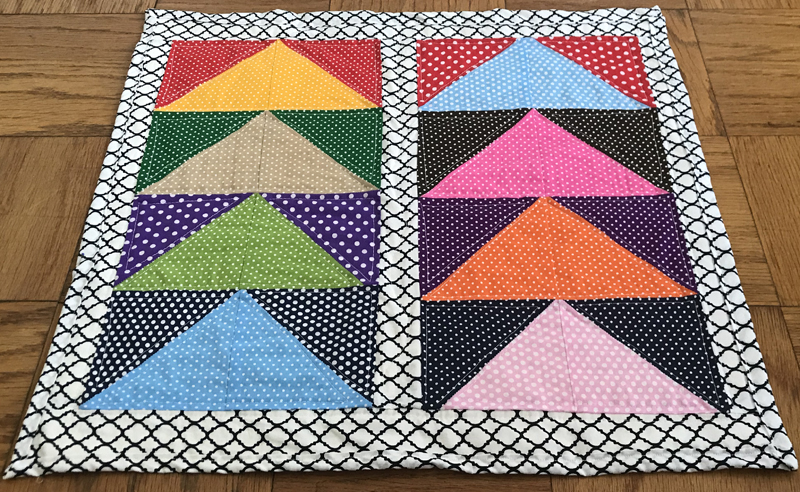
It works out pretty well: if I get stuck while writing and need to think about a plot point or a character's reaction to an event, I can just get up from my desk, go over to my sewing machine, and chain-piece some half-square triangles for my current quilting project to give my brain a chance to work on the problem without really thinking about it. When I have it figured out, I go back to my desk. Win-win situation!

I like to joke that of my two passions, writing wins because it doesn't leave threads all over the carpet. And yes, it's pretty funny that one side of my office has a nice clean rug and the other side is generally less so. But then one day, the two halves blurred together. I got an idea for a novel in which quilting played a major role.

And because a little fantasy or magic creeps into everything I write, I wasn't just going to write about plain old quilts--no, mine were going to contain magic, unwittingly pieced into them by my heroine who has no idea she is doing so...until one of her quilts traps the evil entity terrorizing her small Cape Cod town and saves the selkie she’s lost her heart to. Several types of quilts make an appearance in Skin Deep, but I knew the most important quilt in the book would have to be my favorite design, Storm at Sea.
Storm at Sea basic quilt pattern
A Storm at Sea Block is made up of squares and rectangles set in such a way as to give an illusion of curves without actually including any curved seams, which can be tricky to get right. The resulting quilt has a strong sense of motion, almost like the surface of a restless sea. From what I’ve been able to find, it’s not all that old a block design—probably early 1900s—but it has inspired some breathtakingly beautiful quilts. It’s also a very versatile block: playing with the color arrangement in the blocks can lead to very different looking quilts.

Plug “Storm at Sea Quilt” into Google Images or Pinterest and see what turns up: it’s pure eye candy. Feeling inspired? I’ve got three Storm at Sea patterns for downloading on my website; get out your markers and colored pencils and see what you can do...or what quilt magic you can create. As for me...like my heroine in Skin Deep, Garland, I have more than one stash box of blue fabrics because I can’t resist blue...and one of these days, I’ll be bouncing over to do some piecing on a Storm at Sea quilt while I work on my next book.

Skin Deep
After a painful divorce, Garland Durrell looks forward to settling into her home on Cape Cod to make the quilts that are her passion. On the first morning of her new life she finds a man and a small boy washed up on the beach, both badly wounded. Since the town chief of police is strangely reluctant to help, Garland takes on the care of the mysterious pair who don't seem to remember what happened to them--and feels her own heart begin to heal.

Alasdair does remember. He and his son Conn are the last of the ruling family of selkies from the waters around the Cape, locked in a decades-long struggle with an evil that threatens all, selkie and human. He’s not sure if he can trust the lovely, blue-eyed woman who takes them in until he touches one of her quilts and feels the magic she’s sewn into it...and the emotions that he never thought he’d feel again.

But the evil entity that stole Alasdair’s sealskin and left him for dead quickly senses both his presence and Garland’s magic, and is determined to destroy one and possess the other. Only Garland and her quilts, made with a power she barely believes she has, can save them all from destruction—if she can avoid being destroyed first.