Featuring guest authors; crafting tips and projects; recipes from food editor and sleuthing sidekick Cloris McWerther; and decorating, travel, fashion, health, beauty, and finance tips from the rest of the American Woman editors.

Note: This site uses Amazon affiliate links. As an Amazon Associate, I earn from qualifying purchases.
Showing posts with label Eric Mayer. Show all posts

Friday, April 15, 2022

#COOKING WITH CLORIS--HISTORICAL AUTHORS MARY REED AND ERIC MAYER ON BYZANTINE MYSTERY AND FOOD

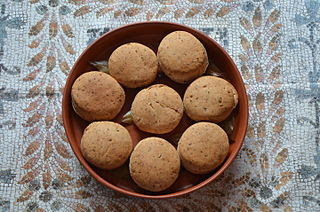
Peppered honey cakes photo from Wikimedia Commons
by Carole Raddato, Frankfurt, Germany
Mary Reed and Eric Mayer's Byzantine mystery series relates the investigations of John, Lord Chamberlain to Emperor Justinian. They also write the Grace Baxter series set in WWII England. Learn more about Mary and Eric at their website and blog.

Adventures in Ancient Roman Cuisine

In our Byzantine mystery Six for Gold self-proclaimed epicure Francio nurses an ambition of recreating Trimalchio's Feast, which according to Petronius' Satyricon featured such gustatory delights as dormice sprinkled with honey and poppy-seeds and a wild boar from which thrushes flew out as it was carved.


Francio's project is unavoidably delayed, however, given plague is currently ravaging Constantinople and food is scarce, so two dinner guests are served a bitter salad composed of weeds, followed by the grandly titled Harbour Chicken in Poseidon’s Special Sauce. Which turns out to be boiled seagull in garum sauce (a fermented fish concoction often compared to modern anchovy sauce). Food may be short but Francio's invention is long, given a later meal he hosts features an offering he terms The Wreck of the Ark, describing its ingredients as "a rather mature octopus, a couple of fig-peckers, and an under-nourished partridge"--  not to mention a weasel caught in his garden.


As biographers of John, Lord Chamberlain to Emperor Justinian, we are aware that although responsible for organising complicated imperial banquets, he would just as soon have less elaborate dishes than those offered at Justinian and Theodora's jamborees. His meals at home therefore are simple. He likes hard-boiled eggs, bread, olives, cheese, and fish, especially grilled swordfish. If pressed. he'd admit to a liking for honey cakes. Whatever is on his plate, however, it will be washed down with what his friends habitually deride as ghastly Egyptian wine, a fondness for which he developed during his time in that country.


Researching food for the upper crust (no pun intended) led us to a modern translation of Apicius' first century recipe collection On the Subject of Cooking. The work offers all manner of recipes both rich and plain, and with John's tastes in mind, I'll mention a few of its more homely dishes.


It has been observed fine words butter no parsnips. Apicius provides a recipe for boiled parsnips, the recipe for which directs taking "celery seed, rue, honey, ground pepper, mixed with raisin wine, stock and a little oil; bind this with roux [bring to a boiling point, immerse parsnips] sprinkle with pepper and serve."


Then there's a sweeter Roman equivalent to today's French toast, made by soaking large pieces of crustless "fine white bread" in milk and beaten eggs, frying the pieces, and serving after covering them with honey


Discerning diners doubtless insisted on Lucanian sausages, historically renowned as best in class and still popular today. The instructions are to "crush pepper, cumin, savory, rue, parsley, condiment, laurel berries and broth; mix with finely chopped [fresh pork] and pound well with broth. To this mixture, being rich, add whole pepper and nuts." The recipe concludes by advising carefully filling casing before hanging the sausages up to smoke.


Although the amounts of ingredients are never mentioned, some recipes tending to the exotic are simple enough to make. Consider sea urchins, still popular fare in certain countries. Trimalchio's feast included quinces sporting artificial spines to mimic sea-urchins but Apicius addresses the real  type, advising cooks to put them "singly in boiling water, cook, retire, and place on a platter."


A more extravagant dish caught my eye:  ostrich boiled in a stock composed of "pepper, mint, cumin, leeks, celery seed, dates, honey, vinegar, raisin wine, broth, and a little oil", the liquid to be strained when the bird is done and thickened with roux before adding cut-up ostrich meat to it and sprinkling the concoction with pepper.


I cannot close without mentioning a culinary tip likely familiar to John's elderly cook Peter when he plans to make a batch of honey cakes for his master. "To make honey cakes that will keep take what the Greeks call yeast and mix it with the flour and the honey at the time when making the cooky dough." Oddly enough, although honey frequently appears as an ingredient, no recipe for making honey cakes is given in Apicius' work. Perhaps Peter invented his own.


Profusely illustrated and footnoted, the modern translation of Epicius' work is titled Cooking and Dining in Imperial Rome. It's fascinating reading. Find it at https://www.gutenberg.org/files/29728/29728-h/29728-h.htm

Six for Gold

A John the Eunuch Mystery, Book 


Why are sheep in the remote Egyptian village of Mehenopolis cutting their own throats? That's the mystery Emperor Justinian inexplicably sends John, his Lord Chamberlain, to Egypt to solve. Mehenopolis is a pilgrim destination, thanks to its ancient shrine to a snake deity.


Among the characters John encounters are a pretentious local landowner battling a self-styled magician for control of the lucrative shrine, an exiled heretical cleric, an itinerant beekeeper, and a disgraced charioteer. Will John uncover what is really happening to these sheep? Are these slayings somehow linked to the murder charge of which John has frantically tried to clear himself?


Buy Links

hardcover 

paperback 

ebook 

Tuesday, June 9, 2020

HISTORICAL MYSTERY AUTHORS MARY REED AND ERIC MAYER PRESENT A TIMELY TOPIC

Mary Reed and Eric Mayer co-author not only the Lord Chamberlain Byantine series but also the Grace Baxter mysteries, set in WWII Newcastle-on-Tyne, England. Today they’re here to talk about a topic in Five For Silver, the fifth book in the Lord Chamberlain series, that’s quite topical right now. Learn more about Mary and Eric and their books at their website and blog. 

A Circumstance Such as has Never Before Been Recorded  
Every now and then pandemics sweep all before them and the lives of those who survive are changed forever in more ways than one, as we shall again doubtless see once the current emergency has passed into history.

Five For Silver, a John, Lord Chamberlain, mystery, which received a stared review from Publishers Weekly, has become timely in a most uncomfortable way. Set during the Justinianaic pandemic, it features the most noir opening sequence of any novel in the series, given it describes a character clawing his way out from a mass burial. Since the plague's illness and its effects form an important part of the structure of the plot, we put on our research hats and went looking for the necessary information.

Of the bubonic persuasion, the plague appears to have originated in Egypt, spreading swiftly across the Roman Empire and beyond and arriving in Constantinople in the spring of 542. Fortunately the historical record provided us with many useful details. In his Ecclesiastical History Evagrius Scholasticus termed the plague as "a circumstance such as has never before been recorded". His description of the course of the disease is harrowing and graphic. Some experienced hallucinations before other symptoms appeared. Signs of infection included swollen faces, affectations of the throat, fever, delirium, and buboes. Death usually followed in two or three days, although Evagrius records some patients recovered once or even twice, only to succumb to a third attack.

He also described what he dubbed the various and unaccountable ways the plague could be contracted: by touching or living with infected persons, entering a sickroom, or by "frequenting public places", a stark reminder of shelter-in-place orders as I write. On the other hand, despite exposure to it, some did not succumb to the disease, including those who, in despair after having lost those they loved, attempted to catch it but to no avail.

In his Secret History, contemporary historian Procopius mentions Justinian was infected but recovered, giving further information about general conditions in Constantinople during that time in his History of the Wars. He mentions similar symptoms as those cited by Evagrius. The number of deaths was so great in the city the rising number of cases finally made it impossible to keep up with burying the dead, and with existing tombs full and mass graves overflowing, states burial parties "mounted the towers of the fortifications in Sycae [Galata], and tearing off the roofs threw the bodies there in complete disorder; and they piled them up just as each one happened to fall, and filled practically all the towers with corpses, and then covered them again with their roofs."

It is within the unthinkable darkness of one such terrible tower that Five For Silver opens.

Five For Silver
John, the Lord Chamberlain, Mystery, Book 5

In 542, Peter, John the Lord Chamberlain's elderly servant, claims a heavenly visitor revealed a murder to him. It transpires that Peter's old army friend has indeed been stabbed, but then John discovers that Gregory was not what he appeared to be. As the plague ravages Constantinople, John's quest for the truth leads him to churchmen and whores, lawyers and bear trainers. Suspects include a dealer in dubious antiquities, a resourceful bookseller, a court poet fixated on bereavement, and a holy fool who outrages the city by dancing with the dead and invading the empress' private bath....

Buy Links

Tuesday, July 2, 2019

MARY REED AND ERIC MAYER DIG INTO THE PAST FOR THEIR BYZANTINE MYSTERY SERIES

Mary Reed and Eric Mayer co-write the John, Lord Chamberlain, Byzantine mystery series set mainly in and around the court of Justinian and Theodora. Under the transparent pen name of Eric Reed, they also co-author of the Grace Baxter novels, set in WWII England. An Empire For Ravens was awarded a starred review by PW. Learn more about Mary and Eric and their books at their website.

The Eyes Have It

Where do writers find plot ideas?

I've found it fruitful to sneak up on those elusive little devils by not consciously seeking them. If asked, my advice would be to read fiercely and widely for pleasure or for news, for you never know what in your reading matter will strike that vital spark. Indeed, we have found ideas all over the landscape while reading something interesting in and of itself and suddenly a sentence or two on the page caused inspiration to flower.

In the short mystery stories department three examples spring to mind. Inspector Dorj's second case was triggered by a newspaper report in the 1990s concerning the large crowd turning out to greet Hong Kong fishermen returning to port with an alleged mermaid aboard. We were never able to find out anything further about it so we don't know the end of the story -- infuriating, isn't it? But we could write a short story and thus was “The Ladyfish Mystery” born.

Dorj's next case was Death on the Trans-Mongolian Railway, his investigation into the demise of a wealthy businessman on the titular train. An enclosed location mystery (a favourite sub-genre at Maywrite Towers) it is another story based on an idea suggested by a newspaper report. This time the article was about a dangerous situation developing on a train, caused by -- well, better not say what or readers won't be surprised when “All Is Revealed”. And yes, its title is also a nod to the Agatha Christie classic mystery.

Then there's “Or Equivalent Experience”, which sprang from an oddly worded help ad spotted in the St. Louis paper some years ago. The advertisement was an appeal for psychics to appear at a psychic faire, requiring applicants to have either genuine ability in that line "or equivalent experience". The story was written tongue in cheek but employed dark underpinnings. I confess it's a favourite, not least because the person to whom I read that very advertisement is long gone but given her robust sense of humour, I know she would get such a kick out of it.

But it's not only the written word. The arts have also contributed ideas for our short fiction. Even Kings Die was directly inspired by a vignette depicted in the border of the Bayeaux Tapestry plus the death and burial of William the Conqueror as related in the Historia Ecclesiastica. There is also “Aunt Ba's Story”, a semi-supernatural solo effort written before Eric and I met. It was based on Arthur Hughes' poignant painting Home From Sea and a dream about a grey-eyed man.

We once had the honour of sharing a book signing with Ed Hoch, the master of short story writing, and at one point, after looking around the bookstore, he proposed several plot ideas sparked by what he saw -- in less than the same number of minutes. So all in all, a good motto for the seeker of plot ideas might well be "the eyes have it".

An Empire For Ravens
A John, the Lord Chamberlain Mystery, Book 12

Emperor Justinian's former Lord Chamberlain John puts loyalty to a friend above his own safety, defying imperial edict by leaving his exile in Greece for Rome. He is ambushed, driving him deep into ancient catacombs before he exits into the heart of the city. Arrested and brought before Diogenes, the general in charge of the defense of Rome, John learns Felix is missing and this and other mysteries must be solved before Diogenes' courier to Justinian can return and prompt John's immediate execution.

Buy Links

Thursday, October 11, 2018

BOOK CLUB FRIDAY--AN INTERVIEW WITH MARY REED AND ERIC MAYER'S JOHN, LORD CHAMBERLAIN

Today we sit down for a chat with John of the John, Lord Chamberlain, Byzantine Mystery series by Mary Reed and Eric Mayer.

What was your life like before your author started pulling your strings?
A quiet one! After I left the life of a mercenary I expected to begin farming in a rural area of Greece, but then I fell in with a troupe of peripatetic performers whose main act was a recreation of bull dancing. I never anticipated visiting Constantinople, much less achieving the high office I eventually occupied.

What’s the one trait you like most about yourself?
I am loyal. It was this that led to my leaving exile in Greece to go to Rome to help Felix, an old friend and newly minted general, who asked me for assistance with a pressing but unspecified difficulty. We both knew leaving exile without Emperor Justinian's permission was likely to lead to my execution, but still I had to go to Felix's aid. He would have done the same for me.

What do you like least about yourself?
Although I control it better now, I have not yet completely conquered the black rage I feel over emasculation and being sold as a slave.

What is the strangest thing your author has had you do or had happen to you?
Among many strange events my authors introduced into my life, events that spring to mind was when they sent myself, my wife Cornelia, and an elderly servant who invited himself along to Egypt to investigate why sheep were committing suicide. At one point this led to my reluctantly taking part in a street performance presenting a glimpse of the life of Empress Theodora, not to mention making the acquaintance of a purveyor of faux cat mummies who bred his own material and a second remarkable individual, a diminutive magician. A complete fraud, the latter's act brought him to Constantinople to perform for the imperial couple. Despite his impudent patter and snake fitted with an obviously counterfeit human head act he kept his own head. My authors chronicled our adventures in Six For Gold.

Do you argue with your authors? If so, what do you argue about?
My authors have no time to argue with me because they argue with each other!

What is your greatest fear?
That my Cornelia will die and I must live on alone.

What makes you happy?
Sitting with her in the ruins of a temple on the edge of my estate overlooking the sea.

If you could rewrite a part of your story, what would it be? Why?
I would be a free man living on a small estate in Greece. It was after my enslavement and subsequent freedom I began my journey to holding the office of Lord Chamberlain. Incidentally, I first met Felix while I was still a slave. We were ordered by Emperor Justinian to investigate a particularly delicate matter involving a murder in broad daylight in the Great Church in Constantinople. My authors chronicled that adventure in Four For A Boy.

Of the other characters in your book, which one bugs you the most? Why?
Clementia, Felix's latest mistress. She continually demonstrates she thinks I am willing to replace him in her affections and further, I have come to believe, she is not always to be trusted to tell the truth, which is vital in any investigation.

Of the other characters in your book, which one would you love to trade places with? Why?
If it were possible, I would drop a few decades and trade places with Viteric, the young soldier escorting me around Rome. At the same time, as was naturally to be expected in the circumstances, he is keeping an eye on what I was doing and reporting back to Diogenes, the general in charge of the city garrison. I would describe Viteric as a good fighter, brave, intelligent, observant, quick-acting, in short the sort of man worth his weight in gold in a battle.

Tell us a little something about your authors. Where can readers find her website/blog?
My authors have been writing about my life for some years now. An Empire For Ravens is the latest installment, and will appear in October from Poisoned Pen Press. Their website may be viewed here  and their blog, largely devoted to reviews of Golden Age novels, here.

What's next for you?
I was hoping for a less eventful life, but it appears this is not likely, given my authors are hinting at further eventful times, so I suppose I shall find out what they have in store for me when everyone else does!

An Empire For Ravens
Emperor Justinian's former Lord Chamberlain John receives a letter from his longtime comrade Felix asking for help, and, placing loyalty to a friend above his own safety, risks defying imperial edict by leaving his exile in Greece for Italy, where Felix is serving under General Diogenes in fighting for Rome against the besieging Goths.

John's covert entrance into Rome is ambushed, driving him deep into ancient catacombs before he exits into the heart of the city. Arrested, John learns that Felix is missing. Sent to lodge at Felix's quarters, John finds the household in disarray, evidence that Felix has taken a questionable lover and run up his usual debts, not to mention someone is rifling supplies. Then a young woman servant, also missing, is found dead. John has many mysteries to solve before Diogenes' courier to Justinian can return and prompt John's immediate execution.

Buy Links

Thursday, August 10, 2017

BOOK CLUB FRIDAY--GUEST AUTHOR ERIC REED

Eric Reed is the pen name of the historical mystery team of Mary Reed and Eric Mayer. Their Grace Baxter World War II series is set in rural Shropshire, and their Lord Chamberlain series is set in and around the sixth century court of Emperor Justinian I in Constantinople. They also write as M.E. Mayer for the British editions of their Lord Chamberlain series. Today they sit down with us for an interview. Learn more about Mary and Eric at their website and blog.            

When did you realize you wanted to write novels?
It was not a sit down and consider the idea decision. Rather the notion crept up on us gradually. Our original co-written fiction was in the form of short stories with various protagonists, and after several featuring John were published, it suddenly occurred to us it might be an idea to write a full-length adventure about him. So we did and the result was One For Sorrow, the first entry in the Lord Chamberlain series.

How long did it take you to realize your dream of publication?
Not long, as far as novels go. We sold One For Sorrow to Poisoned Pen Press within a year of finishing it. We were very, very lucky. On the other hand we had both spent a lifetime writing, and selling, first nonfiction of various sorts and then short fiction. So we weren't exactly overnight successes or child prodigies.

Are you traditionally published, indie published, or a hybrid author?
Traditionally.

Where do you write?
In an upstairs room we share as an office and general living quarters. Fortunately we get along quite well despite the cramped space. Also the knives are all downstairs in the kitchen.

Is silence golden, or do you need music to write by? What kind?
We usually don't listen to music when writing fiction. For his part Eric has a hard time pushing music into the background. It engages his attention and takes his mind off the writing. However, we often play music when we're researching, or tossing ideas around, or jotting down ideas. We listen to just about everything but grand opera and rap, unless you consider Twenty-One Pilots rap. So one day it might be Frederick Delius, the next Lady Gaga or Phil Ochs. Lately we've been
playing brand new albums from Blondie and former members of the Kinks Ray and Dave Davies.

How much of your plots and characters are drawn from real life? From your life in particular?
Ruined Stones is set in an area of Newcastle close to the one in which Mary grew up -- close enough in fact to be able to take a detour when walking to school to visit the scanty ruins of the Roman temple playing a large part in the plot. So a great deal of the background of the novel, including dialect, societal norms, and locations, is based upon her memories of living in the city as a youngster.

The local inhabitants are not based on real persons but rather on the sort of personalities found in all large industrial cities. As local minister Mr. Elliott puts it when talking to Grace, who hails from a rural area of Wiltshire, "...I think you’ll be impressed how my parishioners help out neighbours in need without being asked. You’ll find they have rough tongues and tend to be judgmental, but when misfortune strikes, they’re around unasked with kind words, bringing food and offering help in any fashion they can, from loaning baptismal gowns for the new baby to laying out the dead.”

Describe your process for naming your character?
For our Byzantine novels we consult lists of Roman names that were popular during the sixth century, drawn from histories, literary texts, inscriptions, and miscellaneous written sources. Some of the names for characters in the Lord Chamberlain mystery we are currently writing, set in Rome, come from inscriptions recorded in a late Victorian book about the catacombs.

To avoid confusion we try not to use too many names starting with the same letter, or which sound similar. It's amazing how many Roman names ended in "us" or "a".

For the same reason we mostly avoid the Romans' complicated three part naming system and just identify characters by one of their names.  By the sixth century this system was, in fact, beginning to break down and many Christian names familiar to us today were in use. We prefer shorter to longer ones, although we might give minor characters one of the alphabet soup type just for historical flavor.

For our books set in Newcastle Mary avoided names of people she knew.

Real settings or fictional towns?
The Lord Chamberlain novels are based upon research into sixth century Constantinople plus a dash of imagination for the locations and descriptions of various buildings required for the plot, both on and off the large area occupied by the court. Some structures from that time such as the Hagia Sophia (Church of the Holy Wisdom) are still to be seen so are easy to integrate.

Mary grew up in Newcastle and Eric spent four years going to school in New York so we are both familiar with the ambience of big cities. The dangerous dark alleys of Constantinople down which John ventures are not unlike the dim, deserted corridors of the Port Authority Eric passed through during his time in New York.

In the case of Ruined Stones, some of the novel takes place in real locations in the city, but the two streets of terraced houses in which much of the action takes place are inventions of our own, albeit based upon the housing in which Mary's family lived. The reason for this is explained in our afterword: easily accessible census records list everyone in every house in every area, and by placing our characters in an actual location there was a chance we would press-gang real city residents into service on the fictional ship Ruined Stones.

What’s the quirkiest quirk one of your characters has?
Helias, maker and repairer of water clocks, appears in Seven For A Secret. He also offers a good line in sundials, but is afraid of shadows. Thus his emporium is underground and as far as possible he avoids being outside because, as he tells John, shadows "... trip you up. Nasty things, they are. They move fast." Helias is so afraid of shadows that one scene depicts his agonized attempt to cross a sunny courtyard by walking backwards with his eyes shut.

What’s your quirkiest quirk?
We're both extremely private people who don't like to discuss things like our quirkiest quirks. :)

If you could have written any book (one that someone else has already written,) which one would it be? Why?
EM: This is a puzzler. The obvious, crass, answer is that I'd love to have written this or that bestseller because then we'd be free to do whatever we wanted.  The slightly less crass answer is that it would be great to have written some classic of
literature because, hey, being hailed as a literary genius must be pretty neat.

And, sure, I've often finished a book and immediately thought, wow, I wish I'd written that. But what I really meant was that I wish I possessed the level of skill to write that because then I could apply that skill to writing my own book, that no one else could have written but me.

MR:  A difficult question! Today I would say Ethel Lina White's Wax, in which the waxworks plays an unexpected part and which features one of the most ironic endings I've read in recent years.

Everyone at some point wishes for a do-over. What’s yours?
We are agreed it might have been a good idea to adopt Eric Reed as our pen name first time out, although in that case we would have to choose a different name for the Grace Baxter series. Which might have been difficult as Mary Mayer suggests a different kind of fiction -- although there's a certain ring to it.

Eric wishes we had chosen a more popular era for our mysteries.  We both find the early Byzantine period fascinating but it doesn't catch the public imagination the way many other historical settings do.

What’s your biggest pet peeve?
Eric claims to have a whole menagerie of peeves. And they escape and run wild too often.  Better just to leave them alone.

For Mary it's people who are unkind.

You’re stranded on a deserted island. What are your three must-haves?
MR: a solar-driven desalination machine, the Oxford English Dictionary for reading matter, and a large box of tinned food with a tin opener.

EM: Mary, Mary, and Mary.

What was the worst job you’ve ever held?
Mary recalls her first job with less than affection. She was in a typing pool and confesses she was really glad to climb out of it when promoted to secretary in another office.

Eric worked for thirteen years as an editor/writer for a large legal publisher, which shall go unnamed. The atmosphere was poisonous enough to corrode a person's soul and it often did. The place was run by backbiters, all trying to scramble over each other to the top. It was a branch of the corporate flow chart of Dante's Inferno. Being caught in a downsizing and cast out into the freelance world was the best thing that ever happened to me.

What’s the best book you’ve ever read?
MR: The title will naturally vary from day to day but currently it's Mary Roberts Rinehart's Locked Doors. The denouement is startling and yet it fits as to why children are locked in their bedroom at night, the reason all the carpets and most of the furniture in the house have been removed, what led to all the servants being dismissed, and more.

EM: Each book is unique so there's no real way to compare them to say which is the "best." If I were forced to choose I would pick J.R.R. Tolkien's The Lord of the Rings. It's an epic that I first read as a teenager and loved just as much when I re-read it last year a lifetime later.

Ocean or mountains?
MR: If I must choose, it would be the ocean. It's been years since I saw the sea. When I still lived in Newcastle we used to take the train to go down to the coast on sunny Sundays. And what memories of those trips! Brisk breezes off the North Sea, gathering shells and seaweed from rock pools, paper cones of winkles eaten with pins, older relatives paddling in the water with their skirts hitched up or trousers rolled up to the knees, etc.

EM: If Mary insists on living by the sea what choice do I have?

City girl/guy or country girl/guy?
MR: City girl originally, now a country girl undergoing a crash course in such rural arcana as septic systems and wells.

EM: I grew up in the suburbs so I'm neither here nor there. There was still a scrubby little undeveloped patch of trees my friends and I grandiloquently called "the woods" which would probably count as country these days. My family eventually moved farther out to a house at the base of a wooded mountain and I loved hiking around alone with my own thoughts except for an occasional passing fox. On the other hand, I loved the excitement of the city when I lived in New York. There was something new around every corner. But I hated the noise that went with the excitement even then and it would probably kill me now.

What’s on the horizon for you?
We have just begun writing the next Lord Chamberlain novel, set in a besieged and largely deserted Rome, although there are still enough villains to go around, both inside and outside what remains of its walls. Thus the horizon is still a bit hazy as to details but hopefully it'll clear up soon!

Ruined Stones

In 1941 policeman's daughter Grace Baxter, now a member of the Women's Auxiliary Police Corps, moves from her home village in Shropshire to Newcastle-on-Tyne, northeast England.

Grace is eager to explore city life. And she's turned professional with an official job in the city's constabulary. The war means women can find work, even if most men on the job discount if not actively resent her.

Grace's arrival coincides with the discovery of the body of a young woman, curiously difficult to identify, at the scanty ruins of a Roman temple situated across from a church. The bone-numbing cold, the fogs, and enemy bombing, not to mention the peculiar behavior of some of the citizens, test Grace's resolve to be an effective officer. There are many potential leads, and much suspicious behavior to sort through. What role do ancient rituals play in the murder and what follows? What current misbehavior or crimes is someone desperate to cover up? The investigation, carried out through fog and blackout and fear as well as the hostility of her colleagues, tests Grace's resolve to be an effective officer. Will it also endanger her life?

Buy Links

Sunday, October 4, 2015

#CRAFTS WITH ANASTASIA--GUEST AUTHORS ERIC MAYER AND MARY REED

Eric Mayer and Mary Reed published several short stories about John, Lord Chamberlain to Emperor Justinian, before John's first novel length adventure appeared in 1999. The American Library Association’s Booklist Magazine named the novels one its four Best Little Known Series. Murder in Megara is the eleventh entry in the series, appearing in October 2015. Learn more about Eric and Mary at their website. 

Doubtless many readers will recall childhood fun making mosaics from fragments of painted eggshells, and a messy business it was too!

The Romans were masters of the essentially similar but vastly larger enterprise of creating beautiful floors made of pebbles, stone, and marble pieces, often framing intricate patterned borders around abstract designs or those featuring mythological and other figures. But the highest point of the mosaicists' art must surely be wall mosaics, created from thousands of small cubes of glass and other materials. At their glorious height in the Byzantine world, these mosaics dazzled worshippers in churches, Ravenna and Constantinople in particular, whose mosaics were and are world famous for their beauty and the amazing way tesserae are used to depict subtly graduated colors of garments, buildings, and artifacts, as well as details of facial features.

Our historical mystery series is devoted to the adventures of John, Lord Chamberlain to Emperor Justinian I, in and round the imperial court in Constantinople -- although we have sent him to Egypt to look into the matter of the suicidal sheep and in Murder In Megara he is tasked with solving the murder of which he is accused. All of the covers for these books are illustrated with mosaics.

We introduced the mosaicist Figulus in Seven For A Secret. His artistic hand had, however, been seen in the series right from the beginning entry, One For Sorrow, as it is revealed in Seven For A Secret he created the mosaic in John's study. By daylight it depicts a bucolic landscape in which a young girl stands near two boys playing knucklebones, but flickering lamplight reveals a debauched heaven peopled by Roman gods and goddesses.

John calls this little girl Zoe and often has conversations with her, much to the horror of his elderly servant Peter, who is further scandalized by the revelations lamplight produces.

As a family man and devout Christian, Figulus detests making the vile mosaics popular among certain of the rich, but undertakes them in order not only to feed and house his wife and children but also to finance his ambitious project in the course of creation in a sub basement, shown to John and his friend Anatolius.

The project is nothing less than a mosaic history of the world beginning with the formless void, moving on to the expulsion from Eden, and continuing from there. As Figulus explains "...tesserae are expensive. I could not afford this except for those evil pictures. It is a torment to me to make them. But I am not responsible for the lusts and sinfulness of other men and here their vices are transmuted into a tribute to God's glory."

As for the way the scene in John's study mosaic changes when seen by lamplight, Figulus reveals he discovered the method and it is accomplished by cutting tesserae to certain angles and painting one side of them.

Tesserae, the miniature building blocks of wall mosaics, were manufactured from glass of various colors and shadings, although marble tesserae and the use of semi-precious gems was not unknown. Shimmering gold backgrounds were made by affixing thinly beaten gold leaf to a sheet of glass and then covering the gold with a thin layer of glass, in effect making a gold leaf sandwich, cutting up the sheet into cubes to use as tesserae.

The process of creating a mosaic began by spreading a small area of fine plaster over a wall whose roughened plaster had hardened, setting tesserae into the wet second layer as it dried. Naturally this meant only a small amount of laborious work could be accomplished at each session, and some days were not suitable because it was too hot or too cold for the painstaking process to be completed successfully. Guidelines for the scene were lightly painted on, and it has been suggested stencils may also have been used.

The effect of weather on his work was used by Figulus as he constantly attempted to avoid working again on the completed study mosaic, commissioned by the previous owner of John's house. Finally, the former owner refused to believe Figulus when he said winter was not the best time for the work in that the plaster might not set correctly. So the mosaicist was forced to amend the mosaic -- by adding a portrait of the owner's little girl.

Figulus did however manage to protect her innocence in a fashion only he as a mosaicist could have done. How? Well, you'll have to read Seven For A Secret to find out!


photo caption: Mosaic of the Emperor Justinian from the Basiilica of San Vitale.

Murder In Megara
John, former Lord Chamberlain to Emperor Justinian, has been exiled from Constantinople to a rustic estate John has long-owned in Greece, not far from where he grew up. But exile proves no escape from mystery and mayhem. The residents of nearby Megara make it plain John and his family are unwelcome intruders. His overseer proves corrupt. What of the other staff—and his neighbors?

Before long, John finds himself accused of blasphemy and murder. Now a powerless outsider, he’s on his own, investigating and annoyingly hampered by the ruthless and antagonistic City Defender who serves Megara as both law enforcer and judge. Plus there’s that corrupt estate overseer, a shady pig farmer, a servant’s unwelcome suitor, a wealthy merchant who spends part of his time as a cave-dwelling hermit, and the criminals and cutthroats populating such a seedy port as Megara.

Complicating matters further are two childhood friends whose lives have taken very different paths, plus the stepfather John hated. John realizes that in Megara, the solution to murder does not lie in the dark alleys where previous investigations have taken him, but in a far more dangerous place—his own past. Can he find his way out of the labyrinth of lies and danger into which he has been thrust before disaster strikes and exile turns into execution?

Buy Links