Featuring guest authors; crafting tips and projects; recipes from food editor and sleuthing sidekick Cloris McWerther; and decorating, travel, fashion, health, beauty, and finance tips from the rest of the American Woman editors.

Note: This site uses Amazon affiliate links. As an Amazon Associate, I earn from qualifying purchases.
Showing posts with label India. Show all posts

Sunday, October 23, 2016

#CRAFTS WITH ANASTASIA--GUEST AUTHOR SUSAN OLEKSIW ON INDIAN #EMBROIDERY


Indian pandal (marriage canopy)
Susan Oleksiw writes the Anita Ray series, set in South India, and the Chief Joe Silva/Mellingham series, set in a coastal New England town. Her stories have appeared in Alfred Hitchcock Mystery Magazine and numerous anthologies. Learn more about Susan and her books at her website. 

One of the pleasures of setting stories in India is thinking about the artwork and the crafts. I have always enjoyed handwork, and India has some of the finest examples of this in terms of fabric and embroidery. A common item is the pandal (shown above), or marriage canopy under which the ceremony is conducted. The canopy is decorated with various images in crewel stitching, and one piece can be both hand-stitched and machine stitched. My example is from Rajasthan.
Sozni (satin) stitching
My grandmother gave me a small scarf, really a shoulder scarf, to be worn under a jacket. This is pure Kashmiri wool with a pattern embroidered on one side. This kind of stitching is called sozni, or satin stitch. My grandmother gave me this when I was in college, and I've carried it with me over the years. I have rarely worn it because I recognized when I received it that it was already an antique. It's now probably 140 years old. This stitch is most often found on shawls today sold throughout India and for export.

At one time royal families would commission an entire dress or outfit to be covered in this stitch. The project could take years, and an artisan often made only one in his lifetime. I read years ago that the British were so disturbed that these artisans ended up blind from the close work that they prohibited the making of these outfits. I've seen them on display during textile exhibits in museums, and the stitches are tiny and the patterns intricate, covering every inch of fabric.
Dorukha style stitching 
I treasure another item passed down to me from my grandmother. This Kashmiri shawl is embroidered in the dorukha style, which means the embroidered pattern is double sided. The same pattern appears on both sides in the same or different colored threads. One side is done in red and pink, and the reverse is done in blue. This work is done by hand; it is not woven into the fabric. Embroidering something like this can take a year, and covering an entire shawl in this style can take three years and cost the same as a car. Not many artisans remain who are willing and able to do the work, and few can find younger people to train. This is a dying art, unfortunately.
Test of a true pashmina shawl
One of my first discoveries in India was about pashmina wool. Today I see ads for pashmina wool shawls, but I know they're fake, though even the sellers may not know that. When I wanted to buy a light shawl in Delhi, the seller brought out several but he said I should buy a real pashmina shawl while I had the chance. Did I know how to identify a real pashmina shawl? I did not. So he showed me. A real pashmina shawl will slide through a wedding ring, and the one he offered me did just that. I bought it. It's the only plain shawl I own, but I treasure it. It's as light as a summer breeze.

Anita Ray, the Indian-American photographer in my mystery series, wears cotton dupattas, or long stoles that go with the salwar khameez sets that she wears. She can drape them over her head on a sunny day to block out the sun, or over her shoulders in a cool evening breeze.
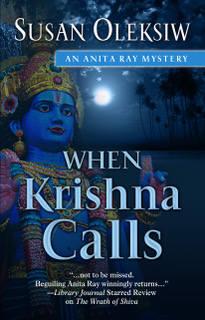
When Krishna Calls
An Anita Ray Mystery

In the glorious beauty of a tropical night, a young woman abandons her daughter in the Hotel Delite compound and flees into the darkness. In the morning Anita Ray recognizes the child as the daughter of an employee, but before she can track her down, the police arrive at the hotel looking for her. She is the main suspect in the stabbing death of her husband. This seems impossible to Anita, but so does the discovery that Nisha and her husband were involved with unscrupulous moneylenders from their family's village.

Anita is ready to let the police do their work as she prepares for a one-woman photography show in a prestigious gallery, but fate conspires against her. An accident wrecks her schedule as well as her car. She sets up her camera for one last shot, but it fails to work. When she inspects the camera she finds a piece of paper wrapped around the batteries and someone else's memory card inside.

Whether she likes it or not, Anita is drawn into the frantic search for a young mother and the murky world of moneylenders and debts of honor, a hidden corner of life in South India.

When Krishna Calls asks how far will a woman go for love and family? Anita Ray thinks she knows how Nisha would answer, but before it is all over Anita must also answer that question. How far will she go to protect her family and her home?

Thursday, March 19, 2015

BOOK CLUB FRIDAY--GUEST AUTHOR ADITE BANERJIE

Today Adite Banerjie sits down for an interview. Adite, who lives in New Delhi, India, is both a screenwriter and an author of contemporary romance and romantic suspense novels. Learn more about her and her books at her website. 

When did you realize you wanted to write novels?

I started exploring the idea of writing fiction about ten years ago. Back then, though, I was more interested in writing screenplays and did a bunch of online courses to learn the craft. It was a fascinating and rewarding experience and I ended up writing several spec screenplays. I was also commissioned to write a drama feature based on a true life story. Writing novels happened quite by accident when I came across an ad for a romance writing contest organized by Harlequin India for aspiring authors.

How long did it take you to realize your dream of publication?

Much faster than I expected! After winning the Harlequin India contest, I was mentored by one of their editors to turn my short story entry into a 50,000 word book. Soon after I was contracted to write four books for Harlequin. Two of these have been published.  My debut book, The Indian Tycoon’s Marriage Deal, came out in 2013 and the second book, Trouble Has a New Name,  will be out as a Harlequin Special Release e-book in N. America in April 2015.

Are you traditionally published, indie published, or a hybrid author?

So far I’ve been traditionally published but I do have plans to go hybrid.

Where do you write?

At the dining table amongst all the chaos of everyday life.

Is silence golden, or do you need music to write by? What kind?

I don’t need music to write or silence. Thankfully, I can turn on whatever I’m in the mood for in my head. ;)

How much of your plots and characters are drawn from real life? From your life in particular?

All my characters are inspired from real life in some way. For instance, I had been on a trip to Kashmir where I met a lady who had the annoying habits of the interfering, advice-spewing Agra Aunty who features in my book Trouble Has A New Name. Apart from that particular aspect to the character, everything else about her is fictionalized.

Describe your process for naming your character?

My characters so far have mostly been Indians and therefore their names, too, are Indian. Sometimes I tend to name my characters depending on their personalities. For instance, in Trouble Has A New Name, the heroine is called Rayna (which means Night) because of her dusky complexion and the hero’s name is Neel (which means blue). Since the story is set in the beautiful Andaman Islands, the name Neel also has a resonance with the setting.

Real settings or fictional towns?

I prefer real settings but sometimes it could be a fictional place within a real setting. The ‘Emerald Isle’ in Trouble Has A New Name is a fictional island, which is set in the real archipelago in the Indian Ocean.

What’s the quirkiest quirk one of your characters has?

Rayna has foot-in-mouth disease.

What’s your quirkiest quirk?

Reading the last ten-twenty pages of a book first!

If you could have written any book (one that someone else has already written,) which one would it be? Why?

I would have loved to write Gone with the Wind. I love the canvas, characters, dialogues, description, historical setting…everything!  You can never forget the book or its characters. If I were to write GWTW, though, I would set it in South Asia.

Everyone at some point wishes for a do-over. What’s yours?

I don’t like do-overs. If things have gone really badly, I don’t want anything to do with it anymore!

What’s your biggest pet peeve?

I wish I had more hours in the day to write more books and all the books on my humungous TBR pile. Sigh!

You’re stranded on a deserted island. What are your three must-haves?

My Kindle. My hubby. My dogs. (In no particular order)

What was the worst job you’ve ever held?

I have been a journalist, a content writer, a screenplay writer and now novel writer and have enjoyed every one of my jobs.

What’s the best book you’ve ever read?

Too many best books on my list. My top favorites are: GWTW as already mentioned, Amitava Ghosh’s Sea of Poppies, Khaled Hosseini’s The Kite Runner, Doctor Zhivago by Boris Pasternak, William Dalrymple’s The White Mughals and many, many more.

Ocean or mountains?

Ocean

City girl/guy or country girl/guy?

City girl

What’s on the horizon for you?

Am currently finishing up a romantic suspense for Harlequin. After that I will be writing another romantic comedy.

Anything else you’d like to tell us about yourself and/or your books?

Someone once asked me what is your “brand of romance”? My answer: heartwarming romance with a dash of Bollywood. These two-hour-plus movies, with their blend of traditional family values, changing mindsets and romance, make for a unique mix, which unfold through a combination of song, dance and plenty of action. A typical Bollywood flick is a mix of romance, comedy and full-on drama. And of course, a hot hero and dreamy heroine. I try to bring in these much loved elements of Bollywood films into my books.

Trouble Has a New Name
Will you pretend to be my fiancé for the next few days?

Recently single model RaynaDutt does not feel like flying to her friend’s big fat Indian wedding. But she does—and when a mix-up with room allocation forces her to share a luxury villa on Emerald Isle with the gorgeous owner of the hotel Neel Arora, best man at the wedding, things begin to look up.

Until Rayna’s ex turns up with a new girl on his arm!

Hitting the panic button, Rayna searches for a solution. Surely Neel wouldn’t mind being her fake fiancĂ©…? In an instant the attraction they share is at fever-pitch, but when scandal comes calling Rayna soon finds herself in more trouble than she can handle!

Wednesday, August 6, 2014

TRAVEL WITH SERENA--GUEST AUTHOR SUSAN OLEKSIW ON TRAVEL TIPS


Lisbon, Portugal
 Today we welcome back Susan Oleksiw with some travel tips. Susan writes the Anita Ray series featuring an Indian-American photographer living at her aunt's tourist hotel in South India. She also writes the Mellingham series featuring Chief of Police Joe Silva. Susan is well known for her articles on crime fiction, and her short stories have appeared in Alfred Hitchcock Mystery Magazine and numerous anthologies. Learn more about Susan and her books at her website

All travelers have their favorite travel tips, and I'm no exception. My current mystery series is set in India and features Anita Ray, an Indian-American woman photographer. She lives in a small tourist hotel, and mutters occasionally about the problems tourists get into. Hence, my first rule.

Indian Singers
1. Know where you're going to stay at least for the first one or two nights. If you arrive during a festival or the high season for travelers, you may not be able to find a room. Driving from hotel to hotel to ask is a waste of time and money. Book in advance. I prefer the small guesthouse to the large western-style hotel. The guesthouses in India are called home stays, and to my everlasting amusement, restaurants serve homely meals.

Festival Lane
2. If you don't know the area, take a walk around the center and then book a short tour. You may not like looking like a tourist, but you will get a sense of the area and the sights, and have a chance to relax and enjoy the first part of your trip without worrying about what you should see and how to get there. I've learned a lot from tour guides, and made some wonderful discoveries. I also got to know the city and surrounding area faster.

3. Once you're ready to strike out on your own, ask the hotel to hire a small taxi or, in India, an autorickshaw. You will get a reputable driver with a tourist license. In a busy city you can pick up a taxi anywhere, but if you are taking a long day trip or going out for the evening, ask the hotel for someone reliable.

4. This is my cardinal rule. If you see people gathering, go over and take a look. If it's a festival with music and dancing, as in Europe, join in if you can. If it's a religious festival, which is more likely the case in India, you can stand on the sidelines and watch respectfully. Special events are easy to find in places like India because they decorate the entrances, or put up special stands for performers. Don't pass up street performers. Many of them are professionals. 

Tucson Bario
5. Read the local papers for listings of free events. I regularly find free concerts and plays, and arrange a taxi to take me there and back. During the tourist season in India, local authorities offer free concerts of South Indian music, dance performances, drama, and all sorts of other events. These are easily located in public parks and halls. Don't worry about arriving late or leaving early. Indians are very casual when it comes to performances.

6. If you see a beautiful street or lane, take a walk, with your camera of course, and enjoy the beauty. Sometimes the best parts of a city are the ones tourists are not expected to see. I usually spend several days walking around parts of Trivandrum and other cities just to get a feel of how people live and regard their homes. Since I'm writing about India all the time, I'm always looking for visuals that will enhance the setting or serve the plot.
 
7. Meet people. This isn't easy on a short trip, but I'm always touched by the number of taxi drivers and others who invite me to dinner or to enjoy a cool drink and introduce me to their family. If they ask me to take a photograph, I always do. I don't really understand why Indians often ask this because they don't want a copy, but I do as asked. Over the years I've collected some photos that I know now are unusual, especially the Muslim woman who stopped me in a tiny village in the hills and posed for me, and the parents of a taxi driver.

8. In some Indian cities it's not safe for women to go out at night. This is changing, but unless I'm attending a concert or meeting friends in their home, I am happy to stay in. In resort areas, dinner is late, and sitting under the rising moon can be the best part of the day.

For the Love of Parvati
Prepare rice according to package instructions. Heat oil in pan and sauté onions until they are translucent. Toss in cashews and raisins and stir regularly until onion begins to brown. Stir another two minutes or so. Place rice in serving bowl. Add onion preparation over rice. Serve at once.

In the foothills of South India a man struggles against ropes tying him to an old bridge while the monsoon rages and wild animals forage for food. In the valley below, Anita Ray and Auntie Meena are stopped at a roadblock while their car is searched.

When Anita and Meena arrive at their destination, Lalita Amma's household is in turmoil. During a break in the rain, Anita discovers a body washed into the riverbank. The police whisk away the corpse and refuse to answer questions.
For the Love of Parvati brings Anita Ray face to face with a killer determined to exact revenge for a code of honor broken, a lover determined to rescue his beloved, and a woman desperate to build a new life.

Buy Links

Sunday, June 8, 2014

PHOTOGRAPHY WITH GUEST AUTHOR SUSAN OLEKSIW

Little Friends of Pongala
Susan Oleksiw writes the Anita Ray series featuring an Indian American photographer living at her aunt's tourist hotel in South India She also writes the Mellingham series featuring Chief of Police Joe Silva. Learn more about Susan and her books, view her photographs of India and read an Anita Ray short story at her website

Readers often ask writers where our characters come from, and I have to admit that I don’t know. Anita Ray, the Indian American woman living in her aunt’s tourist hotel in South India, popped up in a short story. She walked onto the page fully formed.

Anita appeared as a photographer in the very first line of the first story, “A Murder Made in India” (AHMM October 2003). She used a film camera in the first stories but switched to digital later on. She uses a Pentax, as do I. (I long for a Leica, but I’m realistic—not in the budget.)

A professional photographer recently pointed out to me that in most fiction the protagonist who is a photographer could just as easily be a lawyer, a teacher, or anything else. After the first mention of photography, it plays no significant role in the story. That comment made me think about how Anita uses photography in her investigations.

Anita uses the camera to get close to situations where others are barred. Photographers sometimes have access where others are denied. In India that may in part be a result of a generally high regard for artists, but Anita takes advantage of that. She’s nosy and she uses her camera to get in closer. But she also thinks better when she’s holding it, as do I.

Fishermen on the beach
Anita also has a photography gallery, and this brings her closer to the tourists that fill the hotels and restaurants along the beaches. She is close to the ground, so to speak, and knows what’s going on from her fellow vendors along the beach. Anita’s gallery also gives me a chance to display her “take” on people, Indians and foreigners alike, especially those who might be involved in a suspicious death.

In Under the Eye of Kali, the first Anita Ray novel, a postcard sent by an earlier visitor and now posted on her gallery bulletin board turns out to be a clue to the murder. Anita pursues a particular foreigner on the basis of her reaction to the postcard.

In For the Love of Parvati, Anita takes a few shots of the corpse she discovers when she realizes that the man didn’t die a natural death, and no one else seems concerned about the marks on his wrists and the injuries to his shoulder and arm.

I’ve been using Anita’s profession as a photographer in obvious ways that advance the plot, by giving her access to suspects and a way to record evidence of violent death. But as a photographer, Anita sees the world a little differently. Because she has done portrait work, she recognizes shifts in body language—the tilt of a head, the tightening of shoulders, the nearly imperceptible movement of hands—and reads them along with the words spoken. She recognizes when a scene has been staged, or a room reorganized to conceal something. She has strong observational skills.

Anita also knows that some of the best photographs are accidents, the ones you take at the last minute when you’re leaving the market after taking a dozen shots of fish sellers, or while waiting for the autorickshaw driver to finish his elevenses. She has learned to look carefully at each shot when she prints out a contact sheet or uploads to the computer. She studies each photograph for information that eluded her when she pushed the button. This is how she discovers the identity of a murderer in a short story, “The Photographer and the Lover” (AHMM April 2005).

For a long time I thought about photography as an adjunct to writing, a way to get to know India better so that my stories felt more authentic. But the experience of photography itself influences the person taking the shot, and can be more revealing than the story being told. A friend who appraises art once pointed out that my photographs are much more emotional than my fiction. I wondered about this until I remembered another rule for writers. Writers are often told to ignore the censor in their head and just write. Apparently I have no censor as a photographer, and as a result I reveal more. I look at photography as another way to tell a story, to get inside a different world. But in truth it’s another way for me to get my feeling about something onto paper, for others to view. Working out the role of Anita’s photography in the story is some of the best fun I have, and I’m already at work on the fourth Anita Ray, where the camera plays an even more important role.

For the Love of Parvati
In the foothills of South India a man struggles against ropes tying him to an old bridge while the monsoon rages and wild animals forage for food. In the valley below, Anita Ray and Auntie Meena are stopped at a roadblock while their car is searched.

When Anita and Meena arrive at their destination, Lalita Amma s household is in turmoil. During a break in the rain, Anita discovers a body washed into the riverbank. The police whisk away the corpse and refuse to answer questions.

For the Love of Parvati brings Anita Ray face to face with a killer determined to exact revenge for a code of honor broken, a lover determined to rescue his beloved, and a woman desperate to build a new life.

Buy Links