Featuring guest authors; crafting tips and projects; recipes from food editor and sleuthing sidekick Cloris McWerther; and decorating, travel, fashion, health, beauty, and finance tips from the rest of the American Woman editors.

Note: This site uses Amazon affiliate links. As an Amazon Associate, I earn from qualifying purchases.
Showing posts with label Indian embroidery. Show all posts

Wednesday, September 8, 2021

#CRAFTS WITH ANASTASIA--MYSTERY AUTHOR SUSAN OLEKSIW'S LOVE OF INDIAN EMBROIDERY

Susan's Hut and Palm Tree Indian Scene

Mystery author Susan Oleksiw writes the Anita Ray series along with the Mellingham series, set on the New England coast. Her short fiction has appeared in Alfred Hitchcock Mystery Magazine and numerous anthologies. She is a co-founder of Crime Spell Books, which will continue the tradition of publishing Best New England Crime Stories with Bloodroot, due out in November 2021. Learn more about Susan and her books at her website and blog.

Rediscovering Embroidery

When I lived in India in the 1970s and again in the 1980s, I discovered much that was unexpected. Almost everyone knows about the gorgeous silks Indian artisans produce, or the finely crafted silver or gold jewelry. For my marriage, an Indian friend of my mother’s sent me a piece of red silk threaded with gold (red is the traditional color of wedding saris in North India) and a shawl threaded and tasseled with real gold. From my grandmother I inherited a shawl, probably owned by her mother-in-law, woven and embroidered in the Kashmiri durokhu style, in which the shawl is embroidered on two sides with the same design in different or the same colors. 


Durokhu Embroidery

But the handwork that surprised me was that produced by Catholic women at a local nonprofit overseen by my landlady. The women made various crafts for sale, including handkerchiefs embroidered with Indian women in various traditional costumes in one corner, replacing a monogram. I bought loads of them to give to friends, along with other goods.


When I returned to the States I brought with me a new love of needlework beyond sewing (and my attempts as a child), and began doing needlepoint, again to give to family and friends, and later embroidery. My first project, however, was a free-hand image. One night in the middle of winter, I was sick of the cold, the gray, the general gloom of January in New England and pulled out a frame and fabric, and went to work. (see above Indian scene) I missed Kerala. 


I don’t claim any great skill. But I’m always willing to learn and try something new, including mastering various stitches. During the pandemic I’ve been working sporadically on a sampler. Sometimes I think of this as a way to decompress from the stress of the pandemic, or a way to let my mind wander while I’m in the middle of a novel or story that isn’t going well. But lately, I’ve had the same image come to me while I’m working, and now I think I know what it is. Look for Anita Ray to solve a murder using a hotel guest’s embroidery. 
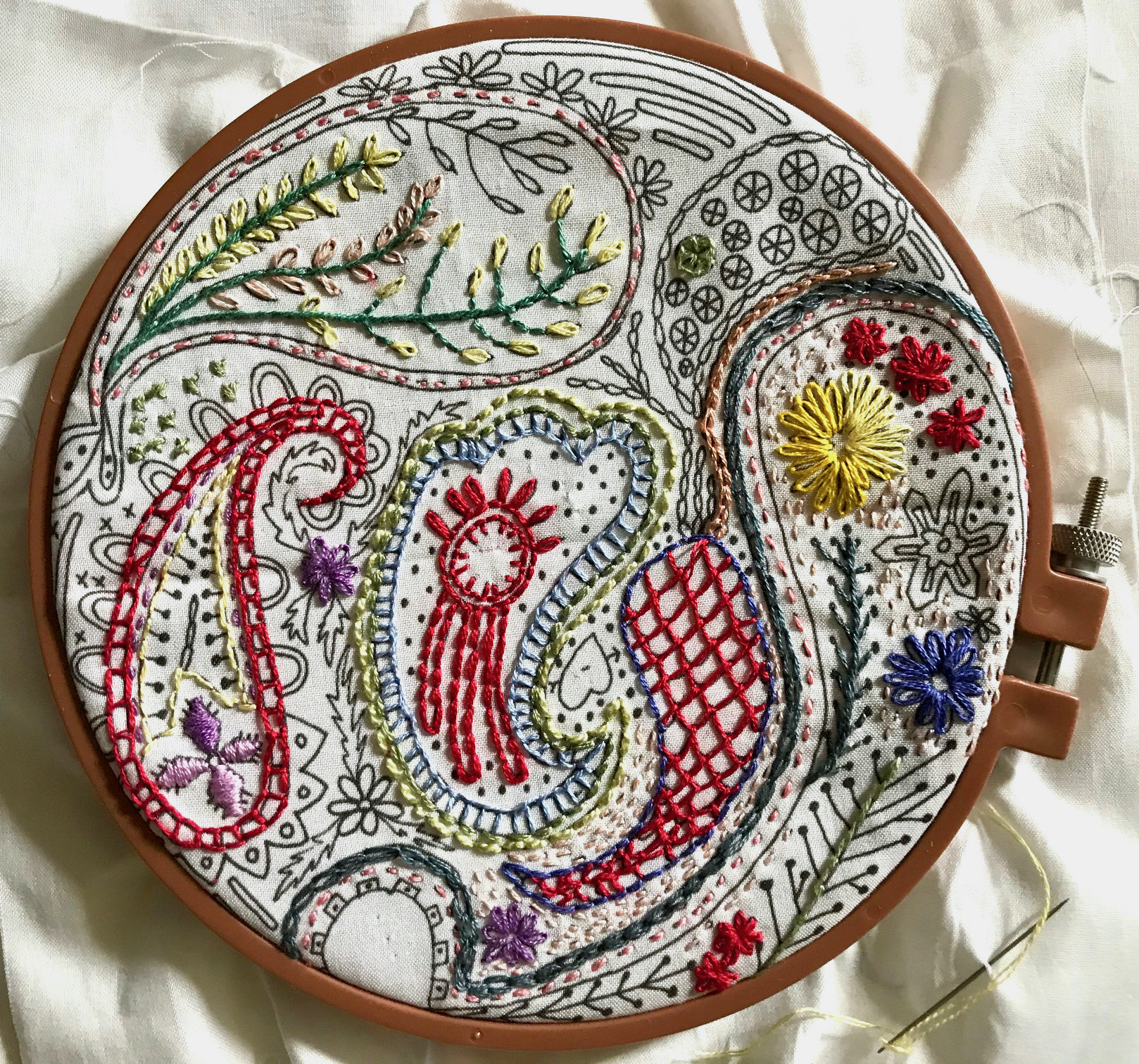

Susan's Sampler


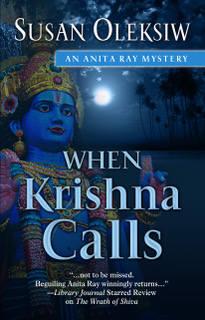
Until that story is written and published, look for the fourth book in the Anita Ray series, When Krishna Calls, soon to be available in trade paperback and ebook.


When Krishna Calls

An Anita Ray Mystery 


Anita is dismayed when an employee disappears and is later accused of murdering her husband, who was involved with a loan shark. But things get worse when she learns that Auntie Meena has taken out a crushing loan and tried to keep it a secret. How far will Anita go to protect her aunt and her home, and to rescue an innocent woman?


Hardcover Buy Link 

(trade paperback and ebook coming soon!)

Sunday, October 23, 2016

#CRAFTS WITH ANASTASIA--GUEST AUTHOR SUSAN OLEKSIW ON INDIAN #EMBROIDERY


Indian pandal (marriage canopy)
Susan Oleksiw writes the Anita Ray series, set in South India, and the Chief Joe Silva/Mellingham series, set in a coastal New England town. Her stories have appeared in Alfred Hitchcock Mystery Magazine and numerous anthologies. Learn more about Susan and her books at her website. 

One of the pleasures of setting stories in India is thinking about the artwork and the crafts. I have always enjoyed handwork, and India has some of the finest examples of this in terms of fabric and embroidery. A common item is the pandal (shown above), or marriage canopy under which the ceremony is conducted. The canopy is decorated with various images in crewel stitching, and one piece can be both hand-stitched and machine stitched. My example is from Rajasthan.
Sozni (satin) stitching
My grandmother gave me a small scarf, really a shoulder scarf, to be worn under a jacket. This is pure Kashmiri wool with a pattern embroidered on one side. This kind of stitching is called sozni, or satin stitch. My grandmother gave me this when I was in college, and I've carried it with me over the years. I have rarely worn it because I recognized when I received it that it was already an antique. It's now probably 140 years old. This stitch is most often found on shawls today sold throughout India and for export.

At one time royal families would commission an entire dress or outfit to be covered in this stitch. The project could take years, and an artisan often made only one in his lifetime. I read years ago that the British were so disturbed that these artisans ended up blind from the close work that they prohibited the making of these outfits. I've seen them on display during textile exhibits in museums, and the stitches are tiny and the patterns intricate, covering every inch of fabric.
Dorukha style stitching 
I treasure another item passed down to me from my grandmother. This Kashmiri shawl is embroidered in the dorukha style, which means the embroidered pattern is double sided. The same pattern appears on both sides in the same or different colored threads. One side is done in red and pink, and the reverse is done in blue. This work is done by hand; it is not woven into the fabric. Embroidering something like this can take a year, and covering an entire shawl in this style can take three years and cost the same as a car. Not many artisans remain who are willing and able to do the work, and few can find younger people to train. This is a dying art, unfortunately.
Test of a true pashmina shawl
One of my first discoveries in India was about pashmina wool. Today I see ads for pashmina wool shawls, but I know they're fake, though even the sellers may not know that. When I wanted to buy a light shawl in Delhi, the seller brought out several but he said I should buy a real pashmina shawl while I had the chance. Did I know how to identify a real pashmina shawl? I did not. So he showed me. A real pashmina shawl will slide through a wedding ring, and the one he offered me did just that. I bought it. It's the only plain shawl I own, but I treasure it. It's as light as a summer breeze.

Anita Ray, the Indian-American photographer in my mystery series, wears cotton dupattas, or long stoles that go with the salwar khameez sets that she wears. She can drape them over her head on a sunny day to block out the sun, or over her shoulders in a cool evening breeze.

When Krishna Calls
An Anita Ray Mystery

In the glorious beauty of a tropical night, a young woman abandons her daughter in the Hotel Delite compound and flees into the darkness. In the morning Anita Ray recognizes the child as the daughter of an employee, but before she can track her down, the police arrive at the hotel looking for her. She is the main suspect in the stabbing death of her husband. This seems impossible to Anita, but so does the discovery that Nisha and her husband were involved with unscrupulous moneylenders from their family's village.

Anita is ready to let the police do their work as she prepares for a one-woman photography show in a prestigious gallery, but fate conspires against her. An accident wrecks her schedule as well as her car. She sets up her camera for one last shot, but it fails to work. When she inspects the camera she finds a piece of paper wrapped around the batteries and someone else's memory card inside.

Whether she likes it or not, Anita is drawn into the frantic search for a young mother and the murky world of moneylenders and debts of honor, a hidden corner of life in South India.

When Krishna Calls asks how far will a woman go for love and family? Anita Ray thinks she knows how Nisha would answer, but before it is all over Anita must also answer that question. How far will she go to protect her family and her home?