Featuring guest authors; crafting tips and projects; recipes from food editor and sleuthing sidekick Cloris McWerther; and decorating, travel, fashion, health, beauty, and finance tips from the rest of the American Woman editors.

Note: This site uses Amazon affiliate links. As an Amazon Associate, I earn from qualifying purchases.
Showing posts with label Susan Oleksiw. Show all posts

Friday, October 7, 2022

MYSTERY AUTHOR SUSAN OLEKSIW TALKS ABOUT TITLES AND INDIAN DIETIES

Susan Oleksiw has lived in India and returned often for short visits. The Anita Ray series is set in a part of South India she knows well, Southern Kerala. She also writes the Mellingham series, set in a small town on the New England coast and featuring Chief of Police Joe Silva. Susan co-founded Crime Spell Books, which publishes the annual anthology of Best New England Crime Stories. Bloodroot appeared in 2021, and Deadly Nightshade will be published in November 2022. Learn more about Susan and her books at her website. 


In Sita's Shadow

Anyone who gets involved with India, on any level, cannot fail to recognize the vastness and richness of its culture. There are so many ways to discover this land, and so many worlds within it to learn about. When I began crafting a novel set in India, I struggled to find a focus. It took a while, several false starts and dead-ends, but at last, the pieces came together. Anita Ray is an Indian American photographer living in South India at her aunt's tourist hotel on the rocky coast of Kerala. Foreigners look out over a beach where guests swim and fishermen work their nets.


To give the series more cohesion I wanted a recurring format for the titles. Each entry in the Anita Ray series revolves around an aspect of a particular deity. This seemed the best way to tighten the focus on parts of the complex culture of this ancient civilization. 


Picking the deity of the title is a big part of the fun of the series. I may have an idea for a story line, but the particular image I choose becomes a heavy influence. Kali, the goddess of diseases and destruction, can be frightening, but as her younger prettier self, she can be enchanting. Her terrifying side, along with various rituals she participates in, seemed the perfect choice for the first book, Under the Eye of Kali


For some time I wanted to write about how traditional cultures have practiced conservation long before it became fashionable or necessary, and after a stay at a traditional home in central Kerala, I found my vehicle. The kaavu is a plot of land set aside by the homeowner for the deity that no one may enter. An image of the presiding deity sits on the boundary and is honored daily. The home where I stayed had a kaavu presided over by Bhairava, a manifestation of a fierce Shiva. From that came the title for the second book, The Wrath of Shiva. Parvati is well known as the consort of the deity Shiva and seemed a good choice for a story about marriage. For the Love of Parvati takes Anita and Auntie Meena into the mountains during the monsoon to visit relatives.


Indian names, terms, and general vocabulary are spreading throughout the English-speaking world, so when I settled on Krishna, the god of love, as the next deity to appear in a title, I wasn't worried about who would recognize it. When Krishna Calls is all about what we will do for love, how far we will go to protect those we care about. While cruelty threads its way through the narrative, pinching the heart of a business woman and curdling the life of a young boy, the devotion of a mother redeems them all.


The fifth entry, In Sita's Shadow, calls on the story of Sita to set the stage and direct the narrative. In India, everyone knows the name Sita, the wife of Lord Rama, both king and deity. She is the epitome of the virtuous woman and perfect wife, loyal and devoted and honorable. When her husband is exiled to the forest, the result of jealousy by another member of the royal family, Sita dutifully goes with him. She's kidnapped, rescued, and restored to her lord, who is also restored to the throne. When rumors spread that maybe she wasn't so virtuous when she was alone with her abductor, she calls on the earth to testify to her purity, and the earth does so. Indians revere her, but she's a tough act to follow.


In Sita’s Shadow

An Anita Ray Mystery, Book 5


Hotel Delite, perched on the rocky coast of South India, has welcomed all sorts of tours. Every one of them has been touched by the beauty of the milky moon rising over the Arabian Sea and glowing over palm trees and clean white beaches. But one group of Americans seems immune to the setting, and very odd in other ways.


Angela Deetcher, a renowned scientist, is a dour creature and seems intent on maintaining an extreme skepticism of everything she sees. Sandra Stover is laconic to the point of muteness, though she is always beautifully coiffed and attired. Larry Forche has eyes for no one else but Sandra and is undeterred by her coolness toward him. Crocker Dawes seems to be the only one pleased to be in India, but no one sees him after he checks in. He disappears the first morning, and the only one who knows he has been in and out of the hotel is the maidservant who cleans his room. But at least the tour leader, Kenneth Maxinter, seems normal. Enthusiastic and gregarious, he encourages his charges to see everything and presides over meals with energy that is exhausting.


When one member of the tour is found dead, Anita and Auntie Meena prepare to tell the other members and cope with their reactions. But the tour members don’t react. They are quiet, still, and nod, offering little more than perfunctory acknowledgments. At least until Anita tells them who the corpse is—Kenneth Maxinter. They insist she must be mistaken.


Tourists have many reasons for coming to India, but as Anita explores the oddities of this particular tour group, she learns of other reasons she had never before considered.


Buy Links

paperback 

ebook 

Wednesday, September 8, 2021

#CRAFTS WITH ANASTASIA--MYSTERY AUTHOR SUSAN OLEKSIW'S LOVE OF INDIAN EMBROIDERY

Susan's Hut and Palm Tree Indian Scene

Mystery author Susan Oleksiw writes the Anita Ray series along with the Mellingham series, set on the New England coast. Her short fiction has appeared in Alfred Hitchcock Mystery Magazine and numerous anthologies. She is a co-founder of Crime Spell Books, which will continue the tradition of publishing Best New England Crime Stories with Bloodroot, due out in November 2021. Learn more about Susan and her books at her website and blog.

Rediscovering Embroidery

When I lived in India in the 1970s and again in the 1980s, I discovered much that was unexpected. Almost everyone knows about the gorgeous silks Indian artisans produce, or the finely crafted silver or gold jewelry. For my marriage, an Indian friend of my mother’s sent me a piece of red silk threaded with gold (red is the traditional color of wedding saris in North India) and a shawl threaded and tasseled with real gold. From my grandmother I inherited a shawl, probably owned by her mother-in-law, woven and embroidered in the Kashmiri durokhu style, in which the shawl is embroidered on two sides with the same design in different or the same colors. 


Durokhu Embroidery

But the handwork that surprised me was that produced by Catholic women at a local nonprofit overseen by my landlady. The women made various crafts for sale, including handkerchiefs embroidered with Indian women in various traditional costumes in one corner, replacing a monogram. I bought loads of them to give to friends, along with other goods.


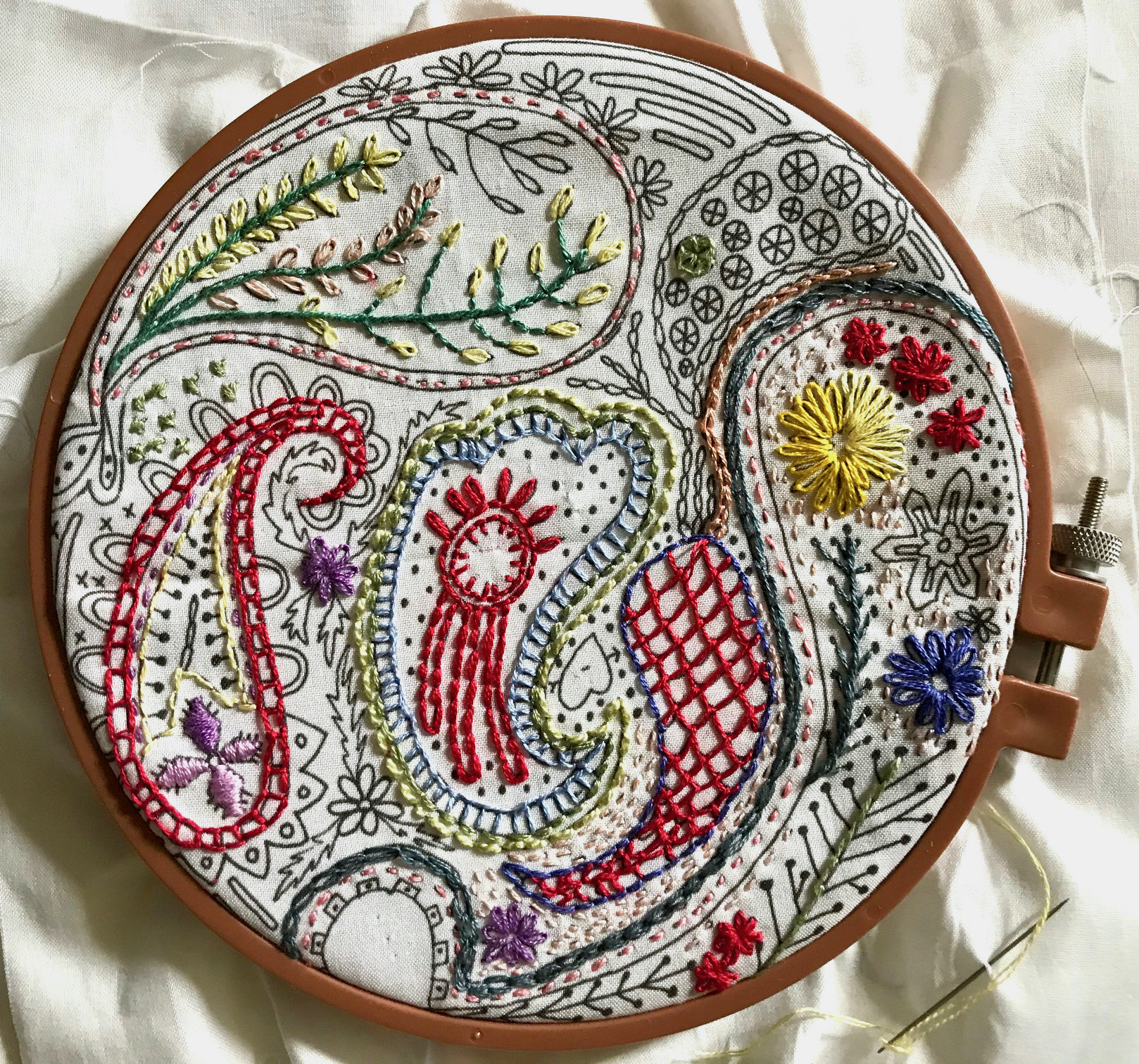
When I returned to the States I brought with me a new love of needlework beyond sewing (and my attempts as a child), and began doing needlepoint, again to give to family and friends, and later embroidery. My first project, however, was a free-hand image. One night in the middle of winter, I was sick of the cold, the gray, the general gloom of January in New England and pulled out a frame and fabric, and went to work. (see above Indian scene) I missed Kerala. 


I don’t claim any great skill. But I’m always willing to learn and try something new, including mastering various stitches. During the pandemic I’ve been working sporadically on a sampler. Sometimes I think of this as a way to decompress from the stress of the pandemic, or a way to let my mind wander while I’m in the middle of a novel or story that isn’t going well. But lately, I’ve had the same image come to me while I’m working, and now I think I know what it is. Look for Anita Ray to solve a murder using a hotel guest’s embroidery. 


Susan's Sampler


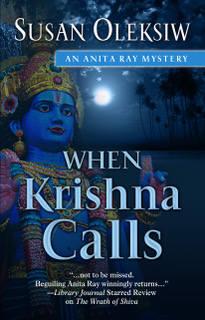
Until that story is written and published, look for the fourth book in the Anita Ray series, When Krishna Calls, soon to be available in trade paperback and ebook.


When Krishna Calls

An Anita Ray Mystery 


Anita is dismayed when an employee disappears and is later accused of murdering her husband, who was involved with a loan shark. But things get worse when she learns that Auntie Meena has taken out a crushing loan and tried to keep it a secret. How far will Anita go to protect her aunt and her home, and to rescue an innocent woman?


Hardcover Buy Link 

(trade paperback and ebook coming soon!)

Wednesday, July 31, 2019

AUTHOR SUSAN OLEKSIW CREATES THE PERFECT SETTING FOR HER PIONEER VALLEY MYSTERY SERIES

In three mystery series and short stories, Susan Oleksiw explores the clash between the traditional and modern: in India in the Anita Ray series, with an Indian-American photographer living at her aunt's tourist hotel; in a New England town with Chief Joe Silva; and on a New England farm with Felicity O'Brien, healer and farmer. Susan's short stories have appeared in numerous anthologies, and her nonfiction appears in A Reader's Guide to the Classic British Mystery (1988) and The Oxford Companion to Crime and Mystery Writing (1999). Learn more about Susan and her books at her website

Building Tall Tree Farm
In Below the Tree Line, Felicity O'Brien takes over the family farm when her father can no longer manage. When I began developing the idea for this series, I didn't have a specific farm in mind but as the research and writing progressed, I drew on the dairy farm where I was born (and left at a young age) and the one my parents bought after my father retired. These helped me with specific details and layout, but they were not enough to build an entirely new one.

I considered a neighbor's farm, which had an envious view across fields and a brook. A farm across the street from where my parents lived for thirty years gave me another idea, and a very small farm, less than ten acres, in a nearby town suggested the advantages of compactness. By the time I was finished, and had written half of the first mystery, Felicity's farm was as alive as any of the trees in my front yard. I sketched out my idea of this new setting, sighting the house and barn, gardens and hayfield, and driveway. The view from the house mattered, as well as the distance from the road, where she could set up her farm stand. Once I started added detail upon detail, it was hard to stop. Tall Tree Farm is now five hundred acres of mostly forest, with a vegetable garden, farm stand, hay field, paddock for sheep, and outbuildings.

Ideas for Tall Tree Farm came randomly, as often happens, so I set up a Pinterest https://www.pinterest.com/susanoleksiw/tall-tree-farm/
page just for the farm. Here I could post images that attracted me, inspired a story idea, or just fleshed out aspects of the farm I might have to consider in the future. When I was thinking about what kind of cat Felicity would have, I gravitated to the snowshoe because we had a dear one who died. In the end I decided on a calico cat, and named her Miss Anthropy.

It was too easy to get distracted by images of tools, and I posted lots of photos of pitchforks, all different designs for different purposes. The same can be said of rakes. When I came across the importance of a certain kind of fork, according to anarchaeologist in England, I stopped to learn about the craft of making them. After that I inspected the handles of all sorts of tools, looking for the preferred hickory and the rarest of rare, the pitchfork made from a single sapling in France by the same family for the last several hundred years.

Anyone who has lived in or visited New England is familiar with the image of the old barn during the autumn season, with gold and red leaves bursting out of the forest and turning magical a structure that anyone else would tear down. I couldn't omit photographs of autumn on a farm.

But where did Felicity fit into the total farming community? In 1974 Massachusetts had 4,497 farms; in 2012 the state had 7,755 (in 1997 the state adjusted how farms were counted, and the numbers jumped, but not enough to account for the entire increase). But farms got smaller. In 1974, the average size of a farm was 130 acres. In 2012, the average size was 107 acres for hay, and 67 acres average overall. Today 22% of farms make hay. Overall, the total land under cultivation declined from 601,734 acres in 1974 to 523,517 in 2012.

Felicity's struggles with making her farm a success fit right into contemporary life. She has several income streams, as we now say, many of them thin, and some that dry up in the summer, but she soldiers on. Like the farms that inspired Tall Tree Farm, the profit margin may be thin but the work is richly rewarding.

Craeft: An Inquiry into the Origins and True Meaning of Traditional Crafts by Alex Langlands

Below the Tree Line
In the Massachusetts countryside, family secrets run deep...but an outside threat could uproot them all.

Felicity O'Brien hopes the warning shot fired from her porch is enough to scare off the intruder who's been snooping around her family's Massachusetts farm. Days later, when two young women are found dead nearby, Felicity can't figure out how the deaths are related, and even her inherited healing touch isn't enough to ease the community's pain over the tragic loss.

Felicity does know that somebody wants something bad enough to kill for it, but all she has is the neglected property her parents passed down to her. Joining forces with her friend Jeremy Colson, Felicity tries to uncover the truth and save herself and her land from those who are capable of unthinkable harm.

Buy Links

Wednesday, September 19, 2018

MYSTERY AUTHOR SUSAN OLEKSIW ON THE SETTING FOR HER NEW SERIES

Susan Oleksiw is the author of twelve mysteries in three series. Below the Tree Line is the first in the Pioneer Valley series. Her short stories have appeared in Alfred Hitchcock Mystery Magazine and numerous anthologies. She also published A Reader's Guide to the Classic British Mystery and served as co-editor for The Oxford Companion to Crime and Mystery Writing. Learn more about Susan and her books at her website. 

Unexpected Discoveries in a New Series

In Below the Tree Line, the first in the Pioneer Valley series, I set out to give the reader a sense of place and what it’s like to live and work on a small farm. Setting is important to me, and I wanted to create as vivid a landscape in this series as I had in my two previous ones. The landscape of this area is worth a visit.

The Mellingham series with Chief Joe Silva was set in a small town on a New England coast, much like the one I grew up in. I knew how people behaved, and I knew local institutions. For Family Album I learned about antiques and for Come About for Murder, I honed up on my sailing skills. My next series was set in India and featured Indian-American photographer Anita Ray, living at her aunt’s tourist hotel in a resort I knew well from the time I lived in a nearby city. In Under the Eye of Kali, I talked a lot about the food, and in When Krishna Calls, I wrote about the way village lenders have trapped villagers into debt for generations.

I expected to follow a similar path when I began writing the Pioneer Valley series, featuring healer and farmer Felicity O’Brien. As I began my research, I expected to add to my store of knowledge (meager at best) about farming and the like. But this time things were different.

Like many others, I have mourned the disappearance of honeybees. But I began to notice other changes in the natural world as well. Large flocks of wrens seemed to be everywhere, and now we have blue jays. But other birds are missing. Our two or three pairs of cardinals are down to one pair, not often seen. We have fewer chickadees, purple finches, and white-throated sparrows. I can’t remember the last time I saw a Baltimore Oriole.

The nature of the forests is changing also, and this is something that will concern Felicity. Part of her income comes from timbering, and any change there will be serious for her. Any reports of new infestations can mean disaster for a farmer. Felicity knows her property well, but even she learns a few things in Below the Tree Line. It seems her parents didn’t tell her everything.

Felicity tracks the weather, like every other farmer, but now she has to track an unstable environment. A neighbor is watching his best maple trees migrate north, and another has been turned out of a field he’s been renting for years because the owners can’t pay the taxes. And then there’s the temptation of selling out to a developer. Why a stranger is offering an inflated price for her land stumps Felicity, and she teams up with her partner, Jeremy Colson, to figure this out.

Despite the challenges of her situation, Felicity has a few assets—patience, doggedness, and observation skills. She also has the support of the people in her community, many of whom know her as a healer, one in a long line of healers that includes her mother and grandmother. But she still lives in a world that teeters precariously on the edge of major loss and disruption. This is the world most people don’t see while driving through on their way to summer concerts or ski resorts. But this is the world that interests me and I hope will interest my readers.

Below the Tree Line, A Pioneer Valley Mystery

In the Massachusetts countryside, family secrets run deep . . . but an outside threat could uproot them all.

Felicity O'Brien hopes the warning shot fired from her porch is enough to scare off the intruder who's been snooping around her family's Massachusetts farm. Days later, two young women are found dead nearby. Somebody wants something bad enough to kill for it, but all she has is the neglected property her parents passed down to her. Joining forces with her friend Jeremy Colson, Felicity tries to uncover the truth and save herself and her land from those who are capable of unthinkable harm.

Buy Links

Sunday, October 23, 2016

#CRAFTS WITH ANASTASIA--GUEST AUTHOR SUSAN OLEKSIW ON INDIAN #EMBROIDERY


Indian pandal (marriage canopy)
Susan Oleksiw writes the Anita Ray series, set in South India, and the Chief Joe Silva/Mellingham series, set in a coastal New England town. Her stories have appeared in Alfred Hitchcock Mystery Magazine and numerous anthologies. Learn more about Susan and her books at her website. 

One of the pleasures of setting stories in India is thinking about the artwork and the crafts. I have always enjoyed handwork, and India has some of the finest examples of this in terms of fabric and embroidery. A common item is the pandal (shown above), or marriage canopy under which the ceremony is conducted. The canopy is decorated with various images in crewel stitching, and one piece can be both hand-stitched and machine stitched. My example is from Rajasthan.
Sozni (satin) stitching
My grandmother gave me a small scarf, really a shoulder scarf, to be worn under a jacket. This is pure Kashmiri wool with a pattern embroidered on one side. This kind of stitching is called sozni, or satin stitch. My grandmother gave me this when I was in college, and I've carried it with me over the years. I have rarely worn it because I recognized when I received it that it was already an antique. It's now probably 140 years old. This stitch is most often found on shawls today sold throughout India and for export.

At one time royal families would commission an entire dress or outfit to be covered in this stitch. The project could take years, and an artisan often made only one in his lifetime. I read years ago that the British were so disturbed that these artisans ended up blind from the close work that they prohibited the making of these outfits. I've seen them on display during textile exhibits in museums, and the stitches are tiny and the patterns intricate, covering every inch of fabric.
Dorukha style stitching 
I treasure another item passed down to me from my grandmother. This Kashmiri shawl is embroidered in the dorukha style, which means the embroidered pattern is double sided. The same pattern appears on both sides in the same or different colored threads. One side is done in red and pink, and the reverse is done in blue. This work is done by hand; it is not woven into the fabric. Embroidering something like this can take a year, and covering an entire shawl in this style can take three years and cost the same as a car. Not many artisans remain who are willing and able to do the work, and few can find younger people to train. This is a dying art, unfortunately.
Test of a true pashmina shawl
One of my first discoveries in India was about pashmina wool. Today I see ads for pashmina wool shawls, but I know they're fake, though even the sellers may not know that. When I wanted to buy a light shawl in Delhi, the seller brought out several but he said I should buy a real pashmina shawl while I had the chance. Did I know how to identify a real pashmina shawl? I did not. So he showed me. A real pashmina shawl will slide through a wedding ring, and the one he offered me did just that. I bought it. It's the only plain shawl I own, but I treasure it. It's as light as a summer breeze.

Anita Ray, the Indian-American photographer in my mystery series, wears cotton dupattas, or long stoles that go with the salwar khameez sets that she wears. She can drape them over her head on a sunny day to block out the sun, or over her shoulders in a cool evening breeze.

When Krishna Calls
An Anita Ray Mystery

In the glorious beauty of a tropical night, a young woman abandons her daughter in the Hotel Delite compound and flees into the darkness. In the morning Anita Ray recognizes the child as the daughter of an employee, but before she can track her down, the police arrive at the hotel looking for her. She is the main suspect in the stabbing death of her husband. This seems impossible to Anita, but so does the discovery that Nisha and her husband were involved with unscrupulous moneylenders from their family's village.

Anita is ready to let the police do their work as she prepares for a one-woman photography show in a prestigious gallery, but fate conspires against her. An accident wrecks her schedule as well as her car. She sets up her camera for one last shot, but it fails to work. When she inspects the camera she finds a piece of paper wrapped around the batteries and someone else's memory card inside.

Whether she likes it or not, Anita is drawn into the frantic search for a young mother and the murky world of moneylenders and debts of honor, a hidden corner of life in South India.

When Krishna Calls asks how far will a woman go for love and family? Anita Ray thinks she knows how Nisha would answer, but before it is all over Anita must also answer that question. How far will she go to protect her family and her home?

Wednesday, June 22, 2016

SOUTH #INDIA WITH GUEST AUTHOR SUSAN OLEKSIW

A lane in Kovalam, India
Susan Oleksiw writes the Anita Ray series featuring an Indian-American photographer living in her aunt's tourist hotel in South India. She also writes the Mellingham series featuring Chief of Police Joe Silva. Her stories have appeared in Alfred Hitchcock Mystery Magazine and various anthologies. Learn more about Susan and her writing at her website. 

Setting Versus Place

A successful novel comprises a number of elements—character, plot, and setting are the most obvious. In some mysteries, the setting can be more generic than specific, such as a small town without any distinctive geographical or historical features. But setting can be much more than a location for the narrative.

Cara Black sets her series in Paris, and the reader looks forward to exploring one of the arrondissements in each book. Louise Penny sets her series in a small village in Quebec, Canada, and its environs. Sara Paretsky gives us Chicago’s South Side. In each of these series, and many more, the setting becomes a character, enriching the novel with detail and depth.

In any novel that includes setting as more than a generic place, we learn about history, economic climate, the people and their social world, even the way a place smells and looks and feels. This is the ideal for setting in fiction.

The Anita Ray mysteries are set in South India. Since most of my readers never expect to travel there, I try to include details about this world. Anita Ray lives in Hotel Delite, her aunt’s tourist hotel, located in the beach resort of Kovalam. In the evening she strolls along the beach Promenade, past the open-air restaurants with their tables of fresh fish awaiting customers and the smells of Indian curries cooking. She chases a suspect down a dirt lane lined with colorful saris and cloth purses. She takes a narrow path to the edge of the resort area, where the residents live and the old irrigation canals are thick with weeds.

The city of Trivandrum is nearby, and Anita rides the bus or takes an autorickshaw, a three-wheeled vehicle with more noise than power. The resort might grow with a new hotel and more shops, but the real change is happening in the city. When I lived there in 1976, in a flat that was considered to be in the middle of the city, I walked to a bus stop located across the road from a lumberyard. Huge teak tree trunks were piled in the yard. Just past the yard were narrow lanes with one-storied buildings, where advocates (or lawyers) had their offices. Across the street, next to the bus stop, was the courthouse. The lumberyard is gone, the street has sidewalks, and the courthouse was abandoned for almost thirty years. It’s now being refurbished and reopened.

To make sure Anita Ray’s activities make sense, I travel around the city, exploring neighborhoods, checking out restaurants, and searching for quiet lanes where my characters carry out their criminal deeds.

No novel can give a true or full picture of the culture of a foreign country. But I strive to bring the flavor of India (its colors, smells, tastes, and people) into the story, to keep the setting vivid.

When Krishna Calls
An Anita Ray Mystery

In the glorious beauty of a tropical night, a young woman abandons her daughter in the Hotel Delite compound and flees into the darkness. In the morning Anita Ray recognizes the child as the daughter of an employee, but before she can track her down, the police arrive at the hotel looking for her. She is the main suspect in the stabbing death of her husband. This seems impossible to Anita, but so does the discovery that Nisha and her husband were involved with unscrupulous moneylenders from their family's village.

Anita is ready to let the police do their work as she prepares for a one-woman photography show in a prestigious gallery, but fate conspires against her. An accident wrecks her schedule as well as her car. She sets up her camera for one last shot, but it fails to work. When she inspects the camera she finds a piece of paper wrapped around the batteries and someone else's memory card inside.

Whether she likes it or not, Anita is drawn into the frantic search for a young mother and the murky world of moneylenders and debts of honor, a hidden corner of life in South India.

When Krishna Calls asks how far will a woman go for love and family? Anita Ray thinks she knows how Nisha would answer, but before it is all over Anita must also answer that question. How far will she go to protect her family and her home?

Wednesday, August 6, 2014

TRAVEL WITH SERENA--GUEST AUTHOR SUSAN OLEKSIW ON TRAVEL TIPS


Lisbon, Portugal
 Today we welcome back Susan Oleksiw with some travel tips. Susan writes the Anita Ray series featuring an Indian-American photographer living at her aunt's tourist hotel in South India. She also writes the Mellingham series featuring Chief of Police Joe Silva. Susan is well known for her articles on crime fiction, and her short stories have appeared in Alfred Hitchcock Mystery Magazine and numerous anthologies. Learn more about Susan and her books at her website

All travelers have their favorite travel tips, and I'm no exception. My current mystery series is set in India and features Anita Ray, an Indian-American woman photographer. She lives in a small tourist hotel, and mutters occasionally about the problems tourists get into. Hence, my first rule.

Indian Singers
1. Know where you're going to stay at least for the first one or two nights. If you arrive during a festival or the high season for travelers, you may not be able to find a room. Driving from hotel to hotel to ask is a waste of time and money. Book in advance. I prefer the small guesthouse to the large western-style hotel. The guesthouses in India are called home stays, and to my everlasting amusement, restaurants serve homely meals.

Festival Lane
2. If you don't know the area, take a walk around the center and then book a short tour. You may not like looking like a tourist, but you will get a sense of the area and the sights, and have a chance to relax and enjoy the first part of your trip without worrying about what you should see and how to get there. I've learned a lot from tour guides, and made some wonderful discoveries. I also got to know the city and surrounding area faster.

3. Once you're ready to strike out on your own, ask the hotel to hire a small taxi or, in India, an autorickshaw. You will get a reputable driver with a tourist license. In a busy city you can pick up a taxi anywhere, but if you are taking a long day trip or going out for the evening, ask the hotel for someone reliable.

4. This is my cardinal rule. If you see people gathering, go over and take a look. If it's a festival with music and dancing, as in Europe, join in if you can. If it's a religious festival, which is more likely the case in India, you can stand on the sidelines and watch respectfully. Special events are easy to find in places like India because they decorate the entrances, or put up special stands for performers. Don't pass up street performers. Many of them are professionals. 

Tucson Bario
5. Read the local papers for listings of free events. I regularly find free concerts and plays, and arrange a taxi to take me there and back. During the tourist season in India, local authorities offer free concerts of South Indian music, dance performances, drama, and all sorts of other events. These are easily located in public parks and halls. Don't worry about arriving late or leaving early. Indians are very casual when it comes to performances.

6. If you see a beautiful street or lane, take a walk, with your camera of course, and enjoy the beauty. Sometimes the best parts of a city are the ones tourists are not expected to see. I usually spend several days walking around parts of Trivandrum and other cities just to get a feel of how people live and regard their homes. Since I'm writing about India all the time, I'm always looking for visuals that will enhance the setting or serve the plot.
 
7. Meet people. This isn't easy on a short trip, but I'm always touched by the number of taxi drivers and others who invite me to dinner or to enjoy a cool drink and introduce me to their family. If they ask me to take a photograph, I always do. I don't really understand why Indians often ask this because they don't want a copy, but I do as asked. Over the years I've collected some photos that I know now are unusual, especially the Muslim woman who stopped me in a tiny village in the hills and posed for me, and the parents of a taxi driver.

8. In some Indian cities it's not safe for women to go out at night. This is changing, but unless I'm attending a concert or meeting friends in their home, I am happy to stay in. In resort areas, dinner is late, and sitting under the rising moon can be the best part of the day.

For the Love of Parvati
Prepare rice according to package instructions. Heat oil in pan and sauté onions until they are translucent. Toss in cashews and raisins and stir regularly until onion begins to brown. Stir another two minutes or so. Place rice in serving bowl. Add onion preparation over rice. Serve at once.

In the foothills of South India a man struggles against ropes tying him to an old bridge while the monsoon rages and wild animals forage for food. In the valley below, Anita Ray and Auntie Meena are stopped at a roadblock while their car is searched.

When Anita and Meena arrive at their destination, Lalita Amma's household is in turmoil. During a break in the rain, Anita discovers a body washed into the riverbank. The police whisk away the corpse and refuse to answer questions.
For the Love of Parvati brings Anita Ray face to face with a killer determined to exact revenge for a code of honor broken, a lover determined to rescue his beloved, and a woman desperate to build a new life.

Buy Links

Monday, June 30, 2014

COOKING WITH CLORIS--GUEST AUTHOR SUSAN OLEKSIW AND AN INDIAN RICE DISH

Sadya
Today we’re happy to have Susan Oleksiw making a return visit. Susan writes the Anita Ray series featuring an Indian-American photographer living at her aunt's tourist hotel in South India. She also writes the Mellingham series featuring Chief of Police Joe Silva. Susan also writes articles on crime fiction and short stories that have appeared in Alfred Hitchcock Mystery Magazine and numerous anthologies. Learn more about Susan at her website

Under the Eye of Kali was the first novel to feature Indian-American photographer Anita Ray. Anita had appeared in a number of short stories but not until I wrote Kali could I dwell on other aspects of South India in addition to the murder plot. I thought I focused on the people, landscape, customs, etc., but an early reviewer pointed out that I talked all the time about food but didn't include any recipes. Could this be? I reread the book, and yes, indeed, it could. I mentioned food, including individual dishes as well as entire meals, 35 times. And not a single recipe. I mention food in the second and third mysteries, but far less often. The Wrath of Shiva includes one delicious meal, and For the Love of Parvati mentions mostly breakfast foods.
In India food seems to be everywhere. Perhaps this is because so many of the markets are set up along main roads or at intersections. If you walk anywhere in South India, you will pass someone selling something edible. In small shops, bananas hang from the awning, and boxes of clementines line the edge of the roadway. Butcher shops, a mere table on a stand, occupy a cement island along a main highway, and lime or sweets vendors push carts along busy streets. For a tourist it's even worse.

Along the beach village women display fresh fruit they will cut up and serve you. The open-air markets entice with smells and unusual vegetables. The fish sellers offer every variety of fish known to Asia, it seems. And restaurants range from those at five-star hotels to the simplest open-air setting. It is almost impossible not to encounter fresh fruits, vegetables, meat, fish, and more wherever you turn.
I have noticed over the years that some tourists in India never feel comfortable around the new tastes or smells. They tend to eat what seems familiar. I, on the other hand, will try almost anything. I've never had a bad reaction to food, but I have contracted a fever from time to time from a chef. That doesn't stop me. Good food is good food. I've eaten in all sorts of homes and restaurants, and always enjoyed myself. When my husband and I lived in India, in the 1970s and again in the 1980s, we hired a local woman. She was a terrific cook. When I went back to visit, many years later, she was quite elderly, and did little cooking. To make sure I was well treated when I went to visit her, she arranged with a neighbor to prepare a meal. I knew at once which part Lakshmee had made and which the neighbor.

My favorite meal is the sadya (top photo,) the formal meal for a wedding or festival. This is served on a banana leaf, and includes certain dishes--at the very least, rice, two vegetable curries, salt, pickle, raw salad, chutney, banana chips, and payasam. This is often followed by another course that includes dhal, or sambhar or curd, each served as a separate course and with rice. The meal ends with a banana. In some households 20 dishes will be served, and I've heard of others that served over 100 in years past.

There are so many tastes to enjoy in Indian cuisine that I have yet to try them all. But I've set about rectifying my error of omission in my first Anita Ray mystery by working up recipes to give away on postcards. I have several ready to go, and offer a favorite here. This is delicious and also very simple.

Garnish for Rice Dishes

Ingredients:
Packaged rice
1 Tbsp oil
One onion, chopped
Handful of cashews
Handful of raisins

For the Love of Parvati
Prepare rice according to package instructions. Heat oil in pan and sauté onions until they are translucent. Toss in cashews and raisins and stir regularly until onion begins to brown. Stir another two minutes or so. Place rice in serving bowl. Add onion preparation over rice. Serve at once.

In the foothills of South India a man struggles against ropes tying him to an old bridge while the monsoon rages and wild animals forage for food. In the valley below, Anita Ray and Auntie Meena are stopped at a roadblock while their car is searched.

When Anita and Meena arrive at their destination, Lalita Amma's household is in turmoil. During a break in the rain, Anita discovers a body washed into the riverbank. The police whisk away the corpse and refuse to answer questions.
For the Love of Parvati brings Anita Ray face to face with a killer determined to exact revenge for a code of honor broken, a lover determined to rescue his beloved, and a woman desperate to build a new life.

Buy Links

Sunday, June 8, 2014

PHOTOGRAPHY WITH GUEST AUTHOR SUSAN OLEKSIW

Little Friends of Pongala
Susan Oleksiw writes the Anita Ray series featuring an Indian American photographer living at her aunt's tourist hotel in South India She also writes the Mellingham series featuring Chief of Police Joe Silva. Learn more about Susan and her books, view her photographs of India and read an Anita Ray short story at her website

Readers often ask writers where our characters come from, and I have to admit that I don’t know. Anita Ray, the Indian American woman living in her aunt’s tourist hotel in South India, popped up in a short story. She walked onto the page fully formed.

Anita appeared as a photographer in the very first line of the first story, “A Murder Made in India” (AHMM October 2003). She used a film camera in the first stories but switched to digital later on. She uses a Pentax, as do I. (I long for a Leica, but I’m realistic—not in the budget.)

A professional photographer recently pointed out to me that in most fiction the protagonist who is a photographer could just as easily be a lawyer, a teacher, or anything else. After the first mention of photography, it plays no significant role in the story. That comment made me think about how Anita uses photography in her investigations.

Anita uses the camera to get close to situations where others are barred. Photographers sometimes have access where others are denied. In India that may in part be a result of a generally high regard for artists, but Anita takes advantage of that. She’s nosy and she uses her camera to get in closer. But she also thinks better when she’s holding it, as do I.

Fishermen on the beach
Anita also has a photography gallery, and this brings her closer to the tourists that fill the hotels and restaurants along the beaches. She is close to the ground, so to speak, and knows what’s going on from her fellow vendors along the beach. Anita’s gallery also gives me a chance to display her “take” on people, Indians and foreigners alike, especially those who might be involved in a suspicious death.

In Under the Eye of Kali, the first Anita Ray novel, a postcard sent by an earlier visitor and now posted on her gallery bulletin board turns out to be a clue to the murder. Anita pursues a particular foreigner on the basis of her reaction to the postcard.

In For the Love of Parvati, Anita takes a few shots of the corpse she discovers when she realizes that the man didn’t die a natural death, and no one else seems concerned about the marks on his wrists and the injuries to his shoulder and arm.

I’ve been using Anita’s profession as a photographer in obvious ways that advance the plot, by giving her access to suspects and a way to record evidence of violent death. But as a photographer, Anita sees the world a little differently. Because she has done portrait work, she recognizes shifts in body language—the tilt of a head, the tightening of shoulders, the nearly imperceptible movement of hands—and reads them along with the words spoken. She recognizes when a scene has been staged, or a room reorganized to conceal something. She has strong observational skills.

Anita also knows that some of the best photographs are accidents, the ones you take at the last minute when you’re leaving the market after taking a dozen shots of fish sellers, or while waiting for the autorickshaw driver to finish his elevenses. She has learned to look carefully at each shot when she prints out a contact sheet or uploads to the computer. She studies each photograph for information that eluded her when she pushed the button. This is how she discovers the identity of a murderer in a short story, “The Photographer and the Lover” (AHMM April 2005).

For a long time I thought about photography as an adjunct to writing, a way to get to know India better so that my stories felt more authentic. But the experience of photography itself influences the person taking the shot, and can be more revealing than the story being told. A friend who appraises art once pointed out that my photographs are much more emotional than my fiction. I wondered about this until I remembered another rule for writers. Writers are often told to ignore the censor in their head and just write. Apparently I have no censor as a photographer, and as a result I reveal more. I look at photography as another way to tell a story, to get inside a different world. But in truth it’s another way for me to get my feeling about something onto paper, for others to view. Working out the role of Anita’s photography in the story is some of the best fun I have, and I’m already at work on the fourth Anita Ray, where the camera plays an even more important role.

For the Love of Parvati
In the foothills of South India a man struggles against ropes tying him to an old bridge while the monsoon rages and wild animals forage for food. In the valley below, Anita Ray and Auntie Meena are stopped at a roadblock while their car is searched.

When Anita and Meena arrive at their destination, Lalita Amma s household is in turmoil. During a break in the rain, Anita discovers a body washed into the riverbank. The police whisk away the corpse and refuse to answer questions.

For the Love of Parvati brings Anita Ray face to face with a killer determined to exact revenge for a code of honor broken, a lover determined to rescue his beloved, and a woman desperate to build a new life.

Buy Links

Monday, May 6, 2013

COOKING WITH CLORIS--GUEST AUTHOR SUSAN OLEKSIW


Susan Oleksiw writes two mystery series, the Mellingham series featuring Chief of Police Joe Silva, and the Anita Ray series, featuring Indian-American photographer Anita Ray, who lives in India at a tourist hotel. Susan is also known for her reviews and articles on crime fiction, and was an editor for the Oxford to Crime and Mystery Writing (1999). Her first book in the mystery field is A Reader’s Guide to the Classic British Mystery (1988). One of the reasons she likes crime fiction is the way it allows her to explore contemporary behavior and problems, and the many different kinds of lives we live today. Learn more about Susan and her books at her website

Last Call for Justice: A Mellingham Mystery grew out of a question a reader once asked me. Why don’t we know more about Chief Joe Silva’s family? I thought that was a fair question, and decided to write a book focusing on Joe and his large Portuguese family. I grew up in an area with a large Portuguese population, and thought this would be fun. I love the large Portuguese gatherings, the complicated families, and the food.

I had some of this in the back of my mind as I began to write, but mostly I focused on the murder—what would the crime be and who would be part of it? But as I got deeper into writing, the personalities of Joe’s siblings took over. Then the way families get together and share with each other began to dominate. Before I knew it, I had a crime set at a family reunion where every relative contributed a favorite dish. Joe’s father, a man now in his nineties, watches the platters come to the table, picking out the ones he wants. He especially notices paella with chicken and shrimp, spinach with raisins and pine nuts, stuffed onions, and cod and potato salad.

Last Call for Justice takes us deep into Joe’s family and background. The middle of seven children, Joe is sometimes called by his family “the one who got away.” He’s worried about the consequences from his father’s bringing together everyone, including the two youngest siblings who disappeared years ago after one was accused of a crime he didn’t commit. It is this lingering accusation that the elderly Pae Silva wants to put to rest. He hasn’t much time left on this earth, and he wants to see his children at peace.

Portuguese cuisine is known for its many fish dishes, and the cod and potato salad is a favorite with a lot of people. It’s simple and easy to make, and is a good accompaniment for a number of other dishes.

Cod and Potato Salad
(This recipe is easily adjusted)

1 lb small red potatoes
½ lb boneless cod
1 onion diced
2 celery stalks, cut lengthwise and diced
EVOO
White wine vinegar
Nutmeg
Salt & pepper

Place cod in saucepan, cover with water, and simmer till tender, about 15 minutes. Drain and cool. Shred into smallish pieces.

Cover potatoes with water and bring to a boil. Boil until tender but not so long that skins pull away. Drain and cool, and cut into one-half to one inch pieces.

Mix together cod, potatoes, celery, and onion. Dress with oil and vinegar. Season with nutmeg, and salt and pepper.

Serve with fish, or with a green salad.

Last Call for Justice
Chief Joe Silva plans a long weekend visit with his family, taking his partner, Gwen, and her daughter, Jennie, along. Joe's father, in his nineties and ailing, has insisted on bringing everyone together for one last family reunion. He even managed to persuade the two youngest, who went west and started new lives. The patriarch has plans to heal an old wound but the family ends up facing a new crime, and Joe works feverishly to catch the killer before even more damage is done.