Featuring guest authors; crafting tips and projects; recipes from food editor and sleuthing sidekick Cloris McWerther; and decorating, travel, fashion, health, beauty, and finance tips from the rest of the American Woman editors.

Note: This site uses Amazon affiliate links. As an Amazon Associate, I earn from qualifying purchases.
Showing posts with label Jeanne Matthews. Show all posts

Friday, January 14, 2022

BOOK CLUB FRIDAY--MYSTERY AUTHOR JEANNE MATTHEWS TURNS TO POST CIVIL WAR CHICAGO FOR HER NEW SERIES

Jeanne Matthews is the author of the Dinah Pelerin international mystery series published by Poisoned Pen Press. Originally from Georgia, she lives in Washington State with her husband and a Norwich terrier named Jack Reacher. Devil By the Tail is her first historical novel. Learn more about Jeanne and her books at her website. 

My grandfather was named Gettysburg. That bit of family history has given me a lifelong interest in the Civil War. But it’s the period immediately following the war that most fascinates me – a time when female reformers, suffragettes, and rebellious housewives began to struggle in earnest against the social straitjacket that confined them to their homes.


In the mid-19th Century, married women lived under the law of coverture. They had no separate identity apart from their husband and no legal rights. To be married was to be one person—the man. He controlled every aspect of their lives and the cult of True Womanhood – piety, purity, and submissiveness – kept the wife a virtual prisoner.


Nice women didn’t work outside the home. There were nurses and domestic servants, of course. But according to the Illinois Supreme Court, “The natural and proper timidity and delicacy which belongs to the female gender unfits it for most occupations.” Judged by that standard, the protagonist of my new mystery is the antithesis of the feminine ideal. Widowed and left in the lurch when her husband died without leaving a will, Quinn Sinclair joins forces with an ex-Confederate POW named Garnick to form their own detective agency.


The pair couldn’t have found a more crime infested place or time to hang out their shingle than Chicago in 1867. The city was a boomtown following the war. Immigrants from Ireland and Europe swarmed into the city along with thousands of battle-hardened veterans to work in the stockyards, lumber mills, and factories. Gambling dens and brothels sprang up to relieve these unsettled men of their wages. Drunkenness and prostitution proliferated, and violence was rampant.


Chicago had become synonymous with political corruption during the Republican Convention of 1860. Newspapers predicted that Lincoln would be “Chicagoed” by his conniving opponents and cheated out of the nomination. On the seamier side of town, to be “Chicagoed” meant simply to be beaten to a pulp. In addition to a reputation for corruption, the city was notorious as a mecca of vice. Its most colorful bawdyhouse madam, “Gentle” Annie Stafford, carried a horsewhip to keep order among her clientele while quoting the love poems of Lord Byron. 


Chicago attracted an intriguing mix of transgressive females in 1867. Mary Todd Lincoln, another victim of a husband who died without a will, tried to make a home in the city, but she needed money. Desperate and deeply in debt, she arranged to auction off the gowns she’d worn as first lady but ended up causing a scandal. 


Victoria Woodhull, who believed in the right of women to marry, divorce, and bear children without social or government interference, traveled to Chicago in 1867 to obtain a divorce. It’s not clear whether she got one or whether she committed bigamy with her next lover, but a few years later she ran for president against Ulysses Grant on a platform of equal rights and short skirts. And Kate Warne, who answered an ad placed in the Chicago Tribune by the Pinkerton Detective Agency, became the first female detective and, probably, the boss’s mistress.


I’d never thought about writing a historical novel, but the more I learned about that “toddlin’ town” in that tumultuous year, the more possibilities I envisioned for a story. It would feature a woman audacious enough to defy convention by her choice of profession and a man unconventional enough to cheer her on. This heroine would venture into the criminal underbelly of the city without being coarsened or compromised and she would maintain her privacy and respectability by using an alias professionally.


My previous novels have included an element of mythology and not even in that department did Chicago disappoint. In January 1867 the famous Italian tragedienne, Adelaide Ristori, performed in a production of Medea at Crosby’s Opera House. In the play as in the myth, Medea takes fiery revenge on her faithless husband by murdering her rival. That gave me my plot. A client of my detectives’ new agency is accused of a similar crime and the scandalmongering, sensationalist press of the era has a field day reporting the crime. With Quinn leading the investigation and Garnick assuming the role of front man to lend “male credibility” to the enterprise, the detectives take readers on a tour of the rough-and-tumble city as it existed before the Great Fire.


Devil by the Tail

A Garnick & Paschal Mystery


What’s a 20-something Union war widow to do in 1867? Start up her own detective agency with a former Reb POW, of course!


Quinn Sinclair, who uses the name Mrs. Paschal professionally, and her wryly observant partner Garnick get two cases on the same day  - one to help a man prove he didn't kill his wife, another to help a lawyer find reasonable doubt that his client killed her ex-lover's new bride. As the detectives dig deeper, they unearth facts that tie the cases together in disturbing ways.


This tantalizing tale of 19th Century Chicago comes complete with corrupt politicians, yellow-press reporters, gambling parlors, and colorful bawdyhouse madams. At every turn in the investigation, Quinn discovers more suspects and more secret motives for murder.


Not least among her worries, someone seems intent on murdering her.


Buy Links

paperback 

ebook 

Wednesday, September 2, 2015

GUEST AUTHOR JEANNE MATTHEWS

Charlie Day, a European American trader's son, costumed as a Navajo God Impersonator, in ceremonial dress including mask and body paint. c. 1904
Jeanne Matthews is the author of the Dinah Pelerin international mystery series. Titles include Bones of Contention, Bet Your Bones, Bonereapers, Her Boyfriend’s Bones, and Where the Bones Are Buried. Learn more about Jeanne and her books at her website. 

Appeasing the Spirits

Over the past two years, hundreds of Native American ceremonial masks have been sold at public auction in France. Both the Hopi and the Navajo peoples believe that these masks embody the living, breathing spirits of their ancestors. They transcend the idea of “art.” They are messengers to the gods. Both tribes regard the selling of the masks as a sacrilege, but have been forced to stand by and watch as these sacred icons are put on the auction block to be sold to the highest bidder. Even if they had the financial means, it would violate the Hopis’ religious beliefs to buy an ancestral spirit. In 2013, a charitable foundation purchased twenty-four Hopi masks called katsinam, and repatriated them to the tribe. But another fifty went under the auctioneer’s hammer, bringing in more than a million dollars.

Both the Hopis and the Navajos have protested and mounted legal challenges to the sales, but their claims were rejected by a French tribunal. The U.S. Embassy intervened on their behalf, urging French authorities to suspend the sales to allow the tribes’ representatives to discover whether the masks had been stolen or removed illegally from museums. The request was denied. It seemed that nothing could be done.

Then in December, 2014, the Navajo broke precedent. When negotiations and a plea to return their relics failed, a tribal delegation flew to Paris to bid on the items, themselves. They lacked the deep pockets of other bidders, but their main competitor deferred to their claim of rightful ownership and withdrew. A Navajo medicine man offered prayers to the spirits and the delegation returned to Arizona with their cherished ancestral deities. Following a nine-day ceremony, the horsehair, bone, and feather masks were disassembled and returned to the earth, and the spirits appeased.

Encouraged by the Navajo success, Hopi tribal leaders flew to Paris last June to try to prevent an auction of seven katsinam, but their attempts to stop the sale failed once again. And once again, the most avid bidders were German.

While traveling in Germany, I learned about der Indianer clubs, which exist throughout Germany and parts of Switzerland. The members, inspired by the books of a 19th century writer named Karl May, dress as Indians, adopt Indian names, erect tepees in their back gardens, hold drumming ceremonies and powwows, and collect Indian art.

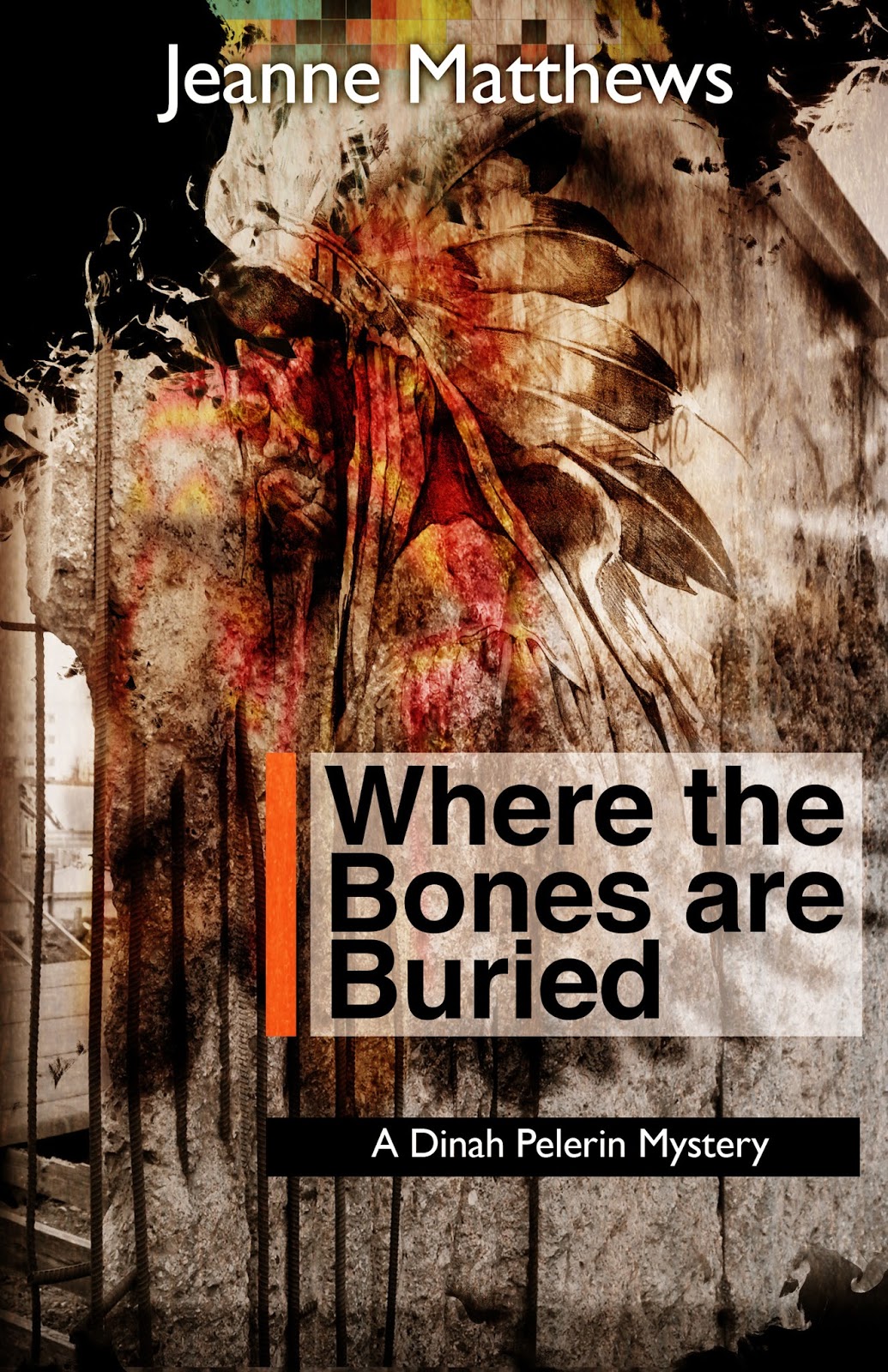
Since my amateur sleuth Dinah Pelerin is half-Seminole, I thought this German fascination with Native Americans would make an entertaining premise for my next novel. In Where the Bones Are Buried, Dinah has moved to Berlin and landed a job teaching Native American cultures at Humboldt University. When her Seminole mother Swan pays a surprise visit to the city, Dinah finds herself drawn into the peculiar subculture of make-believe Indians.

A gallery owned by one of the club’s members is jammed to the rafters with Native American artifacts, including a Hopi katsinam of dubious provenance. But Indian antiquities aren’t the gallery’s only stock in trade. Hidden away in a dark corner is a sculpture she recognizes as Egyptian, recently looted from a museum during the riots following the ouster of President Morsi.

The revolution in Egypt and wars in Syria, Iraq, and Afghanistan have resulted in the devastation of many archaeological and National Heritage sites and thieves have made off with many of the region’s cultural treasures. Dinah thinks she’s stumbled onto a gigantic fencing operation for plundered relics. Before she can substantiate her suspicions, one of the German “Indians” is killed and scalped and her mother becomes the prime suspect.

In the American Wild West of long ago, some Indians took the scalps of their enemies as trophies, and some white settlers returned the favor, going so far as to offer bounties for Indian scalps. But the very last thing Dinah expects to find in modern-day, uber-sophisticated Berlin is a scalping victim. Ghosts abound in the historic city. Reminders of its violent past are thick on the ground – a memorial to the Jews murdered by the Nazis, a memorial to the persecuted homosexuals, a memorial to the East Germans shot trying to escape across the Berlin Wall to the West, a memorial to the artists and writers killed because of their “decadent” paintings and books.

Dinah senses the presence of unhappy spirits everywhere, including that of her father, whose murder more than twenty years ago still haunts her. But as the evidence against her mother mounts, she grows more concerned about appeasing the German police than appeasing the spirits. There are almost as many lies in the air as there are ghosts. If she’s going to succeed in keeping her mother out of prison, she has to persuade her to stop speaking with a forked tongue – not only about the man she’s accused of scalping, but about the murder of Dinah’s father.

Where the Bones Are Buried
Dinah Pelerin has finally put her life in order. Living in Berlin with her boyfriend Thor, she has landed a job teaching Native American cultures at the university. She's never felt happier. And then her Seminole mother Swan shows up with a crazy scheme to blackmail a German tax dodger and dredges up a secret Dinah has kept hidden from the IRS and from straight-arrow Norwegian Thor, a former cop now with hush-hush international duties. Germans harbor a century-long fascination with the American Wild West and American Indians. Some enthusiasts dress up as Indians and adopt Indian names. Like Der Indianer Club which has invited Swan to a powwow where she plans to meet her blackmail victim. Dinah tries to head her off, but arrives at the scene too late. A man has been killed and scalped and Swan quickly becomes the prime suspect. Torn between love for her mother and dismay at her incessant lies, Dinah sets out to find the killer―hoping the killer doesn't turn out to share her DNA. But Swan isn't the only liar. Everyone is lying about something. Margaret, Swan’s dead ex-husband’s former wife, come to the city with Swan. Dinah’s teen-age “ward.” Thor. Especially Dinah. Ghosts of Germany's terrible history haunt Berlin while she faces exorcising a hateful ghost of her own.

Buy Links

Thursday, July 4, 2013

BOOK CLUB FRIDAY--GUEST AUTHOR JEANNE MATTHEWS


Joining us today is Jeanne Matthews, author of the Dinah Pelerin mysteries, including Bones of Contention, Bet Your Bones, Bonereapers, and Her Boyfriend’s Bones.  For more information about Jeanne and her books, visit her website. – AP 


Murder North and South

I set my last book, Bonereapers, in Norway.  The story takes place in late December during polar night, six hundred miles from the North Pole in the tiny town of Longyearbyen, site of the Svalbard “Doomsday” Seed Vault.  Longyearbyen is a town so cold that it’s against the law to die there.  Bodies don’t decompose in the permafrost and anyone who feels sick enough to die is urged to leave town pronto so that they can be buried in softer ground to the south.  If Bonereapers had been published in Norway and released at Easter time, it might have been swept up in the ballyhoo that Norwegians call Påskekrim.

Ninety years ago, Easter fell on April 1st and as an elaborate April Fool’s joke, a couple of Norwegian guys (Nordahl Grieg and Nils Lie) wrote a story about a robbery on the Bergen train during the Easter holiday.  Grieg’s brother, who worked for a publishing company, helped get the story published under the pseudonym Jonathan Jerv.  The publisher placed an ad on the front page of the Norwegian daily newspaper, “BERGEN TRAIN LOOTED IN THE NIGHT!”  It appeared as if it were headline news and believing it true, thousands of people called the train station to check on loved ones who were supposed to have been on the train.  The hoax caused a sensation and ever since, Påskekrim, which translates as “Easter crime,” has become a tradition and the peak season for reading crime novels in Norway.

Publishers cash in on the Easter craze by churning out a fresh batch of thrillers and detective stories.  The national television network broadcasts mystery programs and crime series – Sherlock Holmes, Agatha Christie, Alfred Hitchcock, and Harry Hole, the tough detective created by Norwegian writer Jo Nesbø.  Even the national dairy company gets in on the act, printing cartoon mysteries on their milk cartons.

Norwegian winters are long and dark and bitter.  The night seems to last forever and there is a gloomy streak in the national temperament that inclines people to thoughts of death.  The brooding landscapes, the aura of ancient stones and ghosts of the past strike a deep psychological chord and add a special sense of horror to the crime of murder.  The mental picture of blood oozing across a blanket of pure white show is somehow more shocking than a pool of blood in a filth-strewn alley.  Ironically, the homicide rate in Norway is among the lowest on the planet.  Perhaps it’s the rarity of murder that makes crime fiction so popular.
            
Far to the south in sunny Greece, the murder rate is soaring.  Foreigners are being beaten and stabbed to death on an almost daily basis.  Violence against women and the elderly has risen sharply and the police seem unable to stop the rash of brutal muggings and robberies.  Clashes between the police and people protesting the austerity measures imposed by the German banks have resulted in deaths and widespread destruction of property.  Even if the economy weren’t in a shambles and people could afford to buy books, there is no season for reading about fictional crime in Greece and less appetite for the genre than in Norway.  Greeks read more than enough reports of real crime in the daily news.

I set my most recent book, Her Boyfriend’s Bones, on the Greek island of Samos, which has become a transit point for refugees fleeing wars in the Middle East and Africa.  Smugglers can transport their human cargo across the narrow Mycale Strait from Turkey in less than an hour, but the passage is treacherous.  Many die in the attempt and the Samians, left to cope with the bodies washing up on their beaches and the horde of survivors who must be fed and housed, feel increasingly resentful.  The debt crisis and burgeoning unemployment have stoked fear and xenophobia.  No one trusts anyone.  Corruption is rampant and bitterness bred during the military junta of the late ‘60s lingers on, making the island fertile ground for murder.

My sleuth Dinah Pelerin has looked at murder north and south.  Trust her when she says that blood spilled on a gleaming white beach is no less horrifying that blood on a field of snow. 

Her Boyfriend’s Bones
In 1973, on a remote beach on the Greek island of Samos, a movie star named Marilita Stephan murdered her boyfriend, his mother,and a powerful colonel in the military junta, a crime for which she was executed. Forty years later, Dinah Pelerin arrives on Samos to spend the summer with her Norwegian boyfriend Thor before she joins an archaeological dig nearby. A policeman on sabbatical, Thor seems unduly fascinated by the murders and Dinah soon discovers that the had more than romance in mind when he chose their holiday destination.

Guns supplied to the former junta by the American CIA have turned up in Norway in the hands of terrorists and Norwegian intelligence has traced the source of the weapons to Samos. The island has become a transit point for refugees fleeing the Middle East. When an Iraqi immigrant with a fake ID is killed, Thor suspects a link to the arms traffickers. But before he can investigate, his car plunges off a cliff and he disappears. Greece’s economic woes have bred corruption and Dinah fears that he was betrayed by local police and either kidnapped or murdered. Unable to trust anyone, she sets out to find him. The deeper she digs, the more connections she sees between the present crime wave and what happened in 1973. Marilita may have been innocent, and the fate of her boyfriend holds eerie parallels to Thor’s disappearance. Dinah must be smarter and braver than she’s ever been to prevent another Greek tragedy.

Buy Links

Wednesday, August 17, 2011

TRAVEL WITH SERENA -- GUEST TRAVELER, AUTHOR JEANNE MATTHEWS


Today we welcome author and guest traveler Jeanne Matthews whose mystery, Bones of Contention, takes place in the land of Oz. (No, not Dorothy’s Oz, the other one.)  You can read more about Jeanne and her books at her website, but for now, she’s going to take us on a virtual trip to Australia. -- AP

Ayers Rock
Australians have dubbed their remarkable “Down Under” continent the Land of Oz, and in many ways, traveling through the diverse and surreal landscapes does feel like an Over-the-Rainbow experience.  

I found the Northern Territory, also known as “The Top End” or “Never Never Land” to be the weirdest and most wonderful part of the country.  It occupies twenty percent of the continent but contains only one percent of the population.  Its barren center, famed for the mystical Uluru (Ayers Rock), is a vast desert of red rocks and red soil.  The Outback is studded with eerie canyons, incongruous valleys of palms, gnarled coolabahs, and the fantastical boab trees that look as if God had planted them upside-down. 

Australian Outback
By contrast, the coastal northeast is a wetland, a National Heritage Site that is home to numerous Aboriginal tribes.  Some 750 species of birds flit about through the tropical rain forest – parrots, rosellas, lorikeets, and cockatoos – and the forest teems with creatures that seem to belong to a bygone age.   

Boab Tree
Indigenous tribes have inhabited this place for over 50,000 years and the Territory offers the best opportunity to experience a bit of the native culture.  Aboriginal customs and beliefs, although not written until recently, have been passed down orally from generation to generation.  In their belief system, the past co-exists with the present and the future, and they continue to communicate with the ancestors who created the land and receive inspiration from their ancient wisdom.  Much of this inspiration is reflected in the totemic art rendered by local artists. 

I became so fascinated by the Territory’s unearthly beauties, the colorful Aussie lingo called Strine, and the ambience of Aboriginal mythology that I set my first novel, Bones of Contention, there.  I’d go back in a heartbeat.

Thanks so much for making Australia come alive for us, Jeanne. Readers, any of you ever been to Australia? Or is it on your Must-See list? -- AP