Featuring guest authors; crafting tips and projects; recipes from food editor and sleuthing sidekick Cloris McWerther; and decorating, travel, fashion, health, beauty, and finance tips from the rest of the American Woman editors.

Note: This site uses Amazon affiliate links. As an Amazon Associate, I earn from qualifying purchases.
Showing posts with label sightseeing. Show all posts

Wednesday, July 30, 2014

TRAVEL WITH SERENA--GUEST AUTHOR NEIL PLAKCY

Canal in Yardley, PA
Neil Plakcy is the author of more than two dozen novels and short story collections. He’s here today to tell us about his home county of Bucks County, PA where his Golden Retriever Mysteries are set. Learn more about Neil and his books at his website. 

The River Towns of Bucks County, PA
When I first began thinking about the book that would become In Dog We Trust, the first of my Golden Retriever Mysteries, I wanted to set it in a small town where my hero could run into people he had known growing up. So I turned to my own hometown of Yardley, Pennsylvania as a model. However, my canvas has since spread to encompass a large part of Bucks County.

When I was growing up, Yardley was a small town surrounded by farmlands. Nestled along the banks of the Delaware River, its commercial days were long past. When I-95 came through, it became more easily commutable to Philadelphia and New York, and the area boomed.

Bristol is today a town of mansard roofs and gingerbread Victorians. Lions’ Park, at the foot of Mill Street, is a good place to consider the area’s commercial past. Sit on a bench at the water’s edge behind the stone riprap, and watch the tugboats, barges and container ships as well as powerboats and sailboats. Listen to The Bristol Stomp by the Dovells on your iPod, and practice your moves underneath the imitation covered bridge.

Yardley Friends' Meeting House
In Whom Dog Hath Joined, the most recent in the series, I send my human hero Steve Levitan and his cop pal Rick Stemper to Bristol to interview an elderly Quaker who was active in the anti-war protests of the 1960s. The area’s Quaker heritage is visible in the many Friends’ Meeting Houses.

From Bristol, follow the navy and orange signs, the color of Pennsylvania license plates, along Radcliffe Street to Pennsbury Manor, William Penn’s home. The Manor offers guided tours and special events. My personal favorite is Sheepshearing Day in May.

Stroll through the house and the thirty acres of landscaped grounds, and travel back in time to the 17th century when most commercial traffic in this area was focused on the Delaware. The three-story brick manor house was rebuilt in 1939 to Penn’s specifications, and represents his lifestyle, which was more elaborate than the traditional unornamented style of Quakers of his time.

From Pennsbury Manor continue north, following signs to Route 13, and then Route 1 north. Veer off to the left to Route 32 north to Morrisville, which was almost the capital of the United States, due to the influence of financier Robert Morris.

If you look behind the 7-11 at the Mill Pond Shopping Center, you’ll find the old Delaware Canal, which once transported coal from the state’s mines by mule-drawn barge. Park there and walk down the towpath for awhile. Despite the highway nearby, the area is wild and quiet.

Continue north on Route 32, turning left and following River Road through Morrisville. Here the canal begins to run alongside the river, and across the Delaware you can see the gold-domed capitol and the skyline of Trenton, New Jersey.

The land is so low here and the river is so close you can almost reach out and touch it. Steve lives within walking distance of the Delaware, and often takes his golden retriever Rochester out there for walks. The narrow road and non-existent sidewalks inspired a couple of motor vehicle accidents in the books.

Main Street, Yardley, PA
Up ahead is Yardley, a small town of Victorian gingerbread and native brownstone, where I use many of the town’s landmarks in my fictional town of Stewart’s Crossing. There is only one traffic light in town, at the corner of Main and Afton. Stop for a beer at the Continental Tavern, which has been serving thirsty travellers at this intersection since 1863. I’ve recreated this bar as The Drunken Hessian in my books.

Lake Afton
The quaint Victorian library on Lake Afton, a mill pond just behind the pharmacy, was built by local residents in 1878; now children and adults use the library steps to change into their skates for a quick turn on the ice in the winter.

Old Yardley Library
Continue north on Route 32, River Road, which is overhung with oaks, maples and elms and is lined with purple and white phlox on long stems and the tiny pansies called Johnny jump-ups. My town of Stewart’s Crossing, like Brigadoon, hides there, just on the far side of the Scudder Falls Bridge.

At Washington’s Crossing, George’s hazardous trip is reenacted every year on Christmas Day, in similar flat Durham boats. Washington Crossing State Park contains a number of Revolutionary War era buildings, including restored homes, an inn, and a blacksmith’s shop.

Bowman’s Hill Tower, just inland from the river, was built of local stone in 1930 and now stands over a nice park with barbecues and picnic pavilions named for Revolutionary War heroes. The picnic grounds are green and rolling, and the slope is just right for little kids to roll down. Steve and Rick like to take their dogs to the park to run around and have fun.

The tower is open from April to November, and is the centerpiece of a 100-acre wildflower preserve. Drive up a curving road, or hike the trail up to the tower through woods that seem untouched since Washington’s day. Once you’ve reached the summit, take the elevator up inside the tower and climb the last 21 steps, through a narrow, curving passageway more reminiscent of medieval Europe than depression-era Pennsylvania, to the observation platform, 110 feet up.

On a clear day, you can see 60 miles in any direction, and you’ll understand why Washington sent his scouts to the top of this hill to watch for redcoats. The vista is of farms and fields, but increasingly you’ll see renovated half-million-dollar farmhouses and fake-colonial suburbs.

A few miles farther north, the canal passes over Jericho Creek in an aqueduct, one of nine along the 60 miles of canal. The canal is on your right now, and it’ll be there until you get into New Hope, where the only toll station regulated the flow of anthracite coal from northern mines to southern ports. Check into the Logan, a colonial inn on Main Street, established in 1727, and one of the five oldest continuously run inns in the US.

A restored grist mill in New Hope is the site of the Bucks County Playhouse. Composer Moss Hart was one of a group of investors who renovated the old mill and began putting on shows there. Actors such as Paul Newman, Larry Hagman, Grace Kelly, and Walter Matthau have appeared there.

The area around New Hope is honeycombed with country roads and antique shops. Spend a few hours exploring back roads from Lahaska to Lambertville, NJ, or just browse through New Hope’s peculiar blend of the touristy, the off-beat and the historic.

Afterwards, walk halfway across the bridge to Lambertville, and stop and look below at the eddies and swirls of the river current, which is fast and deep here. A powerboat towing a water skier is sure to pass, leaving a v-shaped wake, while you stand on the wooden walkway and feel the metal bridge reverberate with passing cars and trucks. You can see Bowman’s Hill Tower downriver—wave to the people standing on top. Maybe they’ll see you and wave back.

Whom Dog Hath Joined
Reformed computer hacker Steve Levitan still gets a thrill from snooping into places online where he shouldn’t be. When his golden retriever Rochester discovers a human bone at the Friends Meeting during the Harvest Days festival, these two unlikely sleuths are plunged into another investigation.

They will uncover uncomfortable secrets about their small town’s past as they dig deep into the Vietnam War era, when local Quakers helped draft resisters move through Stewart’s Crossing on their way to Canada. Does that bone Rochester found belong to one of those young men fleeing conscription? Or to someone who knew the secrets that lurked behind those whitewashed walls?

Whether the death was due to natural causes, or murder, someone in the present wants to keep those secrets hidden. And Steve and Rochester may end up in the crosshairs of a very antique rifle if they can’t dig up the clues quickly enough.

Buy Links
ebook  

Wednesday, September 4, 2013

TRAVELS WITH SERENA--LUCCA, ITALY


Walls surrounding Lucca, Italy

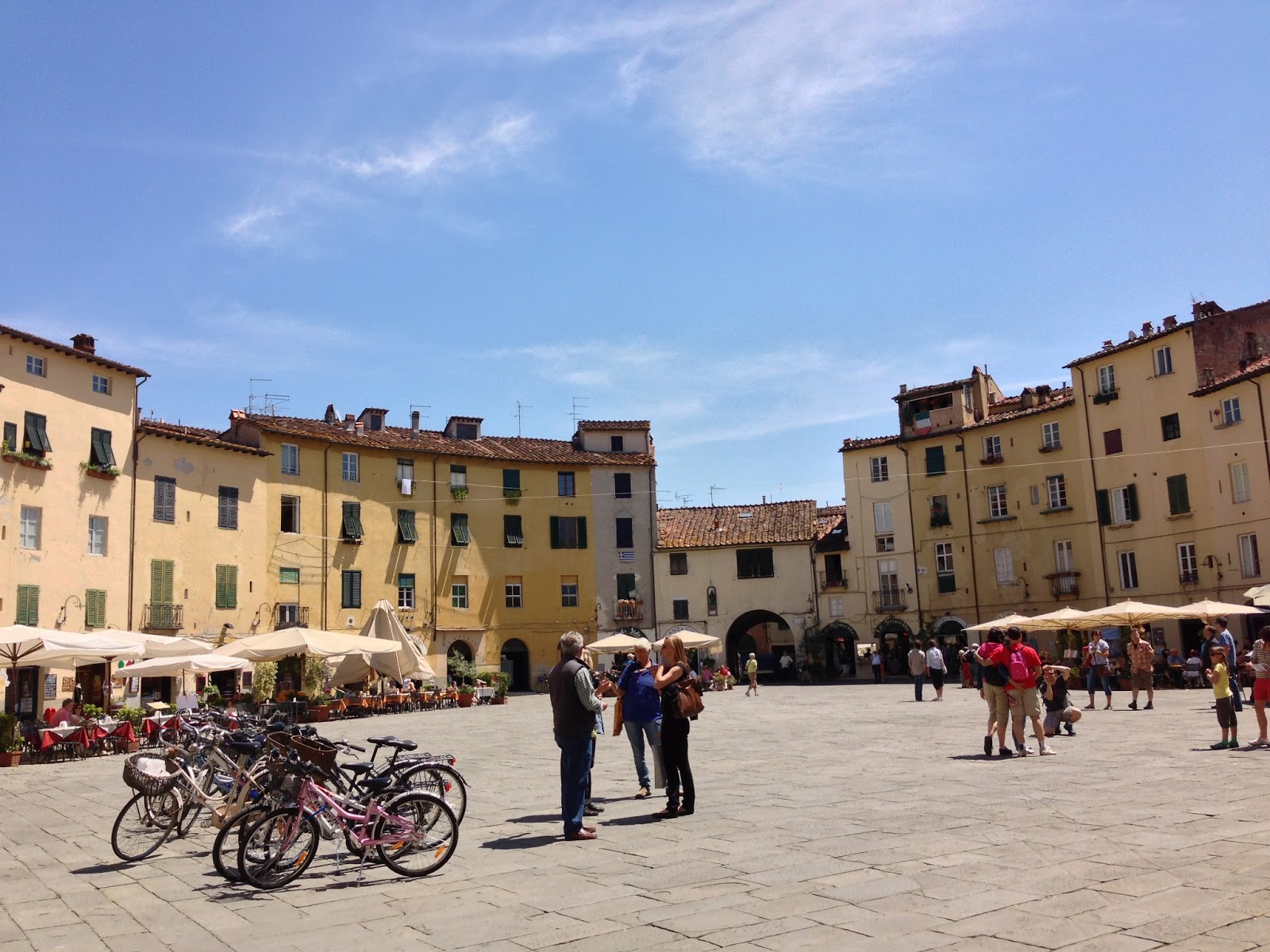
Continuing with our European adventure this week, we travel to Lucca, Italy, first settled by the Etruscans, then colonized by the Romans in 180 BC. The forum the Romans built within the city still stands. 

Due to the unique construction of its four circles of walls surrounding the city, Lucca is the only Italian city not conquered by the Medicis of Florence.

Lucca is the birthplace of Puccini

Facade of the Church of San Michele

Church of San Michele
Lucca is a small city with a population of under 375,000, but it's known as the city of 100 churches, many dating back to medieval times. Some, like the Church of San Michele, were never completed, due to a lack of funds. Above, you can see from a side view of the church that the top third was never built, only the front facade.

Cathedral

Close-up of Cathedral exterior

Exterior of Roman Forum

Inside the walls of the Roman Forum

Thursday, August 15, 2013

TRAVEL WITH ANASTASIA AND LOIS--AIX-EN-PROVENCE


La Rotonde Fountain, Aix-en-Provence
Today, we’re taking you to Aix-en-Provence, one of the stops on author Lois Winston's (and my) recent trip to the Mediterranean. Stop back over the next several Thursdays to read about other stops on her(our) trip.

One of the main boulevards of Aix-en-Provence, this one featured artwork
of local school children.
Saint-Sauveur Cathedral
Aix-en-Provence was the capital of Provence from the 12th century to the French Revolution. It’s a university town famous for its music and literature as well as being the birthplace of artist Paul Cezanne. The places and landscapes he painted are evident in the town and its nearby countryside.
Mont Sainte Victoire by Paul Cezanne

architectural detail of Saint-Sauveur Cathedral
After Paris and Versailles, Aix-en-Provence has the largest collection of Baroque architecture in France, as well as architecture preserved from other centuries. 

sculpture inside Saint-Sauveur Cathedral
Saint-Sauveur Cathedral, for example, features every architectural style from the 5th to the 17th centuries because those cathedrals took forever to build. Amazingly, much of this fabulous architecture has survived two world wars. 

Wednesday, August 31, 2011

TRAVEL WITH SERENA -- GUEST TRAVELER, AUTHOR ELLE DRUSKIN

American born author Elle Druskin has traveled the world, often with children in tow. Today she talks about traveling to Scotland with her children. A nurse by profession and academic, she has used her background in crafting her novels. To Catch A Cop, a romantic comedy/mystery was nominated as Best Romantic Comedy of 2010 by The Romance Reviews. To Catch A Crook, the second book in the To Catch series, is now available. Visit Elle at her website. -- AP

SCOTS WHA HAE!

My newest book, To Catch A Crook, takes place in London and the Scottish Highlands in the fictional town of Fraoch Falls. Fraoch, which is pronounced Frewoch, is Gaelic for heather. I first went to Scotland years ago after reading Diana Gabaldon's Outlander and I'm still reading the series and been back to Scotland many times. Today there are Outlander tours, but in those days, you were on your own. It didn't dampen my pleasure and delight in Scotland, so I thought I would take this opportunity to share some of that with you, especially if you might be traveling with children.

Think you want to see Scotland? Who wouldn't? History, intrigue, architecture, cuisine, scenery and of course, the Scottish people. You can't miss. I've been to Scotland many times, and I’m still ready to get on a plane and go again. My children were so enchanted by my stories about Scotland that they begged me to take them, and they still talk about that trip even if it was many years ago. Traveling with kids is different. It's a slower pace, and the things that fascinate adults might be boring for children, depending on their personalities and ages, but the benefit is that you get to see another country through their eyes. We often went in the middle of winter, bundled up to face a climate where the sun barely comes out that time of year. (The sun rises around 9 and sets around 3 pm. Of course, that meant the kids were fooled by the long darkness and ready for bed by 7pm.)

Edinburgh Castle
I prepared my children, who were 6 and 11 at the time, by telling them what we would see and do and showing them pictures. They also enjoyed Robert Carlyle's Hamish MacBeth series and hoped they were going to run into Hamish somewhere. I think that helped them and gave us a chance to talk about the trip. We landed in Edinburgh after a long flight from Sydney, made our way to our Bed and Breakfast, and were ready to head out to Edinburgh Castle.

Bed and Breakfast is a good way to travel in the UK. It's cheaper than hotels and some of them are more accommodating with children. Some, not all. We were very lucky with the one in Edinburgh; the room was like something out of a Victorian picture book, with a real fireplace, although we relied on central heating, a necessity in a Scottish winter. The owner also had children and kindly invited mine down to play with his kids in the afternoon. This was great; kids want to be with other kids.

He also suggested that we order a delivery for dinner rather than trudge outside in the cold and dark, and he happily supplied any cutlery or plates that we needed. Other Bed and Breakfast arrangements were not as good; we stayed at one that could only be described as a "Tartan Nightmare." Everything from bedspreads to curtains was a plaid riot. In Beauly, up in the Highlands, we stayed at another that was quite Spartan, but when my son asked for a particular breakfast cereal, the owner took him by the hand and the next thing I knew, they were walking outside to the little grocery next door where he told my son to choose whatever he wanted. They also had a party on Saturday night with all the locals, a "ceilidh" where music and dancing went on until 4 am. I suspected we were invited because the noise would have kept us awake, anyway, but it was fun and a chance to spend some time with locals, doing the things that they do, not only touristy activities.

This is the official site for Edinburgh Castle including a lovely photo of it in the snow. This is a great starting point for any visit to Edinburgh; the castle, which is more of a fortress is perched on volcanic rock high above the city and at the start of the Royal Mile. I much prefer walking downhill to uphill <g> so off we went.

Holyrood Palace
There's so much to see within the castle grounds from the Great Hall to the Scottish National War Museum, Prisoner of War Museum and Regimental Museum of the Scottish Dragoons. For my son, this was fantastic! The uniforms, the swords, the cannons, all the colorful military kinds of things that lots of little boys love. We ended up buying several sets of tiny metal soldiers in one of the shops, and my son would line them up and have pretend battles.

Although most tourists will be in Edinburgh in the summer (lots of daylight and much better weather,) we had a few advantages going in December. No long lines for anything, and the castle staff had plenty of time to spend with the kids. They demonstrated how to roll up in a plaid—a length of tartan fabric, and turn it into a kilt and let the kids try. There's no way they would have had time for that in the summer.

The castle has many ghosts associated with its history and the kids loved that. They weren't sure if ghosts were real but they tended to believe it.  Everything from a ghostly drummer warning of impending attack to a musician trapped in the tunnel that runs below the Royal Mile fascinated my children. They were particularly taken by the story of the "ghost dog" who arises from the dog cemetery within the castle grounds. Yep, dog cemetery. "If people can be ghosts, why not a dog?" asked my son. Made perfect sense to him.

My daughter loved seeing the Honors of Scotland, the Scottish Crown Jewels, the Stone of Destiny and the Royal Palace. Being older, she appreciated the history much more than my son and understood the familiar joke that happens every day at 1 pm. At that time, the castle cannon, (The One O'clock Gun) booms over the city. One huge kaboom. The joke? People often ask why at One and not at Noon, where there would be twelve cannons. Of course, the Scots always reply, "You're in Scotland. Far more economical to fire off one cannon than twelve." That went over my son's head but he loved the cannon anyway.

There's a lot to see within the Castle but the best way to approach a visit is to go online and plan in advance. The kids also enjoyed the recorders with headsets and could play them at marked spots throughout the grounds and listen while looking at the various sites.

As you walk down the Royal Mile, there are plenty of places to stop and visit, especially with children. The Royal Mile runs all the way down to Holyrood Palace which looks more like a "fairytale castle" than Edinburgh Castle, and the New Scottish Parliament.  It's the oldest street in the city and full of shops, tourist traps, pubs, whiskey tasting (skip that one with the kids <g>) and things like the Writers' Museum (think Sir Walter Scott, Robert Louis Stevenson, Robert Burns.) Lots of other places like John Knox House, the High Kirk of St. Giles, Outlook Tower, etc.

A few places of interest for kids: Brodie Close. Edinburgh is full of wynds, little alleys that are dark and kind of creepy even during the daytime. Brodie Close is named for William Brodie. Robert Louis Stephenson used Brodie (a respectable man by day, a burglar at night) for his classic novel, Dr. Jekyll and Mr. Hyde. Kids also will enjoy the Brass Rubbing Center where they can make impressions from replicas of the ancient Pictish crosses and the Museum of Childhood, which houses a collection of historical toys, dolls and books.

Greyfriar's Bobby statue
A must see with the kids is a slight detour from the Royal Mile, not more than a minute's walk to Greyfriar's Kirkyard. I made sure that my children saw the old Disney movie about Greyfriar's Bobby and they couldn't wait to see the Kirkyard. Even before you get to the kirkyard, there is a small statue of Bobby (a Skye terrier) on a pedestal. If you don't know the story, Bobby was owned by John Gray, known locally as Auld Jock. When Jock died, he was buried in an unmarked grave in the kirkyard. Bobby was so attached to Jock, that he remained at his master's grave for 14 years. Fed and cared for by the locals, Bobby is an Edinburgh legend, and his signal to leave the kirkyard was that famous One O'Clock Gun.  Off he would go, be fed, and return to guard his master's grave. Bobby is buried in the kirkyard, too. Huntley House, which is on the Royal Mile displays Bobby's collar.

Thanks so much for the virtual tour, Elle! Readers, how many of you have been to Scotland? How many plan to go someday? -- AP

Wednesday, August 17, 2011

TRAVEL WITH SERENA -- GUEST TRAVELER, AUTHOR JEANNE MATTHEWS


Today we welcome author and guest traveler Jeanne Matthews whose mystery, Bones of Contention, takes place in the land of Oz. (No, not Dorothy’s Oz, the other one.)  You can read more about Jeanne and her books at her website, but for now, she’s going to take us on a virtual trip to Australia. -- AP

Ayers Rock
Australians have dubbed their remarkable “Down Under” continent the Land of Oz, and in many ways, traveling through the diverse and surreal landscapes does feel like an Over-the-Rainbow experience.  

I found the Northern Territory, also known as “The Top End” or “Never Never Land” to be the weirdest and most wonderful part of the country.  It occupies twenty percent of the continent but contains only one percent of the population.  Its barren center, famed for the mystical Uluru (Ayers Rock), is a vast desert of red rocks and red soil.  The Outback is studded with eerie canyons, incongruous valleys of palms, gnarled coolabahs, and the fantastical boab trees that look as if God had planted them upside-down. 

Australian Outback
By contrast, the coastal northeast is a wetland, a National Heritage Site that is home to numerous Aboriginal tribes.  Some 750 species of birds flit about through the tropical rain forest – parrots, rosellas, lorikeets, and cockatoos – and the forest teems with creatures that seem to belong to a bygone age.   

Boab Tree
Indigenous tribes have inhabited this place for over 50,000 years and the Territory offers the best opportunity to experience a bit of the native culture.  Aboriginal customs and beliefs, although not written until recently, have been passed down orally from generation to generation.  In their belief system, the past co-exists with the present and the future, and they continue to communicate with the ancestors who created the land and receive inspiration from their ancient wisdom.  Much of this inspiration is reflected in the totemic art rendered by local artists. 

I became so fascinated by the Territory’s unearthly beauties, the colorful Aussie lingo called Strine, and the ambience of Aboriginal mythology that I set my first novel, Bones of Contention, there.  I’d go back in a heartbeat.

Thanks so much for making Australia come alive for us, Jeanne. Readers, any of you ever been to Australia? Or is it on your Must-See list? -- AP  
      

Wednesday, April 6, 2011

TRAVEL WITH SERENA -- GUEST TRAVEL WRITER DR. KELLE Z RILEY


Our intrepid guest travel blogger, Kelle Z Riley, is back again today with more tales from her early travels to Paris. Do you think she’ll get any sightseeing in this time? Read on to find out. -- AP

Kelle's kitties didn't want her to leave.
PARIS, PART 2
Hello fellow travelers!  I’m back after a month off to take care of some nagging health issues.  No doubt it was from a bug I caught while traveling.  So save yourselves the trouble of antibiotics and cough remedies and spend your travel time vicariously with me. . .  Last time we spoke (in Feb.) I told you of my first trip to Paris—where I saw some of the local industry rather than lots of tourist sites.

The second time I visited Paris—in winter—I stayed in a charming hotel in the heart of the city.  By charming, I mean small.  The room was as wide as a king sized bed and just a little longer!  My twin-sized bed lay so close to the window that I could reach out from under the covers and open or close the window to adjust the room temperature.  Since the room was boiling hot, it was delightful to be able to crack open the window and feel cool winter air swirl over the top of my down comforter.  Even the noise of the crowded streets four floors below seemed soothing.

Two feet from the foot of my bed and up one step was the bathroom.  If you dropped something in the shower, you had to get out and stand on the bath mat to retrieve it.  No kidding.  No bending to shave your legs allowed in this shower!  But there was plenty of warm water, so I had no worries.  The real beauty of the bathroom was a floor to ceiling window which could be opened just wide  enough to let me squeeze out onto a balcony.  The streets of Paris are narrow, winding, and intersect other streets at unusual angles.  Form my perch I could see a panorama of shops, pedestrians and vehicles of all kinds (from taxis to bicycles).  Every city has a special energy and I felt it keenly on that tiny balcony.

During this trip, I had some free time.  Two hours of it, to be exact.  In my 2 free hours, I went shopping (to purchase a souvenir suitcase to replace the one broken on the earlier legs of my journey).  Of course I also bought a beret and a scarf and some warm, fuzzy gloves.  The challenge (and a source of adventure) lay in the fact that I had no idea what the currency exchange rate was.  I was using Euros, but during that time the Euro and the U.S. dollar were not even close to the same in terms of spending power.  It is always scary to go to an ATM half a world from home and withdraw cash—you never know till you get home how much you’ve dented your bank account.  Ditto for credit card purchases.  But when you desperately NEED a suitcase on wheels—c’est la vie!

While my tourist activities were still severely limited (saw l’Arc de Triomphe from yet another cab window), I nevertheless learned some important aspects of French culture.  That is to say, I learned about the luxury of croissants, pain au chocolate (a flakey croissant-like bread with a bar of rich chocolate in the middle), and café au lait.  Warning: once you’ve had a croissant in Paris, you’ll never be satisfied with one anywhere else in the world!

The rest of the trip was dedicated to work and cab rides back to the airport where my sparkling new suitcase was properly broken in and began earning it’s travel legs.  We (my bag and I) went on to Germany, Amsterdam and finally home to the U.S., but that is a story for another blog.

I left Paris wishing I’d had more time and longing to return to the city.  As always, I hoped that the next trip would bring a chance to see the wonderful tourist sites that have inspired travelers for decades.  Cross your fingers. . .

I’ll see you next month!
Kelle

Thursday, February 10, 2011

TRAVEL WITH SERENA -- HERE TODAY, POSSIBLY GONE TOMORROW


Travel editor Serena Brower reminds us today that nothing lasts forever. -- AP

We think of tourist destinations as places that will always be there for us to see. Many of them are on our “someday” list, but for some of these places, “someday” may not be around someday. Today I’d like to tell you about a place that attracts upwards of 100,000 sightseers each year but may be gone by the time it comes up on your “must see” list.

There’s a very freaky phenomenon in Austin, Texas. At least, I think it’s freaky for anyone other than vampires and their fans, but certain critters have never had much of an appeal to me. You, on the other hand, might want to check this place out. It’s Austin’s Congress Avenue Bridge.

What’s so special about this one particular bridge? It’s home to the largest bat colony in the world, approximately a million and a half Mexican free-tail bats. Every evening throughout the summer, these bats emerge from their colony under the bridge to feast on insects.

I’m told the sight is spectacular. I’ll take their word for it. I have no desire to see it for myself. However, if you’re batty about bats, you’d better high-tail it to Austin pretty soon because the bats are being threatened. White nose syndrome, a mysterious disease that’s killing bats, is making it’s way across the country. There’s a very real chance that white nose syndrome might wipe out the entire bat population in America.

As much as bats give me the heebie-jeebies, they’re an important link in our ecological chain because they keep insect populations in check. We lose bats, and we tip the fine balance of the ecosystem.

We also lose an awesome sight to behold each summer evening in Austin (or so I’m told.) No one knows if white nose syndrome will wipe out the bats, but if the Congress Avenue Bridge is on your list of sights to see at some point in your life, you might want to consider moving it up closer to the top of your list.


Thanks, Serena. I’m with you when it comes to bats. I once found one living in my bedroom window well when we removed an air-conditioner. I think they probably heard me screaming all the way to Austin, Texas!  What about the rest of you? Any bat experiences? Post a comment to be entered in the drawing for a free book from our Book Club Friday guest author. -- AP