Featuring guest authors; crafting tips and projects; recipes from food editor and sleuthing sidekick Cloris McWerther; and decorating, travel, fashion, health, beauty, and finance tips from the rest of the American Woman editors.

Note: This site uses Amazon affiliate links. As an Amazon Associate, I earn from qualifying purchases.
Showing posts with label Native American mystery. Show all posts

Wednesday, August 28, 2024

AN INTERVIEW WITH MYSTERY AUTHOR MARK EDWARD LANGLEY

Today we sit down for an interview with mystery author Mark Edward Langley. Learn more about him and his books at his website.

When did you realize you wanted to write novels? 

About thirty years ago. I was hired by B. Dalton Bookseller forty years ago, and the world of books was opened up to me. I was watching Spenser: For Hire on ABC when one of my co-workers said, “If you like the show, you should read Robert B. Parker’s novels.” I did. Then I began reading Mickey Spillane, John D. MacDonald, Tony Hillerman, and Ernest Hemingway. I like to think I learned from each of them. 


How long did it take you to realize your dream of publication? 

From the moment I returned from a two-week trip out west in my early thirties, I began formulating a story. I had dictated everything into a tape recorder, came home, and transcribed it all; then began creating characters, back stories and plotline. I did some research on serial killers and how they act and began writing. That was in early 1992. Twenty-five years later, my dream came true because, as John Lennon once said, “Life is what happens while you’re busy making plans.”


Are you traditionally published, indie published, or a hybrid author?

I am both traditionally published and Indie. My first two novels were part of a two-book publishing deal my agent secured, but when the publisher chose not to publish the 3rd novel (When Silence Screams) I published it while they published the audiobook, continuing with the narrator, award-winning actor Bronson Pinchot. My latest novel, Bloodlines, the first Skye Roanhorse novel, is currently with my new agent, and I have faith she will secure a deal soon.


Where do you write?

I write in my home office where I am surrounded by things that give me that creative vibe, like my first edition novel collections of Robert B. Parker, Mickey Spillane, Ian Fleming, Tony & Anne Hillerman, Craig Johnson, CJ Box, and others. I write on a laptop perched on my father’s roll top desk. 


Is silence golden, or do you need music to write by? What kind?

There are times when I write in silence, but mostly I have music to keep the creativity flowing. My taste ranges from smooth jazz to motion picture soundtracks like Body Heat, 80s rock and, my favorite…Pink Floyd.


How much of your plots and characters are drawn from real life? From your life in particular?

A lot of it. I think every writer pulls from the wealth of people they have known, worked with, or seen everywhere they’ve ever gone. And of course, some characters are based on real killers, like the killer who holds April Manygoats hostage in When Silence Screams. I based him on the Internet's first serial killer, John Edward Robinson, aka The Slavemaster. Monsters are real.


Describe your process for naming your character?

First, I conjure up a title, then I begin to give that title a story idea, and then I think of names that would fit those characters. Some are mixtures of names of people I’ve known, some are mixtures of people I read about, and some–like the Native American names–are created during my research phase of what name lives where the story takes place, what clan they would belong to and what type of backstory they would have. My goal is to always strive for authenticity in my writing. I also have several Navajo friends I consult when it comes to aspects of some characters and their behaviors.


Real settings or fictional towns?

I, like many writers, use a mixture of both. There are, of course, real locations for everyday situations and fictional locations for more serious parts, like murder. Let’s face it, you really can’t have someone killed at the actual Ritz Carlton Hotel, so creating a place in the same area, or changing a town's name, is what needs to be done to give yourself the freedom of creation.


What’s the quirkiest quirk one of your characters has?

Arthur Nakai reads books, and Skye Roanhorse only drinks iced tea.


What’s your quirkiest quirk?

I have two: Collecting motion picture memorabilia and collecting first edition hardcover novels, which I mentioned above. My film memorabilia collection spans from 1923 to the late 1980s.


If you could have written any book (one that someone else has already written,) which one would it be? Why?

Seven Days in May by Fletcher Knebel & Charles W. Bailey II. Because I am in awe at how a novel published in 1962 could be so relevant to today’s world sixty-four years later.


Everyone at some point wishes for a do-over. What’s yours?

I wish I had gone to college or a university when I had the chance, but then I wouldn’t have had the life experiences that have given me my creativity. Help or hindrance, I’m still not sure.


What’s your biggest pet peeve?

For better or worse, people who are not organized. 


You’re stranded on a deserted island. What are your three must-haves?

Water, food, and books.


What was the worst job you’ve ever held?

Selling windows and doors. The constant travel was a daily thing, and I couldn’t stand being told to sell at no matter the cost to the consumer.


Who’s your all-time favorite literary character (any genre)? Why?

Robert B. Parker’s Spenser. Every book was a delight, and when you read them in order, you see Parker’s growth as a writer. Much like you can see yours as you progress in your writing. We can all learn something from reading the best in our fields.


Ocean or mountains?

Definitely mountains (and desert). When you are among nature in the American West, you can’t do any better. Concrete and skyscrapers aren’t for me and never will be. Give me a log home on a lake any day with a whiskey and a cigar and I’m happy. 


City girl/guy or country girl/guy?

Country guy. Period. Nothing better than freedom in the wild.


What’s on the horizon for you?

Well, as I mentioned earlier, my latest novel is the first of my second series, the Skye Roanhorse Novels. I am also working on book four of my Arthur Nakai Mystery series (working title: The Source) and Deadfall, Book Two of the Roanhorse series. Since we as writers can never rest, I always try to keep working no matter what. Don’t get me wrong, I do have my moments or days of second guessing myself and wondering if I should keep going. But I always seem to push myself to get back to writing.


Anything else you’d like to tell us about yourself and/or your books?

I’d just like to say that anyone who thinks writing is easy, has never attempted it. They do not understand how much effort and hours go into creating a world that doesn't exist. Like a Navajo weaver creating a rug, a writer weaves a tapestry in their own right; a tapestry, like the Spider Woman weaving her rug, that tells a story. 


I have always wanted to write and have achieved only a small portion of what I started out to do. I hope I can write novels that readers clammer for someday, but if I can at least make someone think, understand, or enjoy a story, then I have attained what I wanted to achieve.


When Silence Screams

An Arthur Nakai Mystery, Book 1


Navajo PI Arthur Nakai is asked to locate a missing teenage girl by her mother. When he discovers she has been lured away from her family by a fake online profile and forced into a world of prostitution, his is already one step behind, Arthur learns, however, she has already been sold to a man known to everyone in the sex trafficking trade as the Cuban. But after she daringly escapes from him, the tables get turned as Arthur if forced into retrieving the girl for the Cuban in order to save the life of his own wife.


Buy Links

hardcover

paperback

ebook

audiobook

Monday, June 26, 2023

A CHAT WITH TEMPE CRABTREE FROM AUTHOR MARILYN MEREDITH'S TEMPE CRABTREE MYSTERY SERIES

Today we sit down for a chat with Tempe Crabtree from the Tempe Crabtree Mystery Series by Marilyn Meredith.

What was your life like before your author started pulling your strings?

First, I am Native American. I worked as a resident deputy in the mountain community of Bear Creek. As a young widow, I raised my son on my own until I met, fell in love with, and married a pastor. 

 
What’s the one trait you like most about yourself?

I care about people and what happens to them. That’s why I never give up when trying to solve a mystery.


What do you like least about yourself?

That I didn’t learn much about my Indian heritage until I met Nick Two John who has helped me learn about the spirituality and mysticism of my culture.


What is the strangest thing your author has had you do or had happen to you?

Ghosts and spiritual beings becoming a part of my life. I’ve been visited many times by the spirits of murder victims—and even demons and angels.


Do you argue with your author? If so, what do you argue about?

Not so much argue, but I do make her understand and see what I will do when something happens to people I care about, or to me. 


What is your greatest fear?

That something might happen to my husband Hutch because of something I’ve done, or someone I’m investigating.


What makes you happy?

Solving a case and helping a soul to find rest. And because I now have a grandchild, being a part of his life.


If you could rewrite a part of your story, what would it be? Why? 

I’d learn about my heritage much sooner than I did. Because Nick Two John opened my eyes to a whole part of my life I should have known about.


Of the other characters in your book, which one bugs you the most? Why?

In this particular book, it’s the husband of the murder victim. He is not the person I thought he was. 


Of the other characters in your book, which one would you love to trade places
with? Why?

I don’t think I’d trade places with anyone in this book or any of the others. I’ve had a great life. Yes, there’s been some heartache, but I share a great love with my husband, raised a son who is now grown, married, and a father. I’ve had a great career as a deputy, had some amazing adventures, met many intriguing people, and solved a multitude of puzzling mysteries.


Tell us a little something about your author. 

Marilyn Meredith is the author of more than forty books, including the Tempe Crabtree Mystery Series and the Rocky Bluff P.D. series. She lives in a place with a great resemblance to Bear Creek, where I worked. Readers can find her at her website and blog.


What’s next for you?

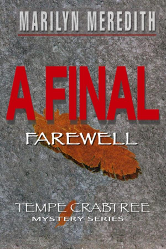
A Final Farewell is the last book in the series. My husband and I are starting a new life, one you’ll have to imagine.


A Final Farewell

A Tempe Crabtree Mystery, Book 20


A woman’s body found in a neighbor’s pond piques Tempe’s curiosity. It isn’t long before she is enmeshed in the intrigue and gossip surrounding the mystery.


Miqui Sherwood has two handsome suitors both wanting to marry her. Does either one have any ties to the murder victim?


Tempe’s life is threatened, and the health of Tempe’s friend and mentor, Nick Two John, is failing.


Buy Links

paperback

ebook

Wednesday, December 28, 2022

MYSTERY AUTHOR L.C. HAYDEN HONORS HER NATIVE AMERICAN HERITAGE IN HER LATEST NOVEL

Pyramid Lake, Nevada
L. C. Hayden is the creator of the award-winning and bestselling Harry Bronson and Aimee Brent Mystery Series. Learn more about L.C. and her books at her website 

Funny thing. I’ve always felt a bond to Native Americans. Even as a child when I watched cowboy and Indian movies, I rooted for the Indians. I had no idea why, but now I do. My recent DNA test revealed that I’m mostly Native American.


Since November has been designated as National Native American Heritage Month, I wanted to honor all Native Americans. To accomplish this, I set my novel, That Last Ghost Dance, in a reservation.


My series character, Aimee Brent, is a reporter for a Lake Tahoe newspaper. Therefore, I needed a reservation that was within her “jurisdiction.”


Enter the Paiute’s Pyramid Lake Reservation, located 35 miles northeast of Reno, Nevada, in a remote desert area. Upon examining the location of buildings and other structures in the reservation, I realized that the Pyramid Lake Reservation provided me with the ideal setting. The desert’s vast emptiness offered several places where the bad guys could hide and go undetected.


Nixon is the Paiute’s small rural town located within the reservation. Some of their homes are scattered sites, away from neighboring homes, and are generally set up on ranches where people grow alfalfa and tend cattle and horses. I used its remoteness to add suspense to the story.


Pyramid Lake stands as the tribes’ most valuable asset and is entirely enclosed within the boundaries of the reservation. The Pyramid rock formation, a sacred place to the natives, stands five stories high and is older and larger than the Egyptian pyramids.


The lake’s pyramid comes with its own legends. One, which I mentioned in my story, deals with Water Babies. In an effort to weed out the weak, ill-formed or premature babies were thrown into the lake by the early Paiutes.


Over the past centuries, the infants’ souls have gathered, and their angry spirits have taken hold of the lake. As a result, each spring, unlucky fishermen disappear and their bodies are usually not recovered.


I mention the Water Babies in my novel to authenticate the book’s setting. However, I mainly focus on the Ghost Dance, a mystical ceremony designed to re-establish the Native Indian Culture, bring a peaceful end to the westward expansion, and return Native Americans their land.


It all began around 1870 when a Paiute shaman and prophet named Wodziwob Wovoka created the Ghost Dance. Every tribe—even those from warring tribes—sent representatives to learn the dance.


In my novel, the Paiute’s chairman wants the members of his tribe to perform the Ghost Dance in order to bring back the true sense of joy the Paiutes once experienced. Several disputes arise. Some claim that the councilman is moving them backward and in order to succeed as a tribe, they must embrace the modern ways. Other natives want him to revive the dance and bring back the old traditions.


The councilman proceeds with his plans and gets killed while performing the dance. Nevada reporter Aimee Brent is granted an exclusive to report on the murder. Upon arriving at Nixon, Aimee finds that not everyone or everything is as should be. She stumbles upon secrets—secrets that could lead to her death. It's up to Aimee to unravel them before more people fall victim to the grand scheme of That Last Ghost Dance.


That Last Ghost Dance

An Aimee Brent Mystery, Book 3


Kuyuidokado, Nevada's Paiute's chief councilman, is murdered while performing the Ghost Dance, a dance created by the Native Americans to bring peace and restore their land to the way it used to be.


Nevada reporter Aimee Brent is granted an exclusive to investigate the crime and report to the world what Kuyuidokado was really like. Aimee is eager to travel to Nixon to investigate the murder. She needs to be away from her editor/fiancé with whom she has just broken up with.


Upon arriving at Nixon, Aimee finds that not everyone or everything is as should be. She stumbles upon secrets—secrets that could lead to her death. It's up to Aimee to unravel them before more people fall victim to the grand scheme of That Last Ghost Dance.


Buy Links

paperback 

ebook 

Thursday, May 9, 2019

BOOK CLUB FRIDAY--MYSTERY AUTHOR MARILYN MEREDITH ON THE INSPIRATION FOR THE SETTING OF HER LATEST NOVEL

Marilyn Meredith is the author of many published novels, including the award winning Deputy Tempe Crabtree mystery series. She lives in the foothills of the Sierra, a place quite similar to Tempe Crabtree’s patrol area. Today she joins us to talk about the inspiration for the town in her latest Tempe Crabtree mystery. Learn more about Marilyn and her books at her website.

A Mountain Town Inspired Spirit Wind
For many years I’ve taken the highway that goes past the mountain town of Tehachapi on my way to various destinations in Los Angeles and to Las Vegas. One of the most fascinating aspects of Tehachapi is the enormous wind machines that cover the mountainsides.
Tehachapi Railway Loop
Tehachapi is also famous for the railway loop, where long, long freight trains pass themselves while going around a large hill.

When I began writing Spirit Shapes I wasn’t quite sure how much of Tehachapi I would include in my mystery, but once I began more and more of that fascinating place became a great background and inspired many scenes and plot ideas.

Once I had most of the story written, I had to return and make sure that I got everything right. My daughter did all the driving. While there we took a self-guided tour of the wind machines, watched several freight trains go around the loop, made sure that the scenes I made up could have happened in real areas, and ate great food in several restaurants.

I visited the police station and asked some questions while I was there. The officer I spoke to seemed a bit bewildered but told me what I needed to know.
Tehachapi Wind Machines
When my daughter and I finished the tour of the wind machines, we gave a ride to a most bedraggled young man who’d injured himself while hiking on the Pacific Crest trail which passes through there.

We found houses that resembled the homes belonging to characters in the book and noted what the areas around them looked like.

And like most of the Deputy Tempe Crabtree mysteries, there is a troubled spirit and references to the local Native people.

And yes, the wind blew all the while—and of course gave me the idea for the title of the book, Spirit Wind.

Spirit Wind
A Tempe Crabtree Mystery

A call from a ghost hunter changes Deputy Tempe Crabtree’s vacation plans. Instead of going to the coast, she and her husband are headed to Tehachapi to investigate a haunted house and are confronted by voices on the wind, a murder, and someone out to get them.

Buy Links

Thursday, March 14, 2019

BOOK CLUB FRIDAY--MYSTERY AUTHOR BETTY WEBB

For twenty years mystery author Betty Webb worked as a journalist, interviewing everyone from U.S. presidents, astronauts who walked on the moon, and polygamy runaways. A nationally syndicated literary critic for more than thirty years, she currently reviews for Mystery Scene Magazine. She is the author of ten Lena Jones books and five Gunn Zoo mysteries. Learn more about Betty and her books at her website. 

The Empty Nest
Although I enjoyed being the mother of two sons, I’ll admit to feeling relieved when they finally left home to begin their own lives. There was no empty nest syndrome for me. Instead, I redecorated their room, turning it into the den where I would attempt to write the Great American Novel.

Twenty years later I still hadn’t written the Great American Novel (Has anyone actually done that yet?), but I did create Lena Jones, a wounded foster child who went on to become a rough and tumble private investigator in Scottsdale, AZ. I watched her as she fought her way through her first big case in Desert Noir in 2000 and cheered her on through nine more adventures. This all ended in December of 2018 when I typed THE END on the last page of Desert Redemption, the tenth and final Lena Jones novel.

Although I hoped they would, the angels didn’t sing. No problem. As an ex-reporter, I stopped hearing the angels a long time ago. But I still heaved a sigh of relief as I wrote the accompanying letter to my editor Barbara Peters at Poisoned Pen Press, and attached the manuscript. There. I was free. Done. Finished. It was over.

My feet did a happy dance under my desk as I wiggled my butt and hummed the first part of the “Hallelujah Chorus.”

But the moment I hit SEND and the manuscript headed off into the ozone, I began to cry.

Writers are weird. Sometimes we take our fictional friends more seriously than our real ones. And even our families.

That’s because a writer’s characters become real to us. For nineteen years I would wake up in the morning, thinking, “What’s Lena going to do today? Where’s she going to go?”

I followed her through Desert Noir, as she explored the abuse of eminent domain. In Desert Wives I took her to a polygamy cult where she investigated the sexual abuse of young girls. Then in Desert Shadows, she fought against the rise of White Power groups. in Desert Run she learned that some new crimes were connected to the escape of German POWs from a Phoenix POW camp during WWII. In Desert Cut Lena confronted an ancient and vicious practice affecting young girls. In Desert Lost she learned that polygamy’s many crimes don’t affect only women. In Desert Wind she exposed the cover-up of the many deaths connected to Nevada’s atom bomb testing In Desert Rage she fought to save two teens from being imprisoned for murders they didn’t commit. In Desert Vengeance she considered killing the foster father who had raped her when she was nine, and in Desert Redemption her long search for the mother who’d abandoned her finally came to an end.

That’s a lot of history with one character, a history that made Lena Jones the daughter I was never fortunate enough to have.

Now I sit in front of my computer with a hole in my heart, an empty space that my Lena Jones used to occupy. She had her problems, sure, but her courage and compassion more than made up for her flaws. So I left her in that happy place she’d always wanted to live in (no, I didn’t kill her!) Finito, Lena, and brava. And today, to nurse my aching heart, I began writing another series.

But in a way, I didn’t really leaving my brave girl behind, because the new series is about her great-grandmother. And in that series, we’ll learn how Lena Jones wound up with her courage and compassion.

Desert Redemption
At the age of four, Scottsdale private eye Lena Jones was shot in the head and left to die on a Phoenix street. After her rescue, she spent years in the abusive foster care system, never knowing who her parents were and why they didn’t claim her. When Desert Redemption begins, she still does not know her real name.

Lena’s rough childhood--and the suspicion that her parents may have been members of a cult—keep her hackles raised. So when Chelsea, the ex-wife of Harold Slow Horse, a close friend, joins a “new thought” organization called Kanati, Lena begins to investigate. She soon learns that two communes—polar opposites of each other—have sprung up nearby in the Arizona desert. The participants at EarthWay follow a rigorous dietary regime that could threaten the health of its back-to-the-land inhabitants, while the more pleasure-loving folk at Kanati are dining on sumptuous French cuisine.

On an early morning horseback ride across the Pima Indian Reservation, Lena finds an emaciated woman’s body in the desert. “Reservation Woman” lies in a spot close to EarthWay, clad in a dress similar to the ones worn by its women. But there is something about her face that reminds Lena of the Kanatians.

While investigating, Lena’s memory is jolted back to that horrible night when her father and younger brother were among those murdered by a cult leader named Abraham, who then vanished. Lena begins to wonder if either EarthWay or Kanati could be linked to that night, and to her own near-death. Could leaders of one or both shed light on what had happened to Lena’s mother, who vanished at the same time as Abraham?

All these mysteries are resolved in Desert Redemption, the tenth and final Lena Jones case, which can also be enjoyed on its own.

Thursday, August 16, 2018

BOOK CLUB FRIDAY--AN INTERVIEW WITH MYSTERY P.I. LETTY VALDEZ

Today we sit down for a chat with Letty Valdez, PI from mystery author CJ Shane’s Letty Valdez Mysteries.

What was your life like before your author started pulling your strings?
Shane doesn’t pull my strings. I took over almost immediately and she writes down what I think and say and what happens to me. Shane thinks she’s a medium. I think Shane is a little bit nuts. But maybe that’s the way artists are. Who knows? I’m a PI, not an artist.

What’s the one trait you like most about yourself?
I’m good at my investigative work and I make money from my work. That means I can provide some financial support for my brothers and sister and for my grandmother who still lives on the Tohono O’odham Reservation west of Tucson. I must mention, though, that other people have told me my best traits are my smarts and my courage.

What do you like least about yourself?
I don’t know how to deal with the terrible things that happened to me when I was a medic in Iraq. I still have these nightmares about the war. My uncle thinks that I have PTSD. I decided to suck it up and keep on going.

What is the strangest thing your author has had you do or had happen to you?
The strangest thing is that I rescued a dog that had been dumped in the desert and then the dog, Millie, rescued my brother Will. Also, I never expected to be working with a Chinese cop sent to Tucson by Interpol.

Do you argue with your author? If so, what do you argue about?
I tend to be a little shy and too humble about my abilities. Shane likes me a lot. She writes down all the nice things that people say about me. I get embarrassed. Shane thinks I’m humble because I’m a six-feet-tall, dark-skinned Chicana-Native American who grew up poor and, as a consequence, I don’t realize how terrific I am. Whatever.

What is your greatest fear?
Having someone I love go into a war zone or having the bad guys go after someone I love are my greatest fears.

What makes you happy?
I like spending time with my friends. Hearing the laughter of those I love makes me happy, especially my goofy brother Will who is eighteen years old. I like my dogs Millie and Teddy. I like it that Teddy, my black lab, will find this man up in a tree in my next book, Dragon's Revenge. The man is really charming and good looking. I keep thinking about him.

If you could rewrite a part of your story, what would it be? Why?
I’ve come to the conclusion that it is what it is. We just have to deal with life the way it is and just do our best.

Of the other characters in your book, which one bugs you the most? Why?
I don’t like the bad guys who try to push me around. They piss me off. I have a lot of martial arts training and I’m willing to use my skills. I’ll break their bones!

Of the other characters in your book, which one would you love to trade places with? Why?
Seri the librarian is the one I’d like to trade places with. She is around books and book readers all day. She deals with ideas, not greedy or mean people with guns. I think it would be really nice to work in a university library.

Tell us a little something about your author. Where can readers find her website/blog?
My author, C.J. Shane, is a visual artist and a writer. When she was in the third grade, the school librarian gave her a Nancy Drew book to read. She’s been a mystery fan ever since. She’s worked as a newspaper journalist and a librarian like Seri. She’s traveled a lot and she’s lived and worked in China and Mexico. She’s written several nonfiction books. One day this idea came to here to write a mystery novel about a Mexican-American/Native-American private investigator working in the Borderlands. That’s me. Her website is: www.cjshane.com  

What's next for you?
In Dragon’s Revenge (coming in November 2018), Seri the librarian and I find a memoir that tells the story of two immigrants, one Chinese and one Italian, who fall in love with each other in Arizona Territory in the 1890s. The memoir has a big clue that will help me solve a murder mystery that happens in contemporary Tucson. Then there’s another book coming after that. It doesn't have a title yet, and Shane doesn't want me to talk about it.  I'll just say that is has something to do with a crime involving money and also that man in the tree I mentioned earlier.

Desert Jade
A Letty Valdez Mystery

Tucson private investigator and Iraq War veteran Letty Valdez joins forces with an unlikely ally, Chinese police Detective Inspector Zhou Liang Wei, in Desert Jade, a fast-paced mystery-suspense thriller set in the Sonoran Desert.

We meet a migrant lost and out of water in the desert, Chinese triad gangsters engaged in criminal activities on the U.S.-Mexico border, a woman murdered in her backyard, a husband who vanished with a large sum of money, and three abducted young women threatened with sex trafficking.

There's a touch of romance, too, when cop Zhou first meets one of Letty's friends. Don't forget Milagro (aka Millie), the runt-sized female pit bull who performs a heroic act and saves a life.

Buy Links

Thursday, October 20, 2016

BOOK CLUB FRIDAY--GUEST AUTHOR MARILYN MEREDITH

Marilyn Meredith (aka F.M. Meredith) claims she’s has had so many books published, she’s lost track of the count, but it’s getting near 40. She lives in a community similar to the fictional mountain town of Bear Creek, the big difference being that Bear Creek is a thousand feet higher in the mountains. Learn more about Marilyn and her books at her website and blog.

When Fiction Comes too Close to Reality

That’s what happened to me with my latest Deputy Tempe Crabtree mystery, Seldom Traveled.

I’m a combination of a plotter and a “pantser”. When I begin writing I’ve already decided who the murder victim will be and why, along with a few ideas who might have done it, where and how it happened.  An actual murder in a mountain community that I read about in a news clip is what got me started, however not much about that murder ended up in my story.

As I wrote, more and more ideas about who might have killed this person and why began to bounce around in my head. As I’m writing the story on the computer, I always have a notebook and pencil at hand to jot down all the new ideas so I don’t forget. This is an exciting process for me and part of why I enjoy writing so much—even after all these years.

Something else real that I included was a fugitive who managed to get away from the law and fled to the foothills where I live. Despite using dogs, law enforcement was unable to find this man. (I don’t know if he ever was apprehended because nothing more was ever mentioned in our local news.) For me, though, this was a great starting point for Seldom Traveled, and my fugitive plays a major part in the plot.

As I continued with the writing, I knew that a forest fire would play a major part in the plot. To make things accurate, I spent a lot of time asking a friend who is a firefighter many, many questions. He supplied me with the answers and made suggestions.

Remember, that a book is written long before it comes out. You probably all know that forest fires have plagued California this summer and into fall. When the book came out, several forest fires were burning around the state. Though I knew I had nothing to do with the fires, I couldn’t help feeling a bit of guilt.

When I sent the book to the publisher and answered the questionnaire about what I wanted the cover to look like, I mentioned the forest fire and a bald eagle that also plays a big part in the ending. My heroine is an Indian (she prefers that to Native American) so there is always a bit of Indian mysticism in the series. The artist did a perfect job. Take a look and see what you think.

Seldom Traveled
The tranquility of the mountain community of Bear Creek is disrupted by a runaway fugitive, a vicious murderer, and a raging forest fire. Deputy Tempe Crabtree is threatened by all three.

Buy Links

Thursday, June 2, 2016

BOOK CLUB FRIDAY--GUEST AUTHOR WARREN C. EASLEY

Warren C. Easley is the author of the Cal Claxton Oregon Mysteries. Learn more about him and his books at his website.

Plotting My Next Plot

To paraphrase one of Shakespeare’s kings—you know, the one who wound up under a parking lot—my kingdom for a plot! I love to write, always have. Give me a scene, any scene, and I’ll flesh it out for you. Give me two people caught in a face-to-face encounter and I’ll capture their dialogue. Show me a setting and I’ll bring it alive, replete with sights, sounds, smells and touch. But put all the elements of a novel together in a coherent, believable plot? That’s a task that gives me pause.

Plotting a mystery, you might argue, is easier than plotting, say, literary fiction. After all, there are some pretty clear rules in the mystery genre. For example, unless you’re a Patricia Cornwell or James Lee Burke, you had better kill someone off in the first fifty pages of your book since the patience of your readers (and publisher) is notoriously short. And you also need to build in an event that signals the approaching climax, and ensure that, in fact, you end with a bang, not a whimper. This leaves the “slushy middle”, which must never be slushy, so all manner of clever devices should be inserted to not only drive the plot but keep the pace brisk, the tone engaging.

Easy, you say?

One school of thought says outlining is the answer. Achtung! What we have here is a need for discipline, we’re told. Put your mind to it, and the plot will seamlessly unfold in an orderly sequence. I tried this in my early scratchings without much success. The experience was a little like driving in a dense fog. I could see a small distance ahead and very little from side to side. Sure, I could get something down on paper, but after a short burst of writing, the outline would become obsolete. Those pesky, unruly characters of mine kept asserting themselves in ways I hadn’t anticipated.

The other school of thought says that the plot is an organic element that must be allowed to evolve as the story progresses. In other words, the plot builds outwardly, informed primarily by what has already been written. This may sound appealing, especially to those like me who hate planning ahead. But the other side of that coin is that the story can easily bob and weave itself into chaos, a kind of literary proof of the law of entropy. And I can tell you from experience, there is nothing more painful than backing out of a corner into which you have written yourself. It invariably involves trashing a lot of good work.

Of course, authors should adopt a strategy for plotting a novel that works best for them. I land somewhere between the extremes of rigid outlining and unfettered evolution, mainly in unfettered territory. I didn’t plan on using a hybrid strategy. It turned out that was the only way I could get a book written and keep my sanity.

Now, if you’ll excuse me, I’ve got to figure out how the book I’m working on now is going to end…

Not Dead Enough
The first closing of the floodgates of the mammoth Dalles Dam on the Columbia River inundated the sacred falls and the Native American village at Celilo, which depended on the river’s magnificent fish. Nelson Queah, Wasco Indian, war hero, and passionate opponent of the dam, watched helplessly as 10,000 years of tribal history and fishing tradition disappeared. That 1957 night, Nelson Queah vanished without a trace.

Fifty years later, attorney Cal Claxton, new to Portland after a career as a prosecutor in Los Angeles, attends a commemoration of the flooding of the falls at the behest of his friend, Philip Lone Deer, who introduces Cal to his cousin, Winona Cloud. Winona is Nelson Queah’s granddaughter. Spurning the story of a witness at the time, who claimed to have seen Queah drunk by the river, she reveals she’s found a cache of letters at her grandmother’s home, letters Queah wrote to his wife before he vanished. They suggest foul play, not an accidental drowning.

Cal, still grieving over his own wife’s suicide, agrees to check out the cold case. He locates the man who put out the drunk story and sets up an interview. When he arrives, he finds the man shot by a sniper. Cal gets a glimpse of the shooter and becomes a target himself.

Struggling to stay one step ahead of a relentless killer, Cal must navigate between Native American and white cultures, and feuding police jurisdictions. Oregon politics are also in play; various men involved with the dam’s construction are still alive, some of them powerbrokers. Plus activists are questioning the value of dams in light of new energy sources and the dwindling spawning salmon. And then there’s Cal’s growing interest in the beautiful, headstrong Winona.

Buy Links

Sunday, December 13, 2015

#CRAFTS WITH ANASTASIA--NATIVE AMERICAN BASKET WEAVING WITH GUEST AUTHOR MARILYN MEREDITH


Marilyn Meredith lives in the foothills of the Southern Sierra, about 1000 feet lower than Tempe Crabtree’s Bear Creek, but much resembles the fictional town and surroundings. She has nearly 40 books published, mostly mysteries. Learn more about Marilyn and her books at her website and blog.  

The Tule River Indians

My heroine in my Deputy Tempe Crabtree mystery series is a Yokut Indian like those who live on the Tule River Indian Reservation. The reservation in my mysteries is the fictional Bear Creek Reservation, but it shares many similarities with the real reservation.

The Tule River Indian Reservation was established in 1873 and covers nearly 85 square miles of rugged foothill lands of the Southern Sierra Nevada. The reservation is located in a remote are approximately 20 miles from the town of Porterville and can be reached by two very winding paved roads that follow the Tule River. It is isolated in a narrow valley.

The Eagle Mountain Casino, though small, has changed the reservation in many good ways, providing jobs and the ability to build a new fire station and other public buildings that serve the community. The tribe also owns 40 acres in the Porterville Airport Industrial Park where they run several businesses. On Highway 190, they own 79 acres in the foothills and have a large gas station and convenience store called Eagle Feather, as well as a large garage where they fix buses. On the way to the coast, they have another gas station/convenience store, Eagle Feather Two.

In the early days, basket weaving was a necessity of daily life for the Tule River Indians. Baskets were used for cooking, gathering, storing and food preservation.

There are four most common types of basket weaving: coiled, plaiting, twining and wicker. Each method used different materials, depending on the flexibility, durability, and what the basket will be used for.

Various materials are used for basket weaving--native grasses, twigs, pine needles, tule, chaparral yucca, willow and red bud.

Deergrass was once a native grass that flourished in the Central Valley. Its use in basket weaving was important because it was flexible, long, and had the ability to become “watertight as the stalks began expanding.” This made it desirable for holding water, and for cooking. Another material commonly used in basket weaving was the tule plant. There are many tule species used in basket weaving. Rhizomes, also called “black root,” are dyed black and used to create designs on the baskets.
Grasses are often combined with sourberry sticks and used to weave water bottles. Yucca leaves are often split and used as a weaving material. The coyote willow was the most common material used in basket weaving. California red bud is used to create beautiful designs woven into the baskets.

Basket weaving nearly died out, but has been revived.

Neither Tempe nor I know how to weave baskets, but I’ve seen many beautiful baskets made by Native women on the reservation.

Not As It Seems
The latest Deputy Tempe Crabtree mystery is set far from the Bear Creek/Tule River Reservation when Tempe and her husband go to Morro Bay to attend their son’s wedding. The maid of honor is missing and Tempe sets out to find her, which takes her on a trail that includes spirit visitations from the Salinan and Chumash Indians.


Buy Links