Featuring guest authors; crafting tips and projects; recipes from food editor and sleuthing sidekick Cloris McWerther; and decorating, travel, fashion, health, beauty, and finance tips from the rest of the American Woman editors.

Note: This site uses Amazon affiliate links. As an Amazon Associate, I earn from qualifying purchases.
Showing posts with label Young Adult fiction. Show all posts

Sunday, November 1, 2020

AN INTERVIEW WITH MIDDLE GRADE, YOUNG ADULT, AND NEW ADULT AUTHOR BETTY MAY

Today we sit down for a chat with middle grade, young adult, and new adult author Betty May. Learn more about Betty and her books at bettymayauthor.com.

When did you realize you wanted to write novels?

Like most writers, I was an avid reader as a kid (when I could sit still long enough). I wrote many short stories—some kind of weird. As a theatrical director I wrote many one-act plays for my Kids’ and Teens’ theater groups. It wasn’t a giant step to move on to novels.


How long did it take you to realize your dream of publication?

After more query letters than I care to count, I finally decided to take things into my own hands. In 2014 I self-published a New Adult nonfiction piece, FACES, based on my experiences working with a group of lifers in a state prison. A year later I published Changing Corners. Last year Payback came out.


Are you traditionally published, indie published, or a hybrid author?

Indie Published


Where do you write?

On my bed, hunched over my computer—probably the worst thing possible for posture.


Is silence golden, or do you need music to write by? What kind?

I have to have some background noise – whether it’s TV or music—classical, pop, jazz and Broadway. Love rock ‘n roll and disco—especially the Bee Gees. Total silence freaks me out.


How much of your plots and characters are drawn from real life? From your life in particular?

Bobbie, the protagonist in Payback and co-star of Changing Corners, is based on me, but she is the girl I wish I had been. I wish I had been more aware of racial injustice, but I didn’t have a Phillis to teach me. Many of the scenes in both books came out of my life, but Payback is semi-autobiographical—based on a traumatic incident in my life. I’d have to say it is a bit cathartic.


I explain the reason for writing Changing Corners in the beginning of the book—perhaps a mea culpa1950s teenagers are often called the “do-nothing” generation. Consumed by their cars, poodle skirts and dance parties, they appear to be an unconcerned lot. However, their seemingly nonchalant, selfish lives had more to do with lack of awareness than lack of caring. Many, when confronted with the truth about racial inequality, became activists in civil rights issues—sometimes with tragic results.


Now, in the 21st century, the struggle continues.


Describe your process for naming your character?

I’m glad you asked this question. I had a lot of fun naming the characters in Changing Corners. They are all based on either real historical figures or people who were important in my life.


For example, Phillis, an aspiring writer, is named for Phillis Wheatly (1753-1784), the first African American poet to be published in the United States.  Her surname, Simpson, is for my best friend’s mother, who lived to be 102.


Leonard Marshall (Phillis’s love interest) is named for Thurgood Marshall. Frank Miller (Bobbie’s love interest) is named for Glenn Miller and Jimmy Miller.


Camille Simmons, the teenage villain, is named for Kamelia, a women’s offshoot of the Ku Klux Klan founded in 1923. Her surname is for William Joseph Simmons (1880-1945), Imperial Wizard of the Ku Klux Klan 1915-1922.


Bobbie is just Bobbie. I chose an androgynous name because she could be any teenager, male or female, fighting against an evil.


Real settings or fictional towns?

I needed a big high school so I chose mine. The town is fictional but resembles any small town in 1950s New York.


What’s the quirkiest quirk one of your characters has?

Bobbie can’t sit still. She never shuts up. And she’s always getting into trouble.


What’s your quirkiest quirk?

As a kid, I could never sit still. I talked too much. And I was always getting into trouble. I still can’t sit still for long—a problem when I taught in a Quaker high school where sitting is the favorite indoor sport.


If you could have written any book (one that someone else has already written,) which one would it be? Why?

I love historical fiction. My favorite historical novel is Pillars of the Earth by Ken Follett. Well-developed characters, great story lines, impeccable research. Now reading the prequel: The Evening and the Morning.


For kid lit it would be The Secret Garden because as a child I related to the protagonist’s loneliness. Also high on my list is any book written by Richard Peck. His whimsical stories and fascinating characters speak to me.


Everyone at some point wishes for a do-over. What’s yours?

I wish I had been more patient with my kids. On the other hand, all five of them have grown into incredible people. They all graduated from college, and they all have successful, happy lives. So my husband and I must have done something right.


What’s your biggest pet peeve?

I have three passions in my life: bullying, racism, and social justice. I turn into a raging maniac when I see bullying, a screaming banshee when I hear about racism, and a radical activist when I witness injustice. I have addressed these passions in my books: FACES (social justice); Payback (bullying); and Changing Corners(racism).


On a lighter note, I don’t like unnecessary adverbs, and I hate it when people say nauseous instead of nauseated.


You’re stranded on a deserted island. What are your three must-haves?

Knife. Source of water. Pens/paper. Maybe some sunscreen.


What was the worst job you’ve ever held?

Without a doubt, high school substitute teacher. All the worst parts of teaching and none of the good ones. You don’t get to know the kids. You don’t get to see them grow. You don’t know if you’re teaching them anything. And you are often treated like dirt by the students and as a nonentity by the teachers. (The question I was asked every day: “Who are you today?”)


What’s the best book you’ve ever read? 

The Secret Garden


Ocean or mountains?

Definitely mountains. Fortunately, my husband also loved the mountains. Mixed marriages (mountains vs. beach) don’t work.


City girl/guy or country girl/guy?

As much as I enjoy mountains, I love the hustle and bustle of a city. If I had a million dollars, I would rent a hotel suite for six months in New York City, go to every Broadway show, and walk the streets enjoying the people, the sirens and the honking taxis.


What’s on the horizon for you?

Have no idea. Just enjoying my family and friends. Continue freelance directing. Maybe write another book. I’m working on an adult mystery-romance but, so far, it’s just garbage. Fun writing, though—a big change from MG and YA. I can expand the vocabulary, use naughty words and people can have—you know—s-e-x. Only problem is, I don’t know how to write sex scenes. Have about seventy pages so far with little notes tucked into the pages: “Insert sex scene here.”


Anything else you’d like to tell us about yourself and/or your books?

As much as I enjoy writing, my first love has always been and will always be theater. I’ve worked in all facets of the theatrical world: cast, chorus, crew, director, ticket taker, janitor… I had my own theater for ten years and I still freelance in community theater.


One of the most exciting things in my life is the time I spent producing and directing productions with ninety street children in a squatters’ settlement in Guatemala. I spent seven summers there from 1993-2000. I met the strongest, bravest women I have ever met in my life. The children were beautiful and talented and more than eager to participate in a song-and-dance show even though they weren’t quite sure what it was. They enchanted every audience they had in their community, in mountain villages, in churches and synagogues, in schools, at the Concha Acustica (Guatemala City’s version of the Hollywood Bowl) and at the National Palace. They were featured on Guatemalan National Television. My first year was difficult because my Spanish vocabulary consisted of eight words: hóla, sombrero, burrito, taco and ¿Dónde está el baño? But we had a wonderful time and I learned as I went along.


Another opportunity arose after my theater closed. I work with a group of lifers at a women’s state prison. They wanted help writing a play that would warn young adults about the dangers of bad choices. The women were amazing, and a number of at-risk kids turned their lives around because of their words. As an additional honor, I was asked to direct the play with professional actors for presentation at the Kennedy Center for the Performing Arts in Washington, D.C. My New Adult nonfiction book, FACES Imprisoned Women and Their Struggle with the Criminal Justice System, tells the women’s stories and my experience with them.


I have been more than lucky with my personal life: Forty-three years with the love of my life and five incredible kids. 


Payback

Eleven-almost-twelve-year-old Bobbie is a bright, inquisitive, cute annoying pest who never sits still and can’t shut up. She is thrilled to be at a week-long Long Island summer camp. There she meets her roommates: three ultra-sophisticated teenagers who are not at all happy about sharing their room with this creature who bounces around like some kind of zany pixie. Their hostility accelerates from ridicule to merciless bullying and near tragedy.


She makes a good friend, Rose, and the two girls talk about their feelings and ideas. Rose is fighting her own battle: her parents fight constantly and are getting divorced. One of their many discussions involves racism, and Bobbie tells Rose about Phillis, an African American girl who was Bobbie’s best friend when the two were five years old. 


The bullying continues until the only friend Bobbie has is a Hoover vacuum cleaner.  How can Bobbie fight back when the girls turn the entire camp against her? Even Rose, upset about the hostility among the girls, turns her back when the roommates spread vicious lies about Bobbie.


How can Bobbie regain her spirit when she feels beaten down and lost?


Buy Links

paperback 

ebook 

Sunday, May 17, 2020

MYSTERY AUTHOR FRANCES SCHOONMAKER ON DEVELOPING A MIDDLE GRADE HISTORICAL FANTASY MYSTERY

Old Shep
A former classroom teacher, Frances Schoonmaker is Professor Emerita from Teachers College, Columbia University. The Last Crystal, the third book in her The Last Crystal Trilogy, won the 2019 Agatha for Best Middle School/Young Adult Mystery. Learn more about Frances and her books at her website.  

Years ago, an uncle told how he and his little brother made a Kansas City to Sacramento train trip every summer to visit grandparents—alone. Their father worked for the railroad. It was an affordable way to keep the family close. The idea captured my imagination. What kind of mischief might two boys get into on a train trip? Who kept an eye on them? What if the train broke down? What if…?

I had the beginnings of a story. Still, it didn’t seem fair for two boys to have all the fun. I knew that if there were two boys, there had to be two girls.

The busy life of wife, mother, elementary school teacher, and graduate student took precedence over writing. By the time I retired, I knew the story was to be a wilderness quest with room for facts, fantasy, and mystery. I wanted the four children to be real, ordinary kids, not superheroes. Intuitively, I wanted them to learn that one can act heroically while shaking in their boots and that sometimes you do what has to be done because it’s right, not because you think you can do it or have any chance of accomplishing it. I wanted the least likely of the characters to step up to the challenges they faced, too. 

After more than a dozen years as an elementary school teacher and another dozen plus as a teacher educator, I know a lot about kids. Circumstances change, but people are driven by needs and wants that have existed since the beginning of time. So I planted four children I barely knew into my quest, starting on the famous Santa Fe Chief a couple of years after the outbreak of World War II. 

I gave the eldest a family name. From that moment, I knew J.D. would be the standard bearer. He’d protect, lead, and keep the others from giving up hope. Mary Carol emerged as a caregiver, responsible, an organizer, imaginative, and bossy. Robert developed with the contents of his rucksack. They needed the rucksack if they were to survive in the wilderness. So Robert became a kid who is always prepared. He has all the answers because he’s read about the questions. From the first, Grace was the kind of protected, manipulative, darling little girl you’d like to give a good smack. 

Underlying the events that shape the lives of the four children, is a struggle between immortal twins C’lestin and Celeste, charged with care of seven crystals set aside for the care and healing of the earth. Forfeiting her immortality to be the most beautiful woman who has ever lived, Celeste steals the crystals and uses them to sustain herself, down to the last one. Leave it to say that their development made me realize that when I finished The Last Crystal, I wasn’t done.

I kept wondering how the last crystal came to be where it was. Why were these particular children on a quest for it? Again, context led my characters. The children start out on the Santa Fe Chief train. What if the quest actually began on the Santa Fe Trail a hundred years earlier with another Grace, protected, privileged, probably equally bratty? Before I finished answering back-story questions, I had The Last Crystal Trilogy.

I didn’t follow a story formula or make a chart of protagonist, antagonist, and secondary characters. I created an evolving time line with settings as close to real as possible, meeting characters along the way. “Who?” “How come?” and “What if?” drove me. Some characters changed as I refined the story. Old Shep is a good example.

Old Shep was Grace Willis’s faithful dog on the Santa Fe Trail. The fourth and fifth graders in schools where I piloted The Black Alabaster Box fell in love with him. They didn’t love my switch from trail life to quest. Thankfully, they were still engrossed in the story. I realized they needed advance notice that magic was afoot. Old Shep was promoted to time traveler, mysteriously appearing in chapter one of The Black Alabaster Boxwith an important role in The Red Abalone Shell. I couldn’t leave him out of book three. I had to find a place for him.

All this is to say that in The Last Crystal Trilogy, character development was a messy, recursive process where circumstance and characters interacted to tell a story.
  
The Last Crystal
The Last Crystal Trilogy, Book 3

When they board the Santa Fe Chief in Kansas City, bound for L.A., the four Harrison children have never heard of the Last Crystal or the magic surrounding it. They are concerned about their father, who has been injured in World War II, and dread having to stay with their boring, old Uncle James. But before the train is half way to L.A., J.D., Mary Carol, Robert, and Grace discover that staying with their Uncle James is the least of their worries. They cross paths with a Nazi spy. One of them is kidnapped. Then, without warning, the four find themselves off the train, magically drawn into a quest for the Last Crystal. To get home again, they must cross two thousand miles of wilderness and find the Crystal with nothing to guide them but their wits, each other, and an old map that only the youngest can read. 

Buy Links

Tuesday, May 12, 2020

AN INTERVIEW WITH ROMANCE AND YOUNG ADULT AUTHOR ASHLYN CHASE/ELISABETH LOROW

Today we sit down for a chat with adult contemporary, light paranormal romance author Ashlyn Chase, who also writes young adult or magical realism as Elisabeth or EB Lorow. Learn more about Ashlyn and Elizabeth and their books at their respective websites.

When did you realize you wanted to write novels? 
I prefer writing novellas, but I’ve had to write longer to satisfy print demands. That’s not what you asked, is it? Okay, I came to writing later in life. I went to art school, nursing school, and didn’t begin writing seriously until I took a screenwriting course in the late nineteen nineties.

How long did it take you to realize your dream of publication? 
From dabbling to epublishing, about three years. From there to traditional publishing with advances, another four years.

Are you traditionally published, indie published, or a hybrid author? 
Hybrid. I'll admit, it's easier to let a publisher take care of all the details and put their money on the line, but it's becoming harder and harder to get those contracts now. Covid 19 has negatively impacted the print publishing world. Big time.

Where do you write? 
I dictate my books on a handheld recorder with a background noise-canceling feature, so the answer is: Anywhere! When the weather is nice, I like to dictate on my balcony while I gaze at the ocean. 

Is silence golden, or do you need music to write by? What kind? 
Silence--or the sound of the waves only, so I can hear the voices in my head.

How much of your plots and characters are drawn from real life? From your life in particular? 
I believe it was Thomas Wolfe who said, “Every novel is an autobiography.” I get that. But sex with vampires and werewolves? Um, no. My characters are never based on real people…unless maybe subconsciously. They come straight out of my imagination.

Describe your process for naming your character?
Mostly I just let a name come to me. (If you haven’t noticed yet, I let my muse do a lot of the work.) I try not to duplicate names. If I come up with a name that isn’t right, the character lets me know. Names come with a personality, especially first names and nicknames. I’ll change the name until I get the right personality. Speaking of that, my young adult pen name was wrong, so I changed it from Liz to Elisabeth or EB Lorow. It just didn't 'feel right' before.

Real settings or fictional towns? 
Real. That’s one of the reasons I like Magical Realism. Previously I set a lot of books in Boston. Sometimes my characters travel, mostly to the Caribbean. I’ve spent a lot of time in both places. 

What’s the quirkiest quirk one of your characters has?
My nursing days have provided me with loads of health challenges for my main characters, but if you’re talking about something just plain weird, one of my secondary characters in the Strange Neighbors series, Nathan, a shapeshifting Raven, admitted he had a thing for women's armpits.

What’s your quirkiest quirk? 
Ha! I should have seen that one coming, but I didn’t. Okay, let me think… I love the ocean, but I won’t swim in it—ever since watching the TV show Dexter. 

If you could have written any book (one that someone else has already written,) which one would it be? Why?
Outlander. Because…Outlander!

Everyone at some point wishes for a do-over. What’s yours?
Not to marry my first husband. I’m glad I have his daughter, but I wouldn’t have married nor lived with him. 

What’s your biggest pet peeve?
People making fun of my accent. Yes, I have a Boston accent. Sheesh! It’s not that funny. There are nine dialects of Boston accent, and I was lucky enough to get one of the classier ones. What drives me nuts is when someone (not from New England) comes right up to my face and announces “Wicked Pissah,” like I would ever say that. Ugh. Never have I uttered those words and I never will. 

You’re stranded on a deserted island. What are your three must-haves?
A library, a fully stocked restaurant with electricity, and a Genie.  

What was the worst job you’ve ever held? 
Waitress at a French restaurant chain in Boston. La Crepe. We called it Le Crap. 

What’s the best book you’ve ever read?
The Big Book of AA. No explanation needed (I hope.)

Ocean or mountains?
If I can’t have both, Ocean wins. 

City girl/guy or country girl/guy?
Small walking city. 

What’s on the horizon for you?
I wish I knew. Or not. That would take the excitement and adventure out of life. But there is one thing… I'm giving all my royalties to my daughter. She picked this really unfortunate time to start her own small business… And I can write for the joy of writing again. Trying to sell, sell, sell really gets in the way!

Anything else you’d like to tell us about yourself and/or your books?
I started writing erotic romance, so my early stuff is hot. I removed one or two nasty words and I was mainstream enough to be traditionally published. Now that I’m writing YA as Liz Lorow, there’s no sex. You can find your comfortable heat level whatever that may be. 

The best way to keep updated on my career is to sign up for my newsletters. I hold giveaways and contests for my subscribers. Find links at my websites.  

Don't Mess With This Witch 
The Witches You Were Warned About Series, Book 1

Teen witches in magical juvie, because they really messed up!

Genevieve Howe, a 16 year-old witch, is not a bad kid, she’s just a really lousy witch. Sometimes her random thoughts unintentionally turn into actual spells, causing all kinds of trouble.

Now the administration needs Genevieve’s help to find a student/inmate who escaped. Why her? Because even though there’s something ‘wrong’ with Genevieve, she seems to be able to do what others can’t. If she can find Logan, will she turn him in, join him on the run, or find some other way to help without violating the code of honor among magical misfits?

Buy Links

Wednesday, April 25, 2018

AN INTERVIEW WITH KASS BATEMAN FROM DENISE JADEN'S LIVING OUT LOUD SERIES

Today we’re joined by Kass Bateman, heroine of Denise Jaden’s Living Out Loud series.

What was your life like before your author started pulling your strings?
God, it was so much easier. I could do what I wanted, keep people in check just by looking at them the right way. Now that she’s pushed me out of my comfort zone, it’s like everyone can see right through my barriers, see how many ways they can crack my shell with a tiny nick in the right place.

What’s the one trait you like most about yourself?
I like the way I can level people with a glare. I’ve gotten past that thing where I feel the need to look away.

What do you like least about yourself?
I’m abrasive. I hate that I can’t seem to just act normal once in a while. No matter what comes out of my mouth, even if I’m in a good mood, it sounds biting and harsher than I mean it to.

What is the strangest thing your author has had you do or had happen to you?
She sent me on tour with Eli’s band, like I’m some kind of damn groupie. I told her we wouldn’t get along, and I, again, was right.

Oh, and she sent me into a burning building, but that’s another story…

Do you argue with your author? If so, what do you argue about?
I’m pretty sure you know the answer to that. Yes, we argue. Pretty much nonstop. It’s usually about her pushing me at Eli, but honestly, it could be about anything, because I hate people telling me what to do. (Surprise, surprise, right?)

What is your greatest fear?
I don’t like to talk about my fears, but OK, if I had to pick one it would be staying by myself. I’ve just never done it. Because Dad’s sick, he’s always home with me, and even though it seems like I can handle pretty much anything, staying on my own is one thing I haven’t gotten my head around yet.

What makes you happy?
Not to contradict myself, but probably Eli. Talking to him. Saying things that are real.

If you could rewrite a part of your story, what would it be? Why?
I wouldn’t have been so fast to jump into bed with Eli. I don’t know, things got weird after that, and I figure if we had had a natural progression in our relationship, like most people, it probably would have been better for both of us.

Of the other characters in your book, which one bugs you the most? Why?
This one’s easy: Steve, the drummer from Eli’s band. He’s cocky and annoying as hell. He thinks he can tell everyone what to do, including me.

Of the other characters in your book, which one would you love to trade places with? Why?
I’d trade places with my sister Hope. She’s so damn cryptic, and I’d love to come out on the other side knowing all of her secrets.

Tell us a little something about your author. Where can readers find her website/blog?
Don’t know, don’t care.

ETA: Thanks, Kass. I always know I can count on you ;).
You can find me at denisejaden.com

What's next for you?
I hear Ms. Jaden has lots of fun things in my future. After the burning building and the road trip with Eli’s band, I’m going to be out on my own for the first time. I’m also going to get more involved with Eli’s music and some photography. There’s a bunch of annoying and painful stuff on the horizon for me, and lucky you, you can be a fly on the wall for it if you want to…

Outcast
She’s not crazy.

Kass Bateman may be a lot of things, but she swears she's not crazy—even when she wakes up strapped to a wheelchair in a psychiatric hospital and can't remember how she got there. 

When Kass's family members go missing one by one, she enlists the smartest guy she knows to help find them. Unfortunately for her, underneath his brains and indifference are some dark secrets and a whole lot of distracting sexy.

Can Kass keep her head together long enough to rescue her family members from their captors—the truly dangerous and crazy ones?

Gritty, steamy, and rife with secrecy, Outcast is the first book in a new upper YA/NA crossover series for fans of Gayle Forman and Rainbow Rowell.

Wednesday, August 24, 2016

#RETRO-FASHION WITH GUEST AUTHOR CATHERINE CHANT

Award-winning author Catherine Chant writes rock ‘n’ roll romantic fiction and stories with paranormal twists for young adults. Learn more about her and her books at her website. 

One of the fun things about writing a time travel romance novel set in 1973 is researching the clothing. Most of the outfits used in Nothing Stays the Same are things I remembered from my childhood, since I grew up in the ‘70s, but I also did some online research to find some questionable outfits that represented the times, and then dressed my characters in them.

I created a Pinterest board as I went. (If you can't see the Pinterest board—you may need a Pinterest account--I have placed links to some of the images in the article below).

Bell Bottoms
A definite fashion staple of the ‘70s. This style of jeans started in the 19th century with sailors, but became popular for everyday wear in the 1960s. Kids were still wearing them in 1979 when I was in high school. They're probably something that will never go completely out of fashion, though they may never be as wide as what David Bowie was wearing in this photo from 1973. 

My main character, Leah, in Nothing Stays the Same is a jeans and sneakers type of gal, so she of course went for the blue jeans whenever possible, and didn’t mind the wide leg.

Gauchos and Culottes
One fashion piece from the early '70s that features in my book has made a recent comeback. Gauchos! You can buy them new at places like Macy's.

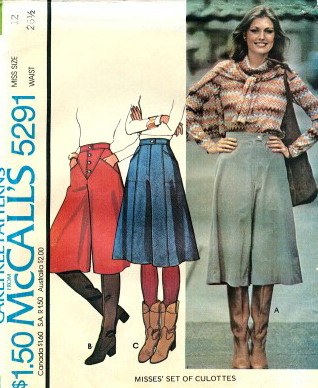
Anyone else ever wear these? Or culottes or skorts? They were all very big in the early-to-mid ‘70s, and my school wardrobe had quite a few. I remember the gauchos less fondly than the culottes, though. Culottes looked a lot like a skirt (as seen here), which wasn't bad, but gauchos always felt like high-water pants to me.

I cringe now just thinking about them. Not attractive at all, so of course I decided to torture one of my characters and make her wear them. Leah's older sister, Callie, the heroine from Wishing You Were Here, gets stuck in gauchos in her first scene back in time--hideously bright orange ones, just like I had to wear to school. {evil grin}

Earth and Other Shoes
Earth shoes are classic icons of the '70s, so of course they make an appearance in the book. Anyone remember them? Introduced in 1970, they were quite popular when I was in school, but I never wanted a pair. Ever. They were plug-ugly, if you ask me, but unisex, so both men and women could wear them.

In the book, Leah shares my opinion on the Earth shoes, but sadly she's forced to wear them most of the time. Supposedly the heel design made them good for your back, but that still wasn't enough to make me want them.

No, my coveted footwear in the early '70s was a pair of white go-go boots. My best friend had a pair and I wanted them so badly, but my mother got me black ones instead. Sigh. I still wore them, but I really wanted the white. In one scene in the book, Leah gets to live my dream and wear a pair of white go-go boots to a party.

I also mention the classic white Keds sneakers in the book. Every girl I knew growing up had at least one pair and we’d use white shoe polish to keep them pristine if the washing machine didn’t. Callie chooses to wear Keds whenever she can. After the gauchos incident, she tries to go for a simple, understated look whenever possible.

Men's Fashions
Although I admit I tortured my characters with vintage fashion, I could have done a lot worse. :-) I tried to stay away from the truly embarrassing styles that men endured in the ‘70s, such as the plethora of ugly knit vests and ponchos that were around, but the male characters in Nothing Stays the Same couldn't escape the classic corduroy trousers, the loud polyester shirts or the blue and white striped "Winner" sneakers from Sears. I had a pair of those puppies myself and wore them until they fell apart. They were unisex, like Earth Shoes. The ‘70s seemed big on equal opportunities for groovy footwear.

Men's swimsuits were particularly "interesting" in the '70s, as well. I stayed away from hand-knit briefs in the book, but they did exist and did not look comfortable at all! Instead, I opted for the tight, shorty-short style you see here for one scene where the characters attend a beach party.

So What's Your Pleasure?
If you found yourself stuck back in 1973, what do you think you would wear? What would you avoid? Are there any vintage '70s fashions you wish would make a come back?

I think I still have a yearning for those white go-go boots, but the gauchos at Macy's are starting to grow on me. I might have to go take another look. :-)

Nothing Stays the Same, the Soul Mates series
One Choice Changes Everything…

Soccer star Leah Reinard has been crushing on Brennan Basford for ages. When they end up at the same summer job, she thinks the fates have finally aligned in her favor. That is, until Brennan suddenly disappears. One day he’s there, the next day, he’s gone. And no one but Leah remembers he ever existed.

Brennan’s wish to change the course of his dead father’s life has dropped him back in 1973, on the set of his father’s successful teen sitcom, and into the midst of its disintegrating made-for-TV band, The Beat Detectors.

Brennan’s determined to redirect the course of his father’s young life and create the happy ending the man deserved, but even the smallest change to the past is wreaking havoc with the present.

Can Leah find Brennan in time to stop him from ruining both their futures?

Wednesday, June 8, 2016

FAVORITES, FAILURES & FRUSTRATIONS--GUEST AUTHOR J.C. LANE


The author wearing her father's tree sweatshirt
J.C. Lane is the author of Tag, You’re Dead, a thriller coming in July. She also writes mysteries as Judy Clemens, including the Grim Reaper mysteries, the Stella Crown series, and the stand-alone, Lost Sons. She lives in Ohio, where her yard is filled with trees: Maple, Oak, Blue Spruce, Pine, Redbud, Peach, Weeping Cherry (that her dad picked out), Crabapple, and probably some others she forgot. Learn more about her and her books at her website. jclanebooks.com

My Favorite Sweatshirt
By J.C. Lane

My father loved trees. When he wasn’t adding one to our yard he was taking pictures of them, studying his tree book, or enjoying a walk in the woods. When a tree came to the end of its life he would use his chainsaw – which my husband now owns – to cut down the tree so it could be used as fuel in our home’s wood-burning furnace, making room in the woods or yard for a new young tree to thrive. He and my mother also spent time visiting nature preserves and parks to not only look for birds, but to appreciate the leaves and varieties of trees found in that part of the country.

About twenty years ago I bought my dad this sweatshirt from the Morton Arboretum in Lisle, Illinois, when I was visiting my brother and sister-in-law who lived in the area. It names and pictures a dozen trees, including one of Dad’s favorites, the White Oak. He loved the sweatshirt and wore it enough that it began to show wear. I can still picture him in it.

After my father died in 2009 I snatched the sweatshirt from the “giveaway” pile. It wasn’t beautiful or pristine or even something I could wear in public. But because of the meaning behind it, it felt like something that still held a huge part of my dad and what he was about. I am so glad to have it.

When I need comforting or warmth or just want to feel close to Dad, I pull on the sweatshirt. The holes in the sleeves and the frayed neckline make it “unfit for company,” but it’s perfect for a day at home, and the signs of use make me love it even more. When I am wearing it, I can imagine that Dad is with me, loving me. In a way, he is.

A favorite sweatshirt from one of my favorite people.

Thanks, Dad.

Trees depicted on the sweatshirt, clockwise, beginning at the top:
Prairie Crab
Shagbark Hickory
Sugar Maple
White Oak
Black Walnut
Downy Hawthorne
Ironwood
Redbud
Sour Gum
Hackberry
Kentucky Coffee Tree
(middle) Catalpa

Tag, You’re Dead
Six young people play a dangerous Game of Tag in public, chasing through the crowds, streets, and buildings of Chicago. This secret, one-of-a-kind, wildly expensive Game offers a macabre twist to the childhood version…if you get Tagged, you get Dead.

Three "Its" have their reasons for buying a place in the Game. Surgically enhanced Brandy is obsessed with destroying a naturally beautiful girl. Untalented Robert covets his target's position as superstar of the basketball team. Brainiac Charles craves a battle against an intellectual equal. Given their elite social status, they reject any possible downside to the contest. Each expects the satisfaction of killing their prey, then walking away.

Hand-picked innocents play as “Runners,” under threat to their loved ones should they refuse to participate: lovely, small-town Laura; celebrated athlete Tyrese; and Amanda, gamer extraordinaire. Alone, hunted by their adversary, each feels a single hope…to survive.
Technological wizardry controls the Game. As soon as Runners receive the “Go” signal on smart watches locked to their wrists, the Game rockets them through the city, from the El to Michigan Avenue to the Lincoln Park Zoo. There is no time to rest. Every thirty minutes the Runner’s location is transmitted to the It, which steadily diminishes the Runner’s chance of ever reaching Home Base alive. The Game will not end until someone is Tagged, so the Runners must choose how to play. Will they accept death? Murder their Its? Or find a way to use individual strengths to stop the Game before anyone dies?

Buy Links

Sunday, March 20, 2016

#CRAFTS WITH ANASTASIA--GUEST AUTHOR CAROLYN MULFORD ON MAKING A BLANKET COAT

Hudson Bay blanket coat
photo by Steelbeard1 from Wikimedia Commons
Carolyn Mulford worked on five continents as a magazine editor and freelance writer before making the transition to fiction. She divides her time between her first love, historical novels, and her last love, mysteries. Her latest releases are Thunder Beneath My Feet, set during the devastating New Madrid earthquakes, Show Me the Ashes, the fourth book in her Show Me series. Learn more about Carolyn and her books at her website.

My teenager had to have a blanket coat. Nothing else would do for her.

Lots of young women felt that way last year when fall fashions arrived. But the blanket coats advertised in 2015 were ponchos or ruanas rather than the original hooded, calf-length wool coat. Worn by French-Canadian voyageurs from the late 1700s, the warm, durable garment spread rapidly among American fur trappers and Native Americans.

And it endured. Most fashions and textiles have changed drastically in 200 years, but the frontier blanket coats—particularly those made from the Hudson Bay Company’s white wool blanket with short red, yellow, green, and black stripes—lived into this century. Today those who value them for outdoor activities settle for used ones or buy the blanket and make their own.

My teenager, fifteen-year-old Betsy, wasn’t making a fashion statement in 1812. She needed the coat to survive a three-week trek from a mild climate into weather so cold that the Mississippi River froze from bank to bank.

Betsy is the resourceful, courageous protagonist of Thunder Beneath My Feet, a novel for tweens and teens set during the devastating earthquakes centered near New Madrid, Upper Louisiana (Missouri) Territory in 1811-1812. Weeks of quakes, severe aftershocks, and shakes destroyed homes, made the river run backwards, created lakes, and prompted most of the population to flee.

Betsy stayed on her family’s farm with her younger brother and four strangers until the shocks and shakes posed more danger than a 200-mile walk north.

I’d placed her in this historically accurate fix, so I had to find her a realistic way out. Her shawls definitely wouldn’t withstand the cold and snow. She couldn’t walk and work under the weight of the buffalo robe. She lacked the time and materials to make a wool-lined buckskin coat. That left the blanket coat, which she could also curl up in at night.

I’d seen the coats in photos and a museum, but my 4-H sewing projects hadn’t included making a coat of any kind. I remembered how frustrating it had been to put a sleeve in a blouse or a dress. At least these coats had no buttonholes to contend with. Instead a sash held the open front closed. Could Betsy make coats for herself and her little brother?

I went to Google for advice. To my surprise, links led me to information on making blanket coats, including the original French-Canadian capote (cape). One site said it took only three to five hours. A Californian who used a pattern to make one for winter hiking warns that he’d spent three days, part of that time practicing on an old blanket. Smart man. And he had no regrets.

Betsy had no pattern. She borrowed a blanket coat to figure out how to size it by measuring with a piece of yarn, cut the pieces with a knife and by tearing, and sewed together the loose-fitting garment. Ease of construction and warmth far outweighed such considerations as how it draped.

A traditional blanket coat has only five or six pieces. The major one is the body, made by cutting according to the wearer’s girth and height and folding that piece with the edges overlapping several inches at the front. Betsy would have overlapped folds on the shoulders and left a flap for the collar. The pointed hood, two pieces sewn together, attached to that. The hood had to be big enough to go over a skunk- or coon-skin cap.

A slit from each shoulder to under the armpit allowed her to insert the broad end of the raglan-style sleeves, ones long enough that she could turn down the cuffs to cover her mittened hands. She would have used a multipurpose rope rather than a sash to keep the front closed.

Making a blanket coat remains relatively simple today despite our concern for fashion. If you want to make a traditional or modified one, I recommend investing in a pattern rather than winging it as Betsy did.


Thunder Beneath My Feet
Shy, sensible fifteen-year-old Betsy takes charge of the family farm and her ten-year-old brother Johnnie when their mother rides south to bring her sick husband home to New Madrid, Missouri Territory. Four days later on December 16, 1811, powerful earthquakes destroy homes and trees, flood and poison the land, and turn the Mississippi into a river of death. Their neighbors flee the never-ending quakes. Betsy stays to wait for her parents, care for the animals, and find the family’s stolen money. She and Johnnie share a lean-to with four strangers—a 16-year-old French-Shawnee boy, a mute slave woman, a poor French tutor, and his elegant Spanish wife. Their secrets hold them there as the quakes and the cold threaten their lives.

Buy Links